

Russia, the world's second-largest oil exporter, may have slowed down efforts to tackle methane emissions from its energy sector as it seeks new export markets for its products amid Western sanctions.
Before the war broke out on February 24 last year, Russian oil and gas exporters — under pressure from European customers — were investing in equipment to help monitor and curtail methane discharges from their operations.
Robert Kleinberg, a senior research scholar at the Columbia University Centre on Global Energy Policy said that, before the Ukraine conflict, Russia had been sending signals that it was taking methane emissions more seriously.
“Gazprom acknowledged satellite detections of very large methane emissions from its pipeline system and was taking steps to reduce them,” he told The National.
Europe's natural gas imports from Russia currently account for less than 10 per cent of its overall imports of the fuel, Andrea Fontana, the EU ambassador to the UAE, told The National last week.
Hence, Russia now has fewer incentives to make the investments necessary to decrease emissions.
“They’ve been cut off from their most fastidious customer, Europe, and potential new customers such as India and China are looking for low prices, without putting a lot of environmental conditions on their imports,” said Mr Kleinberg.
“The leverage was always the monopsony that Europe had over Russian exports from its western gasfields.”

Before the conflict, Russia was considered to be one of the leading sources of emissions of methane caused by human activity.
The greenhouse gas has a short-term warming potential more than 80 times greater than carbon dioxide.
After CO2 emissions, methane is the second largest contributor, caused by humans, to climate change.
Climate experts consider reducing the international output of methane emissions as the most effective and least disruptive way to slow down the increase in global temperatures over the next few decades.
Russia released 24.36 million tonnes of methane into the atmosphere last year, representing nearly 7 per cent of global emissions, the International Energy Agency said in its latest Global Methane Tracker report.
Although countries such as China, the US and India emitted more methane in 2022, the share of the energy sector in Russia’s emissions — at 74 per cent — is the highest among large countries, IEA data showed.
Last year, the largest recorded emissions of methane occurred due to leaks in the Nord Stream pipelines, which transported natural gas from Russia to Europe.
A drop in Russian energy exports due to Western sanctions, could, in theory, reduce methane emissions from the country’s fossil fuel industry.
“To the extent that they are producing and transporting less gas, that would suggest lower emissions,” said Mr Kleinberg.
“The usual doctrine is that the leaks are proportionate to the amount of gas being handled.
“However, that way of estimating methane emissions is very unreliable and it is known to, in some cases, vastly underestimate the amount of methane being actually discharged into the atmosphere.”
View from the top
Governments and independent climate-tracking bodies have been increasingly relying on satellites to detect methane releases, particularly in the oil and gas industry.
In the next few years, a number of newly developed satellites with significantly improved resolutions are scheduled to be deployed, including MethaneSat, which is scheduled for launch by the US non-profit Environmental Defence Fund this year.
However, satellites only have a better track-record for detecting large methane leaks or “super-emitting events” like the one seen after the Nord Stream ruptures.
In the case of Russia, satellites rely on the country’s self-reported methane emissions data as an initial guess, said Mr Kleinberg.
“Although no one should be better positioned to monitor the operations of the very large and far-flung Russian oil and gas industry than Russia itself, it is hard to take methane emission reports seriously because the numbers change substantially from year to year,” he said.
Moscow, which has repeatedly changed the way it calculates its emissions, reported four million tonnes of methane emissions from its oil and gas sector to the UN Framework Convention on Climate Change in 2021 — roughly a third of the IEA’s estimate for the year.
Gazprom and Novatek — Russia’s main natural gas-exporting companies — did not respond to The National’s queries regarding the status of their methane-reduction plans.
In its latest sustainability report, Novatek said it reduced its methane emission intensity by 11 per cent to 12.9 tonnes per million barrels of oil equivalent in 2021.
In August, the company also launched a project for methane leak monitoring with the use of unmanned aerial vehicles.
Russia’s top oil producer Rosneft said it allocated about $4 billion towards green investment in the last five years.
“Rosneft is implementing a comprehensive programme of production process improvements and initiatives to reduce methane emissions,” said the company told The National, without specifying a timeline.
The “expansion” of this programme, along with the introduction of ground and air monitoring technologies, will help Rosneft reduce its methane emission rate to less than 0.2 per cent, it said.
‘No good’
The IEA and several climate bodies have urged oil and gas companies to do more about methane emissions, considered cheaper and easier to control than carbon dioxide.
The Paris-based agency has said that oil and gas companies would need to set aside less than 3 per cent of their 2022 profits to reduce the industry's methane emissions by 75 per cent.
The global oil and gas industry's income jumped to almost $4 trillion last year, from a recent average of $1.5 trillion, according to the IEA.
“A number of major oil companies are going after methane. After all, they derive no benefit from emitting methane,” said Mr Kleinberg.
“The solutions are technical and oil companies are really good at technical solutions.”
-
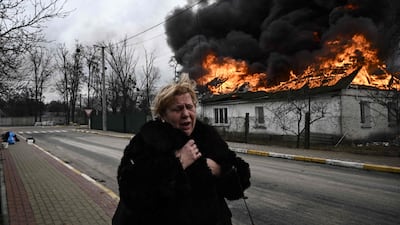
February 24 will be a year since Russia started the Ukraine war. The National picks out the most powerful images from the conflict. AFP -
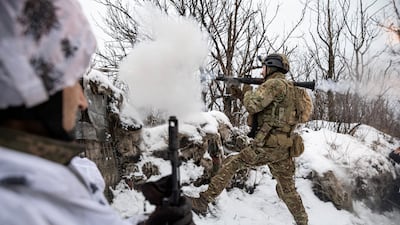
A member of Ukraine's 79th Air Assault Brigade fires a rocket-propelled grenade at Russian positions near Marinka in February. Reuters -
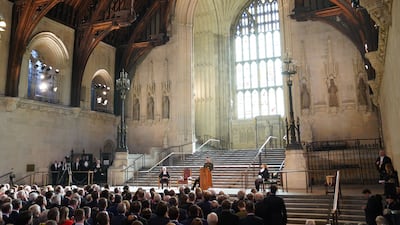
Ukrainian President Volodymyr Zelenskyy addresses MPs in Westminster Hall, London, in February 2023. Getty Images -

Destroyed buildings 32km west of the front lines in Donetsk in January. Getty Images -
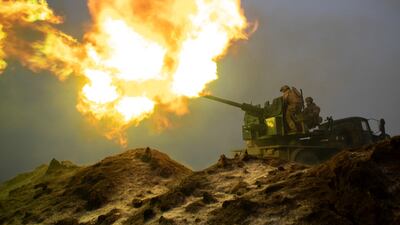
An anti-aircraft gun in January fires at Russian positions near Bakhmut, Donetsk. Reuters -
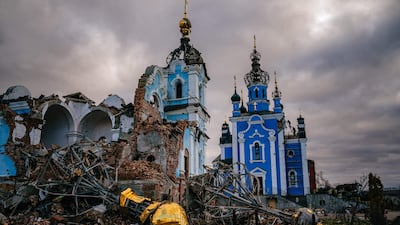
Destruction in the village of Bohorodychne, Donetsk. AFP -

A Ukrainian artilleryman discards an empty shell on the outskirts of Bakhmut, eastern Ukraine, in December 2022. AFP -
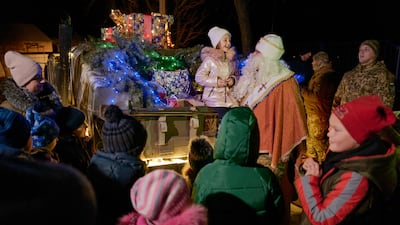
Children receive presents from a Ukrainian soldier dressed as Santa on Christmas Eve in Sloviansk. Getty Images -
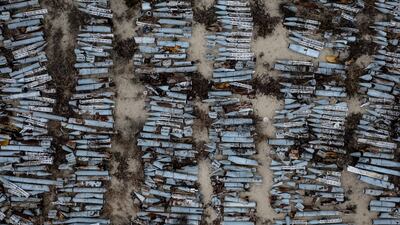
More than 1,000 missiles and rockets fired by Russian forces collected for cataloguing in Kharkiv in December 2022. Getty Images -
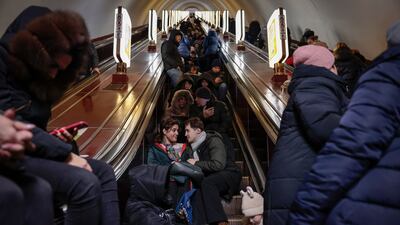
The Metro provides shelter as Russia launches another missile attack on Kyiv, Ukraine's capital, in December 2022. Getty Images -

Children at a PE class in Kyiv after Russia abandoned its attempt to seize the capital in November 2022. Getty Images -
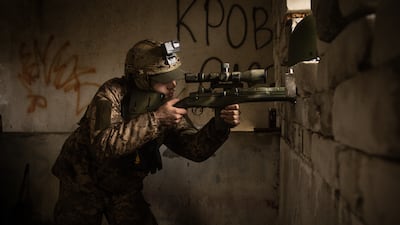
A sniper searches for Russian positions on the bank of the Dnipro river in Kherson in November 2022. Getty Images -
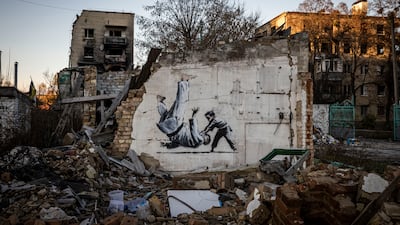
Graffiti by Banksy on a wall among the debris in Borodyanka in November 2022. Getty Images -
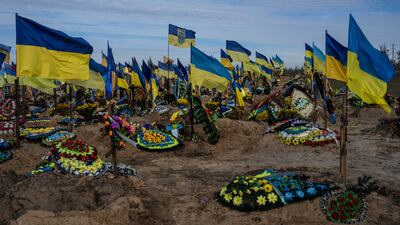
Ukrainian flags flutter around graves in a cemetery for soldiers killed in action in Kharkiv in October 2022. Getty Images -
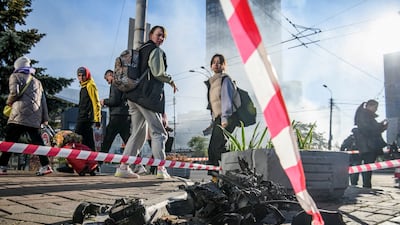
Parts of a drone, which Ukrainian authorities said was Iranian-made, after a Russian strike in Kyiv in October 2022. Reuters -
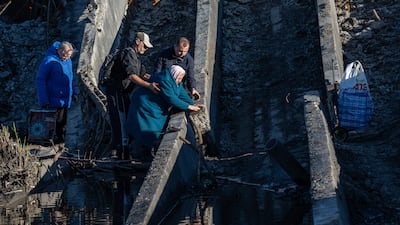
An elderly woman is helped across a damaged bridge in Bakhmut in October 2022. Getty Images -
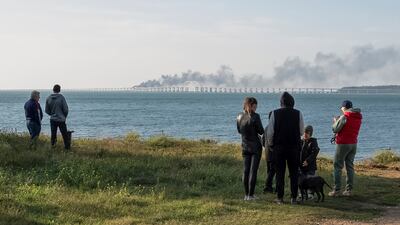
Fuel tanks ablaze on damaged sections of the Kerch bridge in Crimea, in October 2022. Reuters -

A destroyed bridge makes crossing the Donets river difficult, in Staryi Saltiv, east of Kharkiv, in September 2022. AFP -
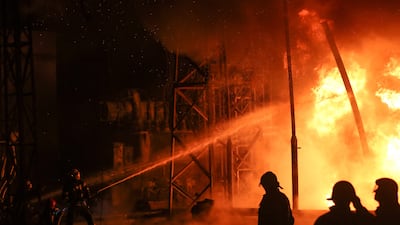
Firefighters at a thermal power plant in Kharkiv damaged by a Russian missile strike in September 2022. Reuters -
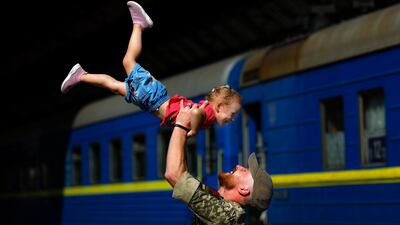
Ukrainian soldier Oleksandr with his daughter Nikole at Lviv railway station in August 2022. Getty Images -
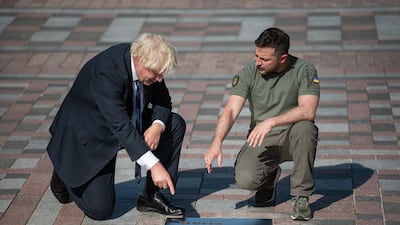
Ukrainian President Volodymyr Zelenskyy and then-British prime minister Boris Johnson read a plaque in Kyiv in August 2022 dedicated to the latter for his support. Getty Images -
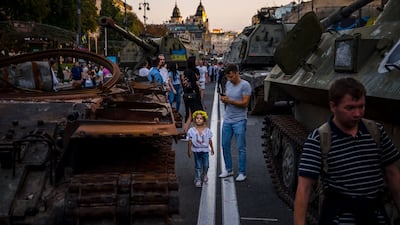
Destroyed Russian military equipment on Khreshchatyk street in Kyiv. The materiel was turned into an open-air military museum ahead of Ukraine's Independence Day on August 24. AFP -
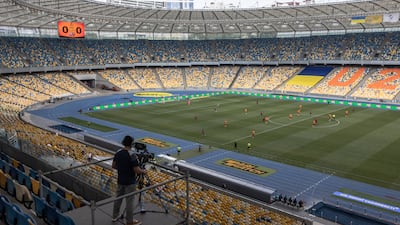
Shakhtar Donetsk v Metalist Kharkiv kicks off the Ukrainian Premier League season in August 2022 amid fears of bomb and missile alerts. EPA -
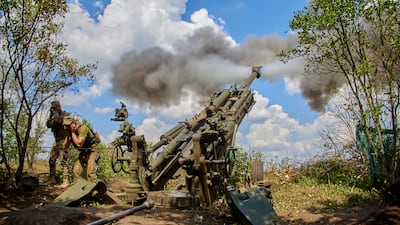
Ukrainian servicemen fire an American-made 155mm M777 howitzer in July 2022 in the Kharkiv area. EPA -
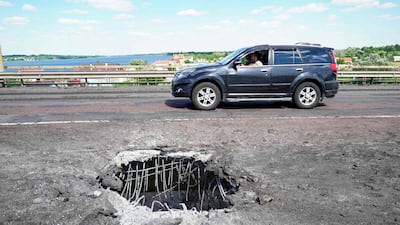
A bomb crater on the Antonovsky bridge across the Dnipro river in Kherson, July 2022. AFP -

Maksym and Andrii with plastic guns at a 'checkpoint' they set up while playing in Kharkiv, July 2022. AP -
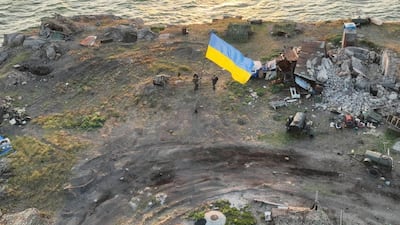
Ukrainian troops on Snake Island in June 2022. Reuters -
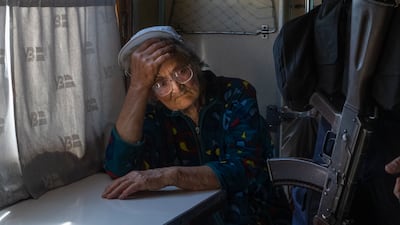
A woman evacuated from an area of conflict in June 2022 contemplates what the next move might be. AP -
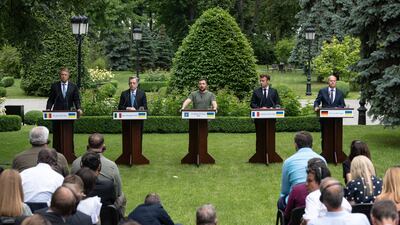
Romanian President Klaus Iohannis, Italian Prime Minister Mario Draghi, Ukrainian President Volodymyr Zelenskyy, French President Emmanuel Macron and German Chancellor Olaf Scholz in Kyiv in June 2022. Getty Images -
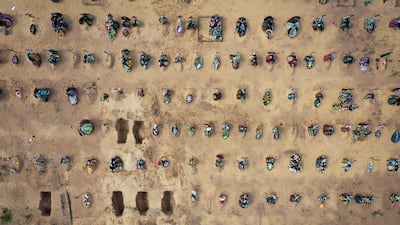
Graves in Irpin cemetery, May 2022. Getty Images -
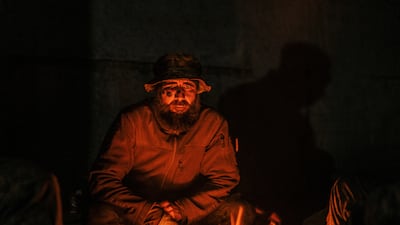
A Ukrainian soldier trapped within the besieged Azovstal Iron and Steel Works complex in Mariupol in May 2022. Reuters -
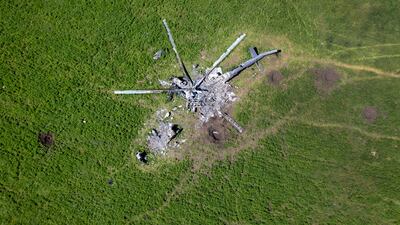
The wreckage of a Russian helicopter in a bomb-cratered field in Biskvitne, May 2022. Getty Images -
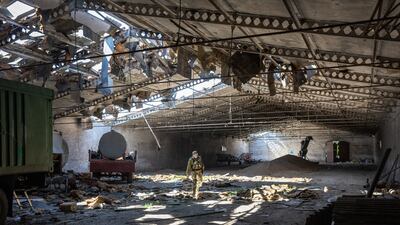
A Ukrainian army officer inspects a grain warehouse shelled by Russian forces in May 2022 near Novovorontsovka, Kherson. Getty Images -
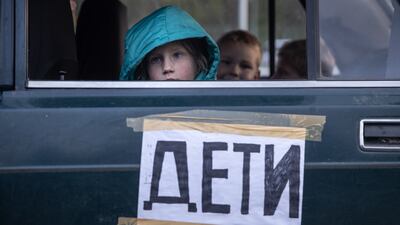
A boy from Mariupol arriving at an evacuation point in Zaporizhzhia in May 2022. Getty Images -
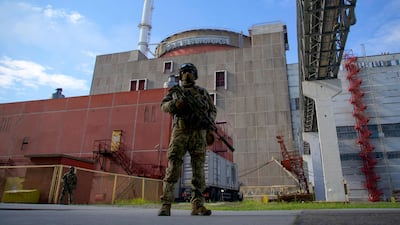
A Russian serviceman on guard outside Zaporizhzhia nuclear power station in May 2022. AFP -
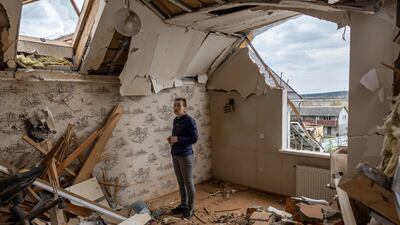
Oksana searches for salvageable items on the destroyed second floor of her home in Hostomel, April 2022. Getty Images -

A floral memorial wall in Lviv for Ukrainian civilians killed during the Russian invasion, April 2022. Getty Images -
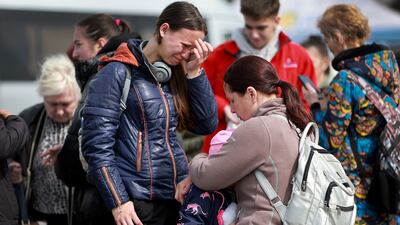
People fleeing Lviv, eastern Ukraine, in April 2022, wait for a bus that will take them to Poland. Getty Images -
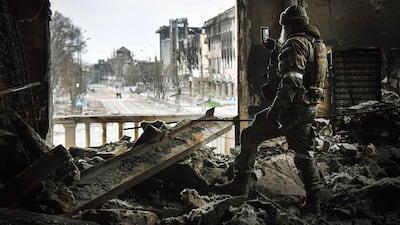
A Russian soldier patrols a bombed Mariupol theatre in April 2022, as Moscow intensified its campaign to take the strategic port city. AFP -
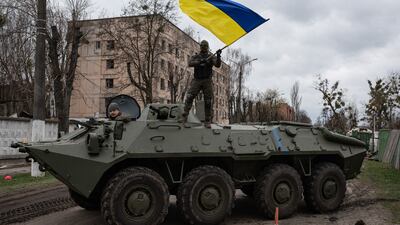
A Ukrainian celebrates success in Hostomel in April 2022. Getty Images -
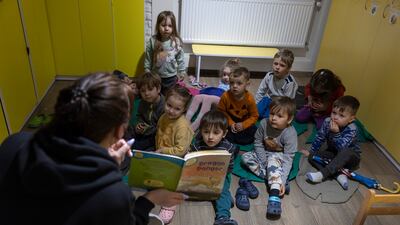
Julia Palovskaya reads to children during an air raid drill in the basement shelter at a preschool in Lviv, April 2022. Getty Images -
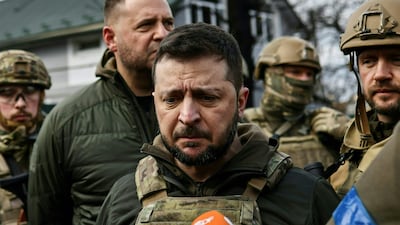
Volodymyr Zelenskyy in Bucha in April 2022, where hundreds of bodies were found in the street and it was claimed the Russian leadership was responsible for killing civilians. AFP -
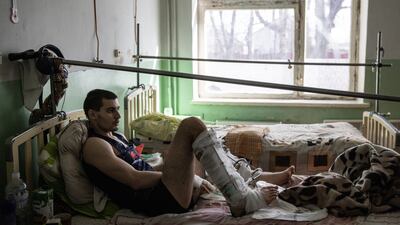
Oleh Smolin, 23, who suffered leg injuries from Russian shelling in April 2022, in hospital in Chuhuiv. Getty Images -
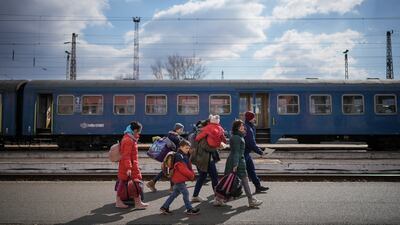
Fleeing refugees arrive at the border train station of Zahony, Hungary, in March 2022. Getty Images -
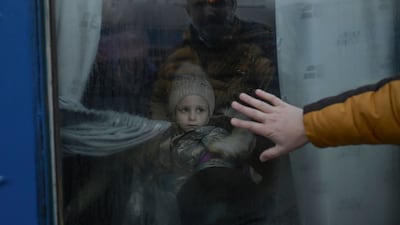
A father says goodbye to his daughter on an evacuation train about to leave Odesa in March 2022. AFP -
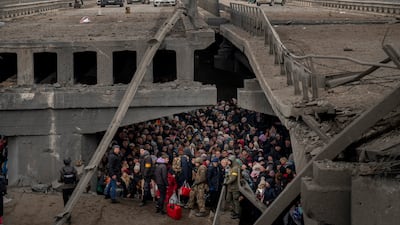
Ukrainians under a destroyed bridge as they try to cross the Irpin river on the outskirts of Kyiv in March 2022. AP -
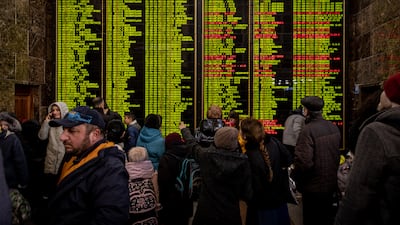
People cram into Kyiv station to catch trains to Poland or to western parts of Ukraine, shortly after the initial invasion in February 2022. Getty Images -
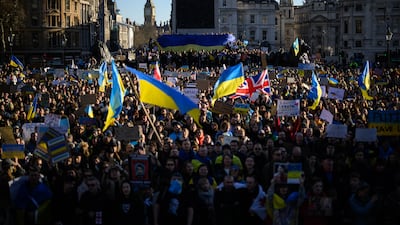
A demonstration in support of Ukraine in Trafalgar Square, London, February 2022 . Getty Images -
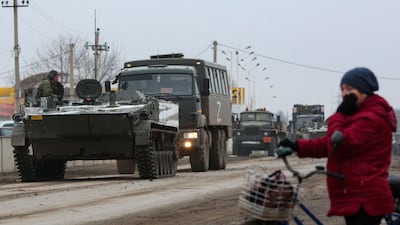
Russian army vehicles in Armyansk, Crimea, in February 2022. AFP -
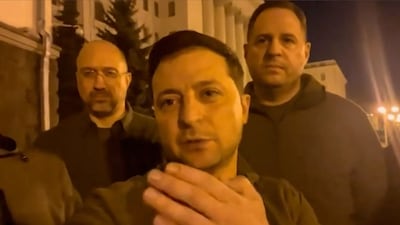
Volodymyr Zelenskyy in Kyiv on February 25, 2022, in a video on Facebook. He said 'we are all here', shortly after the Russian invasion began. AFP -
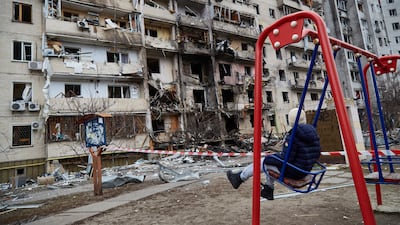
A residential building damaged by a missile strike in Kyiv in February 2022. Getty Images -

A metro station in Kyiv in February 2022, crowded with people trying to escape the invasion. AFP -
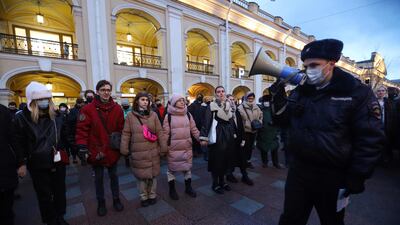
A police officer addresses people gathered to protest against the invasion of Ukraine, in central Saint Petersburg, Russia, February 2022. AFP -
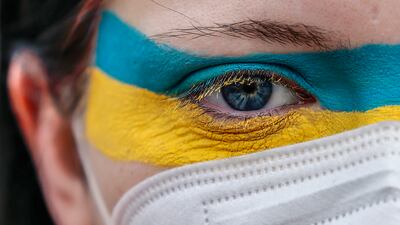
A protester in support of Ukraine, in Berlin, Germany, in February 2022. Getty Images -
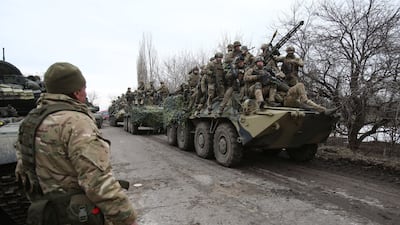
Ukrainian soldiers prepare to repel an attack in Ukraine's Lugansk region on February 24, 2022. AFP -
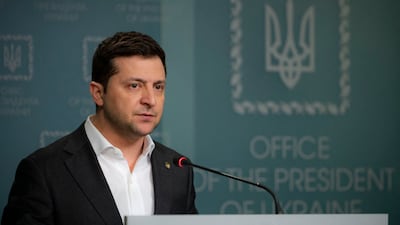
Volodymyr Zelenskyy in Kyiv on February 24, 2022, after Russia launched a full-scale invasion. AFP -
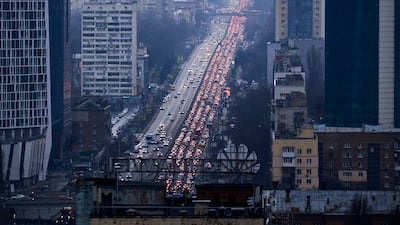
A mass exodus from Kyiv after pre-offensive missile strikes by Russian armed forces on February 24, 2022. Getty Images -
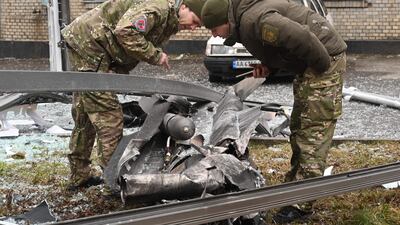
Security personnel inspect the remains of a shell in Kyiv on February 24, 2022, soon after Russian President Vladimir Putin announced a military operation in Ukraine. AFP -
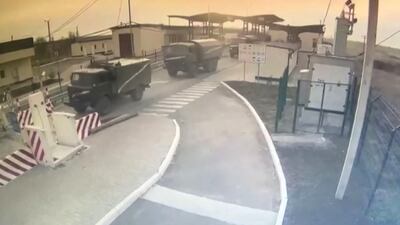
CCTV footage shows Russian military equipment crossing a Crimea border checkpoint on February 24, 2022. AFP -
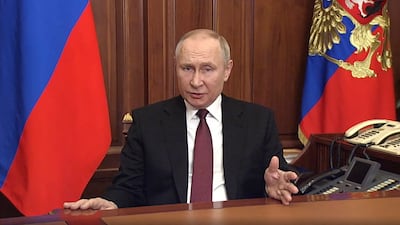
Russian President Vladimir Putin in the Kremlin early on February 24, 2022, when he announced a 'military operation' in Ukraine. AFP



