

The Opec+ alliance of 23 oil-producing countries has agreed to roll over its existing oil output cuts as the fuel demand outlook in China — the world’s second-largest economy and top crude importer — improves.
"The [Joint Ministerial Monitoring Committee] reaffirmed their commitment to the [declaration of co-operation] which extends to the end of 2023," said the group, which slashed its collective output by 2 million barrels per day in October last year.
The committee reviewed crude oil production data for the months of November and December and urged all participating countries to achieve "full conformity".
The next meeting of the JMMC is scheduled for April 3.
The announcement comes as oil prices have rallied by nearly 13 per cent since falling to a low of $76 last month, after China lifted Covid-19 restrictions and hopes grew that easing inflation would slow the rate of interest rate increases by central banks.
Brent, the benchmark for two thirds of the world’s oil, was down 3 per cent at $82.90 a barrel at 11.26 pm UAE time.
The International Monetary Fund on Tuesday marginally raised its global economic growth forecast for 2023, but said that more work needed to be done for a full recovery to take place.
The fund, which raised its economic growth estimate for this year to 2.9 per cent from a previous forecast of 2.7 per cent, said a depreciating US dollar, coupled with global monetary policy tightening, was starting to cool demand and inflation.
Meanwhile, global oil demand is set to reach record levels this year, supported by fuel demand recovery in top manufacturing hub China.
The International Energy Agency (IEA) has said the Asian country will account for nearly half of its 2023 oil demand growth forecast of 1.9 million bpd.
Research firm Energy Intelligence expects demand to grow to 101.2 million bpd this year, surpassing a previous record of 100.6 million bpd in 2019.
Although China represents 10 per cent to 15 per cent of global oil and gas demand, the country's recovery has not been entirely priced in by global commodity markets, according to Japanese bank MUFG.
The existing commodity prices do not “tally up” with China’s economic growth and “rapidly normalising” mobility in the country, said Ehsan Khoman, head of research — commodities, ESG and emerging markets at MUFG, in a report.
Energy markets are set to tighten further as an EU embargo on Russian crude products comes into effect on February 5.
The Group of Seven advanced economies is also considering a price cap on refined products from Russia, similar to the one the alliance imposed on Russia’s crude exports at the end of last year.
“Once the EU embargo on Russian seaborne fuel exports kicks in, we are likely to see prices for gasoline and especially diesel remain supported by tightening supply,” said Ole Hansen, head of commodity strategy at Saxo Bank, this week.
“Russia may, however, struggle to offload its diesel to other buyers, with key customers in Asia being more interested in feeding their refineries with heavily discounted Russian crude, which can then be turned into fuel products selling at the prevailing global market price,” said Mr Hansen.
Russian oil exports declined by 200,000 bpd last month after an EU crude embargo and the G7 price cap on the country’s crude shipments came into effect on December 5, according to the IEA.
The latest Opec+ meeting, the group’s third over the last four months, underlines its growing role in maintaining oil market stability as oil and gas producers in Europe and North America face supply constraints and rising investor pressure.
The supergroup would take a decision “that serves balancing the market”, Suhail Al Mazrouei, the UAE's Minister of Energy and Infrastructure, told reporters on the sidelines of an event in Abu Dhabi this month.
“With China reopening, hopefully, we will see a pick-up in the [crude] demand.”
Oil prices have been volatile since the start of Russia’s military offensive in Ukraine last February. After surging to a 14-year high of nearly $140 a barrel last March, Brent is currently trading in the $80 to $85 range.
“The biggest dangers to the oil price complex are actually coming from the potential demand destruction because of the Ukraine and Russia war and also under-investment,” Karen Kostanian, oil and gas analyst at Bank of America (BofA) Global Research, said at a media round-table last week.
Opec+ may have held its output steady at the last meeting fearing the demand destruction that would come with a recession, Mr Kostanian said.
Meanwhile, oil and gas exploration activity picked up pace last year after the pandemic had stalled or delayed several projects.
New oil and gas discoveries in 2022 could create at least $33 billion in value at Brent prices of $60 a barrel, according to Energy consultancy Wood Mackenzie.
While exploration well numbers were less than half the levels seen in pre-pandemic years, the total volume of 20 billion barrels of oil equivalent matched the average annual volumes from 2013 to 2019, Wood Mackenzie said.
“The highest value came from world-class discoveries in a new deepwater play in Namibia, as well as resource additions in Algeria and several new deepwater discoveries in Guyana and Brazil,” said Julie Wilson, director of global exploration research at Wood Mackenzie.
“The average discovery last year was over 150 million barrels of oil equivalent, more than double the average of the previous decade.”
-
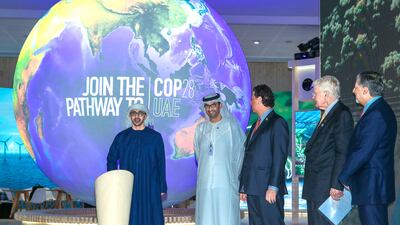
Sheikh Abdullah bin Zayed, Minister of Foreign Affairs and International Co-operation, unveils the Cop28 logo with President-designate Dr Sultan Al Jaber, Minister of Industry and Advanced Technology, at Abu Dhabi Sustainability Week. Victor Besa / The National -
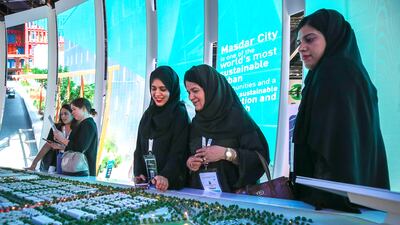
The Masdar display at the event. Victor Besa / The National -

The Mohamed Bin Zayed University stall. Victor Besa / The National -
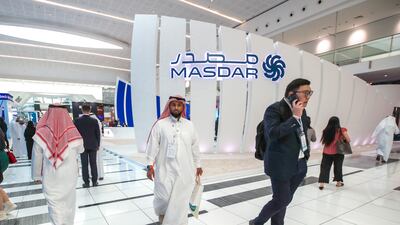
Visitors walk past the Masdar stall. Victor Besa / The National -
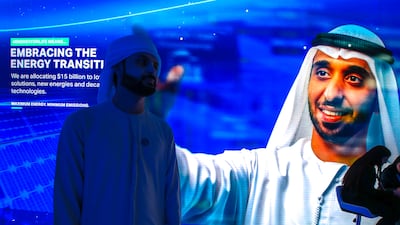
The Adnoc display. Victor Besa / The National -

The National signage on display at the event. Victor Besa / The National -
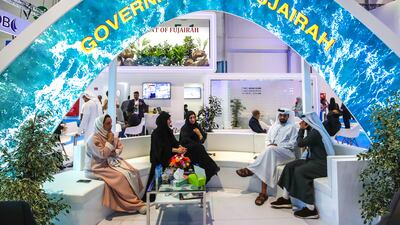
The government of Fujairah's stall. Victor Besa / The National -

The Abu Dhabi Department of Energy's display. Victor Besa / The National -

Another view of the Adnoc stand. Victor Besa / The National -
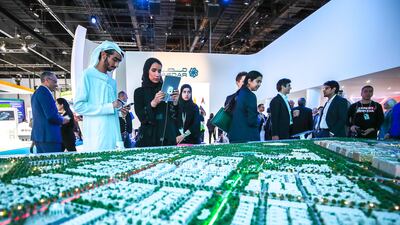
Another view of the Masdar display. Victor Besa / The National -
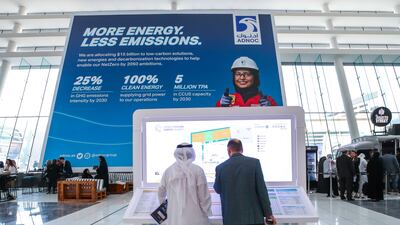
Visitors at Abu Dhabi Sustainability Week. Victor Besa / The National -
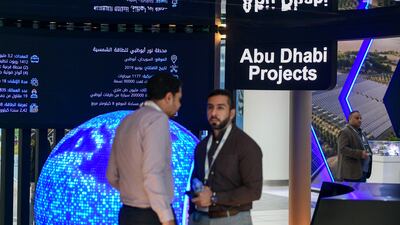
Day two of Abu Dhabi Sustainability Week. Khushnum Bhandari / The National -

Abu Dhabi Sustainability Week aims to accelerate sustainable development and advance economic, social and environmental progress. Khushnum Bhandari / The National -

The Envision stand at Abu Dhabi Sustainability Week. Khushnum Bhandari / The National -
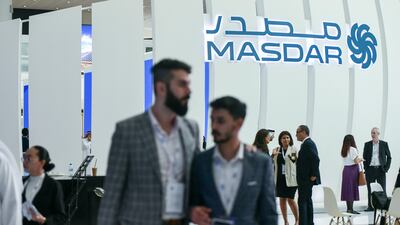
Masdar's stand at Abu Dhabi Sustainability Week. Khushnum Bhandari / The National -
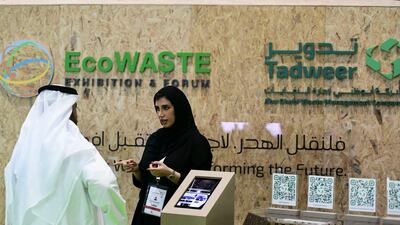
The Tadweer stand. Khushnum Bhandari / The National -
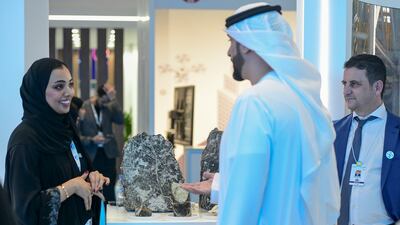
The event brings together heads of state, industry leaders, entrepreneurs, investors and senior policymakers. Khushnum Bhandari / The National -

A solar energy diorama on Day 2 of Abu Dhabi Sustainability Week at Adnec in Abu Dhabi. Khushnum Bhandari / The National -

Abu Dhabi Sustainability Week plays host to some very big names in international business, including Huawei of China. Khushnum Bhandari / The National -
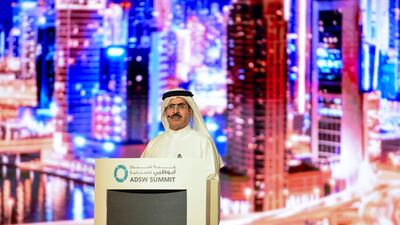
Saeed Al Tayer, managing director and chief executive of Dubai Electricity and Water Authority, delivers a speech. Khushnum Bhandari / The National -

Mahmoud Mohieldin, executive director of the IMF, left, in discussion on Day 2 of Abu Dhabi Sustainability Week at Adnec in Abu Dhabi. Khushnum Bhandari / The National -
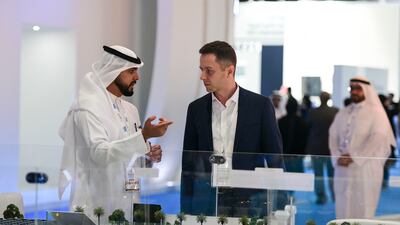
Visitors at the Dubai Electricity and Water Authority stand at Abu Dhabi Sustainability Week in Adnec, Abu Dhabi. Khushnum Bhandari / The National -
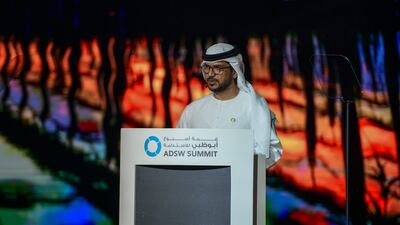
Awaidha Al Marar of the Abu Dhabi Department of Energy, an Abu Dhabi Executive Council Member and Member of Enec's board of directors, delivers opening remarks on Net-Zero Ambitions in Energy on Day 2 of Abu Dhabi Sustainability Week at Adnec. Khushnum Bhandari / The National -
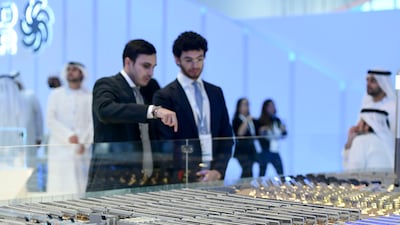
The Dubai Electricity and Water Authority (Dewa) stand at Abu Dhabi Sustainability Week in Adnec, Abu Dhabi. Khushnum Bhandari / The National -

The Aldar stand at Abu Dhabi Sustainability Week in Adnec, Abu Dhabi. Khushnum Bhandari / The National -
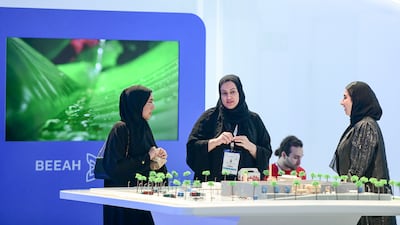
The Bee'ah stand at Abu Dhabi Sustainability Week in Adnec, Abu Dhabi. Khushnum Bhandari / The National -
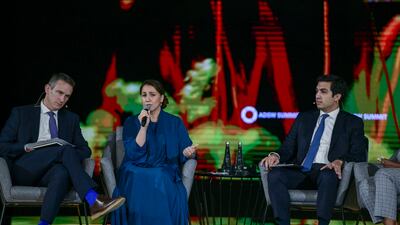
Mariam Al Mheiri, Minister of Climate Change and Environment, and Ahmed El Hoshy, chief executive of Fertiglobe, right, in a panel discussion titled A Manifesto for Food Systems at Abu Dhabi Sustainability Week in Adnec, Abu Dhabi. Khushnum Bhandari / The National -
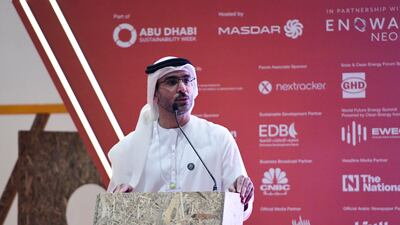
Sharif Al Olama, Undersecretary of the Ministry of Energy and Infrastructure, delivers a speech promoting solar power at the opening of Abu Dhabi Sustainability Week. Khushnum Bhandari / The National -
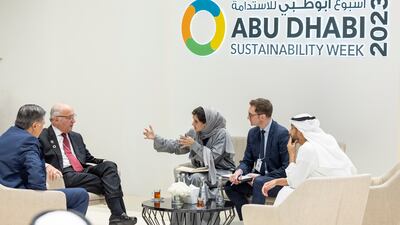
Laurent Fabius (2nd L), president of the constitutional council of France, speaks to guests at Abu Dhabi National Exhibition Centre. Photo: Presidential Court -
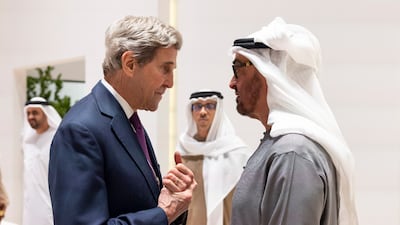
President Sheikh Mohamed speaks to John Kerry, US presidential envoy for climate, at a reception before the opening ceremony. Photo: Presidential Court -
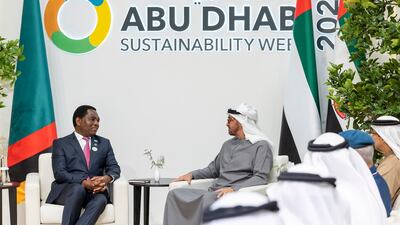
President Sheikh Mohamed meets Hakainde Hichilema, President of Zambia. Photo: Presidential Court -
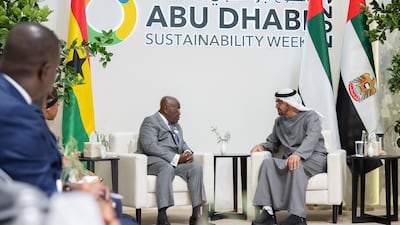
President Sheikh Mohamed meets Nana Akufo-Addo, President of Ghana. Photo: Presidential Court -
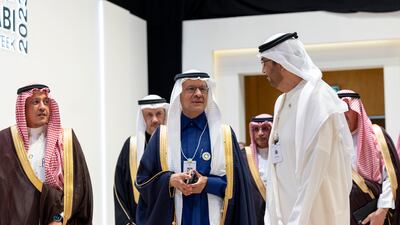
Dr Sultan Al Jaber, right, Minister of Industry and Advanced Technology Group, chief executive of Adnoc and chairman of Masdar, receives Prince Abdulaziz bin Salman, Saudi Arabia’s Minister of Energy. Photo: Presidential Court -
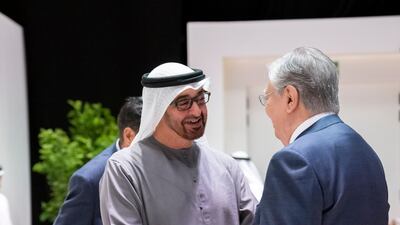
President Sheikh Mohamed greets Kassym-Jomart Tokayev, President of Kazakhstan. Photo: Presidential Court -

President Sheikh Mohamed stands for a photograph with heads of state and government. (Front row: R-L) presidents Surangel Whipps Jr of Palau, Nana Akufo-Addo of Ghana, Kassym-Jomart Tokayev of Kazakhstan, Yoon Suk Yeol of South Korea, Ilham Aliyev of Azerbaijan, Joao Lourenco of Angola, Filipe Nyusi of Mozambique and Abiy Ahmed, Prime Minister of Ethiopia. (Back row: R-L) Aziz Akhannouch, Prime Minister of Morocco, Wavil Ramkalawan, President of Seychelles, Hakainde Hichilema, President of Zambia, Yoweri Museveni, President of Uganda, Tiemoko Meyliet Kone, Vice President of Ivory Coast and Dr Sultan Al Jaber. Photo: Presidential Court -
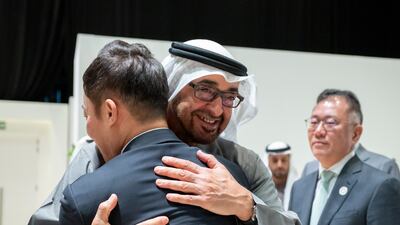
President Sheikh Mohamed greets a guest. Photo: Presidential Court -
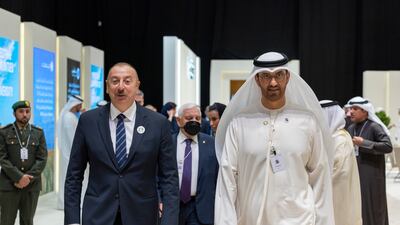
Dr Al Jaber with Ilham Aliyev, President of Azerbaijan. Photo: Presidential Court -
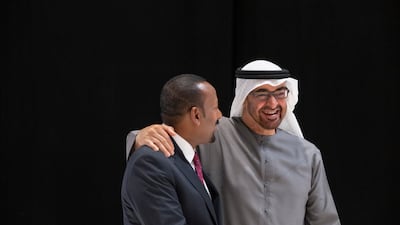
President Sheikh Mohamed greets Abiy Ahmed, Prime Minister of Ethiopia. Photo: Presidential Court -
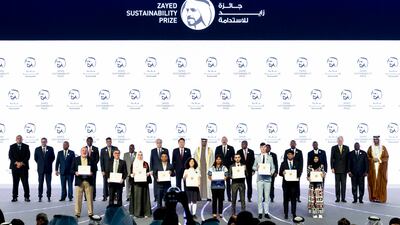
(Back row L-R) Siaosi Sovaleni, Prime Minister of Tonga, Aziz Akhannouch, Prime Minister of Morocco, Wavil Ramkalawan, President of Seychelles, Hakainde Hichilema, President of Zambia, Surangel Whipps Jr, President of Palau, Nana Akufo-Addo, President of Ghana, Kassym-Jomart Tokayev, President of Kazakhstan, Yoon Suk Yeol, President of South Korea, President Sheikh Mohamed, Ilham Aliyev, President of Azerbaijan, Joao Lourenco, President of Angola, Filipe Nyusi, President of Mozambique, Abiy Ahmed, Prime Minister of Ethiopia, Yoweri Museveni, President of Uganda, Olafur Ragnar Grimsson, former president of Iceland and chairman of Arctic Circle, Tiemoko Meyliet Kone, Vice President of Ivory Coast, and Dr Sultan Al Jaber, Minister of Industry and Advanced Technology. Photo: Presidential Court -
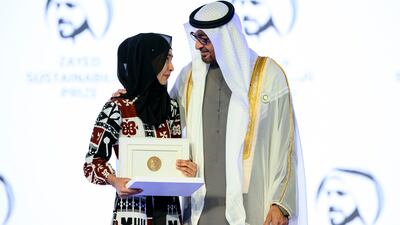
President Sheikh Mohamed presents the 2023 Zayed Sustainability Prize for East Asia & Pacific Global High Schools to a representative from Kamil Muslim College, Fiji. Photo: Presidential Court -
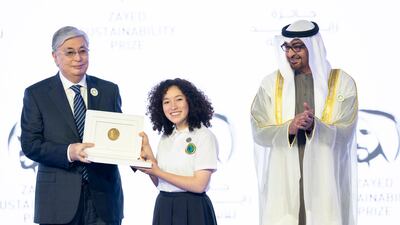
Kassym-Jomart Tokayev, President of Kazakhstan (L), and President Sheikh Mohamed present the 2023 Zayed Sustainability Prize for Americas Global High Schools, to a representative from Fundacion Bios Terrae in Colombia. Photo: Presidential Court -
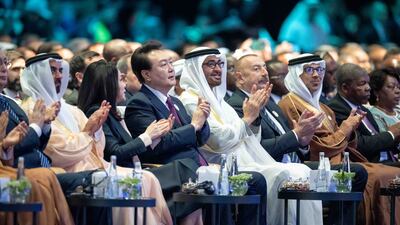
(L-R) Sheikh Saif bin Zayed, UAE Deputy Prime Minister and Minister of Interior, Kim Keon Hee, first lady of South Korea, Yoon Suk Yeol, President of South Korea, President Sheikh Mohamed, Ilham Aliyev, President of Azerbaijan, Sheikh Mansour bin Zayed, Deputy Prime Minister and Minister of the Presidential Court, Joao Lourenco, President of Angola and Ana Dias Lourenco, first lady of Angola. Photo: Presidential Court -
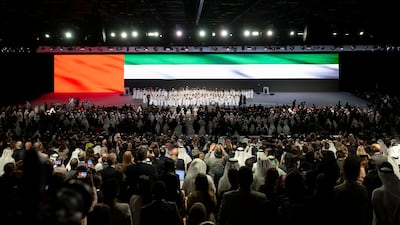
Guests stand for the national anthem during the opening ceremony of Abu Dhabi Sustainability Week. Photo: Presidential Court -
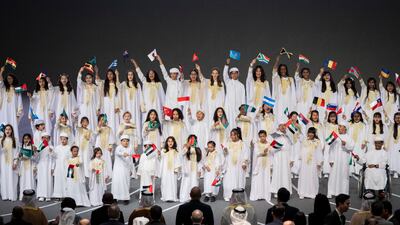
Children sing the UAE national anthem . Photo: Presidential Court -
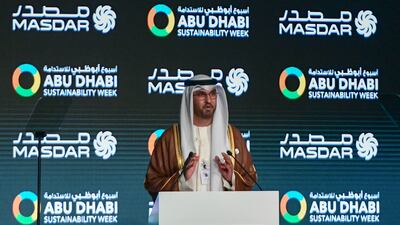
Dr Sultan Al Jaber, Cop28 President-designate and the UAE's special envoy on climate change, speaks at the opening of Abu Dhabi Sustainability Week. Khushnum Bhandari / The National -
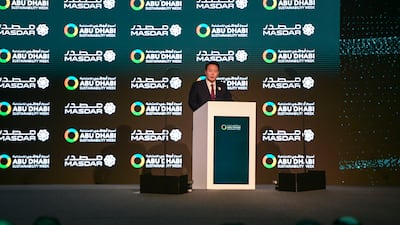
Mr Yoon, a keynote speaker at Abu Dhabi Sustainability Week. Khushnum Bhandari / The National -
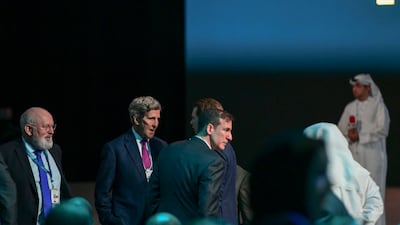
US climate envoy John Kerry, centre. Khushnum Bhandari / The National -
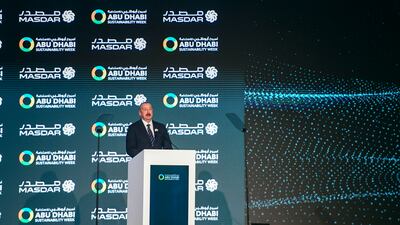
Azerbaijan’s President Ilham Aliyev. Khushnum Bhandari / The National -
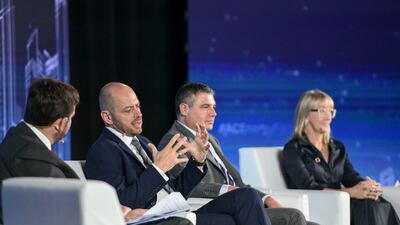
From left, Phillip Cornell, senior fellow of Atlantic Council Global Energy Centre; Christian Bruch, president and chief executive officer of Siemens Energy; Lorenzo Simonelli, chairman, president and chief executive of Baker Hughes; and Marisa Drew, chief sustainability officer of Standard Chartered. Khushnum Bhandari / The National



