

The market for liquefied natural gas will be “tight” in the medium term as demand recovers in China and Europe boosts imports of the super-chilled fuel, according to the chief executive of Inpex, Japan’s largest oil and gas exploration company.
“The demand and supply situation will continue to be relatively tight perhaps until the end of 2030, but no one knows what will happen after that,” Takayuki Ueda told The National in an interview on Tuesday.
Global competition for LNG cargoes is set to intensify after China, the world’s second largest economy, reopened its borders for the first time in three years.
“The demand in China will increase after [the lifting of Covid-19 curbs] … that’s a good thing for us,” said Mr Ueda.
On the supply side, decisions from the Opec+ group of oil producers could be “very important” for short-term natural gas prices, he said.
The Russian military offensive in Ukraine has led to a “structural change” in global energy markets, with several countries severing diplomatic and trade ties to Moscow, effectively changing the dynamics long term, the Inpex chief noted.
Europe, faced with dwindling Russian natural gas supplies, has increased LNG imports from the Gulf and the US.
“I think long-term LNG [contracts] seem to be much more important after the Russian war,” said Mr Ueda.
“What seems to be clear for me during this crisis … is that natural gas [and] especially LNG will play a very important role for a long time.”
Last year, the International Energy Agency (IEA) said it expected fossil fuel demand to peak or reach a plateau in all its scenarios for the first time.
Based on current policies, natural gas demand will reach a plateau by the end of the decade while oil demand will “level-off” in the mid-2030s amid rising sales of electric vehicles, the agency said.
“There are a lot of LNG receiving terminals under construction in Germany and a lot of exporting facilities are also under construction in the US … I think the usage of LNG will be longer than we originally expected,” said Mr Ueda.
Last month, Inpex signed a long-term agreement with US-based Venture Global LNG for the supply of 1 million tonnes per annum for 20 years.
Meanwhile, the Tokyo-based company is also expanding its production and sales of LNG.
Inpex plans to boost the annual production capacity at its Australian LNG project — Ichthys — to 9.3 million tonnes this year, from 8.9 million tonnes, said Mr Ueda.
While most of the fuel produced from the mega-LNG project is going to the Japanese market, Inpex could potentially ship it to other markets in Asia.
“Demand in Japan … will gradually decrease in the long run, then South-East Asia, China or India will be much more important,” said Mr Ueda.
Several energy companies have announced plans to produce and sell clean hydrogen as countries move towards net-zero emissions targets.
Inpex has also been receiving blue ammonia shipments from UAE’s Adnoc.
Blue ammonia is a chemical compound produced using hydrogen manufactured through steam methane reformation. Ammonia is one of the easiest ways to store and transport hydrogen.
“We are also looking [at] the worldwide market of blue hydrogen [and] ammonia,” said Mr Ueda.
“There might be a turning point for demand somewhere between 2027 and 2033, so we need to prepare for [that].”
Hydrogen, which can be produced using renewable energy and natural gas, is expected to play a key role in the coming years.
French investment bank Natixis estimates that investment in hydrogen will exceed $300 billion by 2030.
-
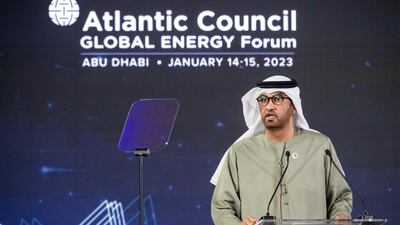
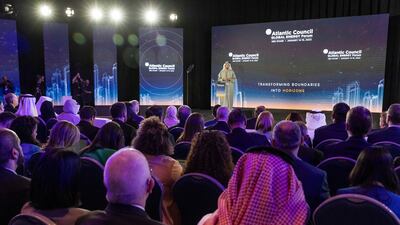
Dr Sultan Al Jaber, President-designate of Cop28, told the Atlantic Council Global Energy Forum that the world will require 'transformational' progress to meet net-zero targets. All photos: Antonie Robertson / The National -
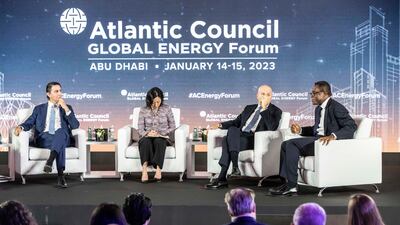
The energy forum brings together heads of state, policymakers and industry leaders for dialogue on movement towards to a net-zero future. -

Delegates at the Atlantic Council Global Energy Forum in Abu Dhabi on Saturday. -
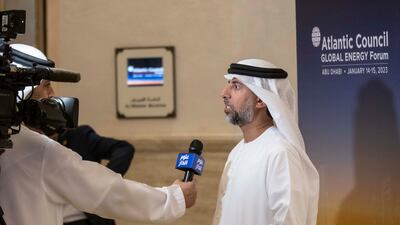
Suhail Al Mazrouei, Minister of Energy and Infrastructure, speaks to media on the sidelines of the event. -
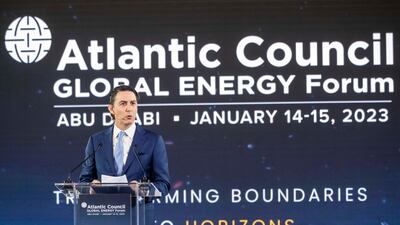
Amos Hochstein, special presidential co-ordinator for global infrastructure and energy security with the US Department of State, addresses a session. -

The Atlantic Council Global Energy Forum is a part of the Abu Dhabi Sustainability Week, which will run from January 14 to January 19. -
Dr Sultan Al Jaber, Minister of Industry and Advanced Technology, was named as president-designate of the UN Cop28 climate change summit, which will be held in the UAE this year.



