Austrian plastics company Borealis will not cut jobs or reduce its production capacity as high energy prices shrink industry margins.
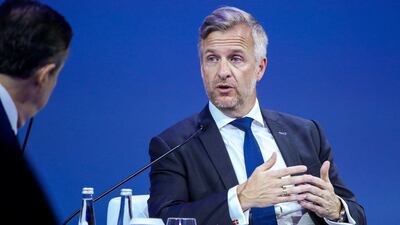
“We see some announcements from other companies of downsizing and reducing capacities in Europe,” chief executive Thomas Gangl told The National on Wednesday on he sidelines of the Abu Dhabi International Petroleum Exhibition and Conference (Adipec).
“For us, this is not a topic. We have a very stable asset base.”
Last week, Germany’s BASF announced cost-reduction measures until the end of 2024 to save the world’s largest chemical company €500 million ($495m) annually amid high natural gas and power prices.
Natural gas prices in Europe have soared since Russia, the region’s largest supplier of gas, began curtailing exports in response to EU sanctions.
The Dutch TTF gas futures contract, the benchmark in Europe, has fallen in recent weeks as natural gas storage levels rise but is still up nearly 200 per cent from 2021 levels.
Natural gas liquids and naphtha created from crude oil during the refining process are used as feedstock to manufacture a variety of petrochemicals.
“Europe has prepared well for this winter …. we need to make sure that energy prices are coming down again,” said Mr Gangl.
Borouge, the joint venture between Adnoc and Borealis, reported a 14 per cent rise in its nine-month revenue last week on higher sales volumes of polypropylene, a key petrochemical.
There was a “significant” increase in polypropylene sales but “the overall situation is tougher than what we had before”, said Mr Gangl.
Borouge, which listed on the Abu Dhabi Securities Exchange in June after raising $2 billion in an initial public offering in Abu Dhabi's biggest listing, said it remained confident about reporting a profit for the 2022 financial year.
After its listing, Borouge was included in the FTSE Global Equity Index Series, which is used by investors globally to guide asset-allocation decisions and support portfolio construction.
_____________________________
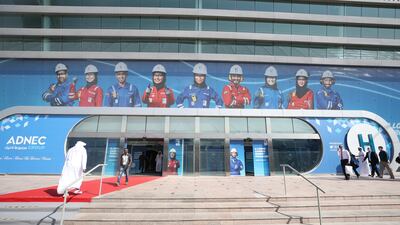
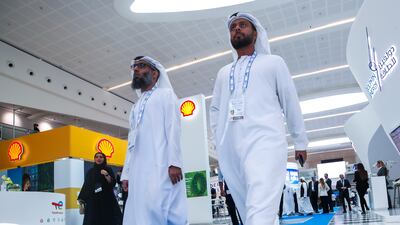
Adipec 2022: day three — in pictures
_____________________________
“This is a cyclical business, especially with demand slowing down due to inflation effects [and] China's growth not where it used to be,” said Mr Gangl.
Frequent lockdowns under its zero-Covid policy have dampened China’s economic growth in recent quarters.
Russia’s invasion of Ukraine and global supply chain bottlenecks pushed shipping rates higher in the first half of 2022.
“The freight rates are coming down [and] this is a clear signal that the overall situation is easing [but] it is not back to normal,” said Mr Gangl.
Supply chains in the automotive industry, a major consumer of plastics, are “working better”, he said.
Global car makers have reported record profits as demand outpaced the supply of new vehicles amid production and supply chain issues.
“They have quite a backlog … we also see that the demand in this area is improving,” said Mr Gangl.
“What we have to get used to is that disruptions [and] changes are happening more often and it is getting more volatile due to all the political topics.”
Borealis, which is majority owned by Austrian energy company OMV, reported a 2021 net profit of €1.4bn ($1.38bn).
The Vienna-based company employs about 6,900 employees and operates in over 120 countries, according to its website.

Killing of Qassem Suleimani
Mercer, the investment consulting arm of US services company Marsh & McLennan, expects its wealth division to at least double its assets under management (AUM) in the Middle East as wealth in the region continues to grow despite economic headwinds, a company official said.
Mercer Wealth, which globally has $160 billion in AUM, plans to boost its AUM in the region to $2-$3bn in the next 2-3 years from the present $1bn, said Yasir AbuShaban, a Dubai-based principal with Mercer Wealth.
“Within the next two to three years, we are looking at reaching $2 to $3 billion as a conservative estimate and we do see an opportunity to do so,” said Mr AbuShaban.
Mercer does not directly make investments, but allocates clients’ money they have discretion to, to professional asset managers. They also provide advice to clients.
“We have buying power. We can negotiate on their (client’s) behalf with asset managers to provide them lower fees than they otherwise would have to get on their own,” he added.
Mercer Wealth’s clients include sovereign wealth funds, family offices, and insurance companies among others.
From its office in Dubai, Mercer also looks after Africa, India and Turkey, where they also see opportunity for growth.
Wealth creation in Middle East and Africa (MEA) grew 8.5 per cent to $8.1 trillion last year from $7.5tn in 2015, higher than last year’s global average of 6 per cent and the second-highest growth in a region after Asia-Pacific which grew 9.9 per cent, according to consultancy Boston Consulting Group (BCG). In the region, where wealth grew just 1.9 per cent in 2015 compared with 2014, a pickup in oil prices has helped in wealth generation.
BCG is forecasting MEA wealth will rise to $12tn by 2021, growing at an annual average of 8 per cent.
Drivers of wealth generation in the region will be split evenly between new wealth creation and growth of performance of existing assets, according to BCG.
Another general trend in the region is clients’ looking for a comprehensive approach to investing, according to Mr AbuShaban.
“Institutional investors or some of the families are seeing a slowdown in the available capital they have to invest and in that sense they are looking at optimizing the way they manage their portfolios and making sure they are not investing haphazardly and different parts of their investment are working together,” said Mr AbuShaban.
Some clients also have a higher appetite for risk, given the low interest-rate environment that does not provide enough yield for some institutional investors. These clients are keen to invest in illiquid assets, such as private equity and infrastructure.
“What we have seen is a desire for higher returns in what has been a low-return environment specifically in various fixed income or bonds,” he said.
“In this environment, we have seen a de facto increase in the risk that clients are taking in things like illiquid investments, private equity investments, infrastructure and private debt, those kind of investments were higher illiquidity results in incrementally higher returns.”
The Abu Dhabi Investment Authority, one of the largest sovereign wealth funds, said in its 2016 report that has gradually increased its exposure in direct private equity and private credit transactions, mainly in Asian markets and especially in China and India. The authority’s private equity department focused on structured equities owing to “their defensive characteristics.”
More on Quran memorisation:
Zayed Sustainability Prize
Key facilities
- Olympic-size swimming pool with a split bulkhead for multi-use configurations, including water polo and 50m/25m training lanes
- Premier League-standard football pitch
- 400m Olympic running track
- NBA-spec basketball court with auditorium
- 600-seat auditorium
- Spaces for historical and cultural exploration
- An elevated football field that doubles as a helipad
- Specialist robotics and science laboratories
- AR and VR-enabled learning centres
- Disruption Lab and Research Centre for developing entrepreneurial skills
if you go
The flights
The closest international airport to the TMB trail is Geneva (just over an hour’s drive from the French ski town of Chamonix where most people start and end the walk). Direct flights from the UAE to Geneva are available with Etihad and Emirates from about Dh2,790 including taxes.
The trek
The Tour du Mont Blanc takes about 10 to 14 days to complete if walked in its entirety, but by using the services of a tour operator such as Raw Travel, a shorter “highlights” version allows you to complete the best of the route in a week, from Dh6,750 per person. The trails are blocked by snow from about late October to early May. Most people walk in July and August, but be warned that trails are often uncomfortably busy at this time and it can be very hot. The prime months are June and September.
What can you do?
Document everything immediately; including dates, times, locations and witnesses
Seek professional advice from a legal expert
You can report an incident to HR or an immediate supervisor
You can use the Ministry of Human Resources and Emiratisation’s dedicated hotline
In criminal cases, you can contact the police for additional support
THREE
%3Cp%3EDirector%3A%20Nayla%20Al%20Khaja%3C%2Fp%3E%0A%3Cp%3EStarring%3A%20Jefferson%20Hall%2C%20Faten%20Ahmed%2C%20Noura%20Alabed%2C%20Saud%20Alzarooni%3C%2Fp%3E%0A%3Cp%3ERating%3A%203.5%2F5%3C%2Fp%3E%0A
Our Time Has Come
Alyssa Ayres, Oxford University Press
COMPANY%20PROFILE
%3Cp%3E%3Cstrong%3EName%3A%20%3C%2Fstrong%3EElmawkaa%3Cbr%3E%3Cstrong%3EBased%3A%3C%2Fstrong%3E%20Hub71%2C%20Abu%20Dhabi%3Cbr%3E%3Cstrong%3EFounders%3A%3C%2Fstrong%3E%20Ebrahem%20Anwar%2C%20Mahmoud%20Habib%20and%20Mohamed%20Thabet%3Cbr%3E%3Cstrong%3ESector%3A%3C%2Fstrong%3E%20PropTech%3Cbr%3E%3Cstrong%3ETotal%20funding%3A%3C%2Fstrong%3E%20%24400%2C000%3Cbr%3E%3Cstrong%3EInvestors%3A%20%3C%2Fstrong%3E500%20Startups%2C%20Flat6Labs%20and%20angel%20investors%3Cbr%3E%3Cstrong%3ENumber%20of%20employees%3A%3C%2Fstrong%3E%2012%3Cbr%3E%3C%2Fp%3E%0A
The five pillars of Islam