

Adnoc has set a new methane emissions target for its upstream unit as part of its efforts to reduce its overall greenhouse gas emissions.
The state-owned oil company is aiming for the “Middle East’s lowest” methane intensity target of 0.15 per cent by 2025, it said in a statement on Monday.
Intensity-based targets measure the amount of methane or carbon dioxide per unit of energy or barrel of oil and gas produced.
“Our aim is to reduce the methane intensity from our operated oil and gas assets, at the same time as we meet the forecast growth in energy demand for decades to come,” Abdulmunim Al Kindy, executive director of Adnoc's people, technology and corporate support directorate.
The announcement came on the opening day of the Abu Dhabi International Petroleum Exhibition Conference (Adipec), one of the world’s largest energy industry events.
Adnoc plans to lower its greenhouse gas emissions intensity by 25 per cent by 2030 as it adopts new sustainability goals.
In 2020, the company was among the five lowest greenhouse gas emitters in the oil and gas industry, with a methane intensity of 0.01 per cent.
The new target of 0.15 per cent reflects the total volume of methane emissions from all operated upstream oil and gas assets, the company said.
The UAE, which is Opec’s third-largest oil producer, plans to boost its production capacity to 5 million barrels per day by 2030.
Even as Covid-19 lockdowns drove carbon emissions down in 2020, methane emissions continued to climb.
But unlike carbon dioxide, methane breaks down in the atmosphere in about 10 years, meaning action to stop it from reaching the ozone layer can make a huge difference.
The UN estimates that human-caused methane emissions may be reduced by as much as 45 per cent this decade, if the right action is taken.
_______________________________
Adipec 2022: day one — in pictures
-

Visitors at the Abu Dhabi International Petroleum Exhibition and Conference, which is being held in the UAE capital. Chris Whiteoak / The National -

Dr Sultan Al Jaber, Minister of Industry and Advanced Technology, and managing director and group chief executive of Adnoc, said the world will lose 5 million barrels per day of oil each year from current supplies if spending comes to a halt. Photo: Adipec -

Dr Al Jaber called for 'maximum' energy with 'minimium' emissions to ensure global energy security. Photo: Adipec -

Sheikh Khaled bin Mohamed, member of the Abu Dhabi Executive Council and chairman of the Abu Dhabi Executive Office, is given a briefing at one of the exhibition stands at Adipec, during a tour with Dr Al Jaber. Photo: Abu Dhabi Media Office -
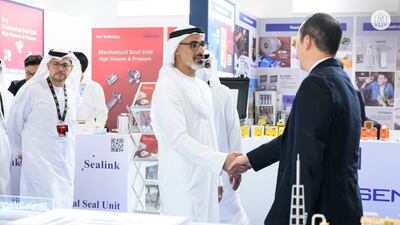
Sheikh Khaled is greeted by an executive at one of the stands at Adipec. Photo: Abu Dhabi Media Office -

Sheikh Mansour bin Zayed, Deputy Prime Minister and Minister of the Presidential Court, inaugurated the energy conference. Photo: Abu Dhabi Media Office -

Sheikh Mansour with other sheikhs and officials at Adipec. Photo: Abu Dhabi Media Office -

US presidential co-ordinator Amos Hochstein speaks during the opening ceremony at Adipec 2022. Chris Whiteoak / The National -

Saudi Energy Minister Prince Abdulaziz bin Salman said the kingdom and the UAE will be 'exemplary' hydrocarbon producers while also achieving all their sustainability goals. Chris Whiteoak / The National -

UAE Minister of Energy and Infrastructure Suhail Al Mazrouei said the Emirates and the Opec+ are 'keen on' meeting global energy requirements. Chris Whiteoak / The National -

Tarek El Molla, Egypt's Minister for Petroleum and Mineral Resources, speaks during a panel discussion. Chris Whiteoak / The National -

Indian Energy Minister Hardeep Singh Puri makes a point during the panel discussion. Chris Whiteoak / The National -

Upstream energy investment in 2021 was depressed for a second consecutive year at $341 billion — about 25 per cent below 2019 levels. Chris Whiteoak / The National -

Musadik Masood Malik, Pakistan's Minister of State for Petroleum, with Belinda Balluku, Albania's Deputy Prime Minister and Minister of Infrastructure and Energy, speak on the topic 'Geopolitics of Today: How the Energy Industry is Navigating Through Change' at the Adipec 2022 conference in Adnec, Abu Dhabi. Chris Whiteoak / The National -

Nicolas Terraz, member of the executive committee, president of exploration and production at Total Energies, addresses a panel discussion on 'Transitioning to New Energy Supply and Demand Needs: a Look into the Future' at Adipec 2022. Chris Whiteoak / The National -

Tengku Muhammad Taufik, president and chief executive of Petronas, during a panel discussion on 'The New Business and Energy Portfolio Model: Managing Geopolitical Uncertainty and the Energy Transition' at Adipec 2022. Chris Whiteoak / The National -

Professor Dr Klaus-Dieter Maubach, chief executive of Uniper, at a panel discussion on the topic 'Transitioning to New Energy Supply and Demand Needs: A Look into the Future' at Adipec 2022. Chris Whiteoak / The National -

Haytham Al Ghais, Secretary General of Opec, during OPRC's World Outlook 2022 at Adipec 2022. Chris Whiteoak / The National -

Delegates at Adipec 2022. Chris Whiteoak / The National -

Adipec 2022 draws industry representation from across the world to Adnec in Abu Dhabi. Chris Whiteoak / The National


_______________________________
“Reducing emissions of this powerful greenhouse gas is an essential short-term action if we are to meet the climate goals of the Paris Agreement,” said Mark Radka, chief of energy and the climate branch at the UN Environment Programme.
The UAE is investing Dh600 billion ($163.5bn) in clean and renewable energy projects over the next three decades as part of its strategy to achieve net zero emissions by 2050.
The country is building the world’s largest solar park — the Mohammed bin Rashid Solar Park — in Dubai with a 5-gigawatt capacity.
Fossil fuel combustion will grow by less than 1 per cent in 2022, supported by a “strong” expansion of renewables and the rising adoption of electric vehicles, the International Energy Agency said in a recent report.
Carbon emissions jumped by about two billion tonnes in 2021 as the world economy rebounded from the effects of the first year of the Covid-19 pandemic, which brought travel to a standstill.

