

Climate pledges produced by oil giants BP, Royal Dutch Shell and Equinor are incompatible with Paris Agreement goals for a safe and habitable planet, research published in Nature Communications on Tuesday suggests.
Oil industry companies have generated their own scenarios for future world energy consumption for many decades, but in recent years they have moved to include decarbonisation objectives and resulting climate change outcomes. These inform planning across the globe by governments and other organisations aiming to determine how rapidly different sectors must reduce greenhouse gas emissions.
The joint Climate Analytics and Imperial College London study said the decarbonisation scenarios delay reductions in fossil fuel consumption and run the risk of overshooting vital climate goals.
To arrive at this conclusion, researchers analysed six institutional scenarios published between 2020 and mid-2021 and calculated their temperature outcomes.
The scenarios include four from the oil majors: two from BP, one from Royal Dutch Shell and one from Equinor — as well two developed by the International Energy Agency.
“Most of the scenarios we evaluated would be classified as inconsistent with the Paris Agreement as they fail to limit warming to ‘well below 2 ̊C, let alone 1.5 ̊C, and would exceed the 1.5 ̊C [above pre-industrial levels] warming limit by a significant margin,” said Climate Analytics' Dr Robert Brecha, co-lead author of the study.
Equinor’s “Rebalance” scenario peaks at a median warming of 1.73°C above pre-industrial levels in 2060, BP’s “Rapid” scenario at 1.73°C in 2058, Shell’s “Sky” scenario at 1.81°C in 2069, and the IEA’s sustainable development scenario (SDS) at 1.78°C in 2056.
BP’s “Net Zero” scenario results in a median peak warming of 1.65°C, too high to be consistent with the Paris Agreement criteria, where every fraction of a degree matters.
Only the International Energy Agency's “Net Zero 2050" scenario is aligned with the criteria for Paris Agreement consistency that the researchers applied in the study.
“It’s good that traditionally fossil-based institutions are planning for the upcoming transition to clean energy,” said co-author Dr Robin Lamboll, from the Centre for Environmental Policy at Imperial College London.
“However, it’s important that we don’t allow oil companies to mark their own work when providing suggestions for how the world can transition away from fossil fuels in a way that meets the Paris Agreement.
“It’s also important to be aware of these biases when databases of scenarios like this are used to frame what is possible and what is ‘radical’ in terms of climate goals.”
Reforestation insufficient
All scenarios project notably high coal and gas use and attempt to offset the resultant emissions through reforestation, an approach the report questions.
“Although protecting existing forests and afforesting more regions is good, in a world of limited land and increasingly challenging growing conditions, it is unwise to rely too heavily on forests to save us from continued use of fossil fuels,” said Dr Lamboll.
“Furthermore, coal use is particularly noxious for health reasons quite unrelated to climate change, and should not play a role in our future even if we can grow forests or deploy negative emissions technologies to counteract the carbon.”
The study gives policymakers the tools to critically assess scenarios published by a number of public, commercial and academic institutions to describe how they will meet the Paris Agreement goals.
“Institutional assessments have historically been opaque on climate outcomes,” said Dr Matthew Gidden, co-author of the study from Climate Analytics.
“Our study provides a direct line of sight from pathways to temperature. Governments should use these tools to carry out a robust assessment of the energy-system transformation to meet the Paris Agreement goals.”
Climate change tipping points - in pictures
-

Greenland ice sheet disintegration – Rising temperatures causing the retreat of the ice sheet, which would cause sea levels to rise. -
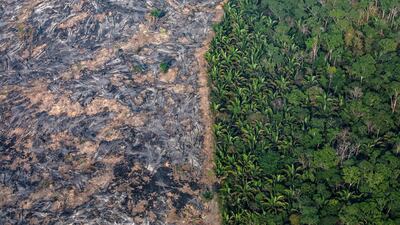
Amazon rainforest dieback – Large-scale dieback of the forest, via increased temperatures and drying, or direct deforestation, would amplify global warming. -

Permafrost loss – Thawing of carbon-rich soils, which releases greenhouse gas into the atmosphere. -

Atlantic meridional overturning circulation breakdown – An increased amount of freshwater in the Northern Atlantic disrupting the system of currents. -
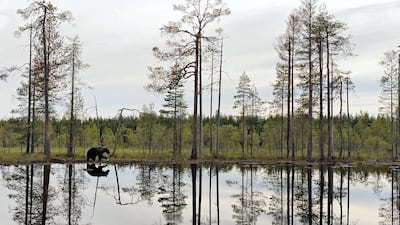
Boreal forest shift – Warming causes dieback in the south of the forests, and expansion into the tundra in the north, which would cause regional warming. -

West Antarctic ice sheet disintegration – The melting of major ice sheets would lead to significant increases in sea level. -
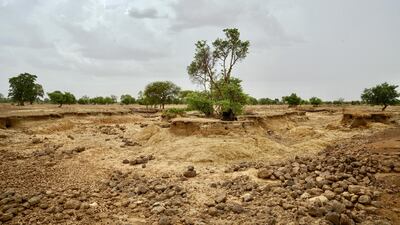
West African monsoon shift – A change in the monsoon season would lead to agricultural disruption and effect the ecosystem. -
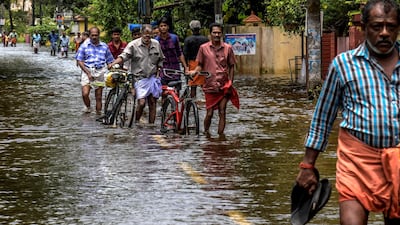
Indian monsoon shift – An increase in the planetary albedo (increases in the atmospheric brown cloud haze over India) has the capability of switching off the monsoon, which is crucial for the local economy, as well as being important for agriculture. -

Coral reef die-off – Exposure to increased sea temperatures can kill off reefs, which has a serious effect on ecosystems and local economies.



