


Global oil markets face tighter supply in the short term, validating the need to adopt transition strategies that deal with real-world scenarios, said Dr Sultan Al Jaber, the UAE's Minister of Industry and Advanced Technology.
Policymakers must not try to defund the current energy system, Dr Al Jaber told delegates at the Global Energy Forum in Dubai.
He said the world was seeing how sensitive energy markets are to geopolitical situations. However, at the base of the current volatility in oil prices is a deeper, underlying structural issue.
The long-term underinvestment into the oil and gas sector has left markets more exposed, said Dr Al Jaber, who is also managing director and group chief executive of Adnoc.
“We as energy leaders have a responsibility to inject a dose of realism into the planning for energy transition,” Dr Al Jaber said on Monday.
“Let’s invest in new and future energies but let’s not defund the current energy system … before a new one can take its place.”
The world at this stage needs a clear road map and policies that can “strengthen the stability of the energy market”.
________________________
Atlantic Council's Global Energy Forum in Dubai - in pictures
-

Suhail Al Mazrouei, the UAE's Minister of Energy and Infrastructure, with Opec Secretary General Mohammad Barkindo, centre, at the Atlantic Council's Global Energy Forum in Dubai. AFP -
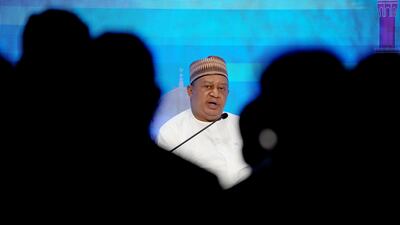
Mr Barkindo speaks the forum as part of a panel that emphasised the need for more investment in oil and gas, even as countries work to reduce emissions. AP -

The forum was held at Expo 2020 Dubai. AFP -
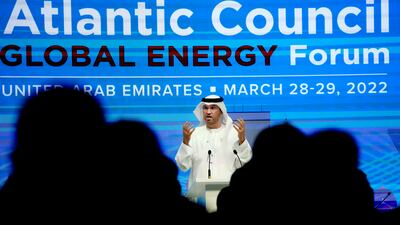
Dr Sultan Al Jaber speaking during the Atlantic Council's Global Energy Forum at Dubai Expo 2020. AP Photo -
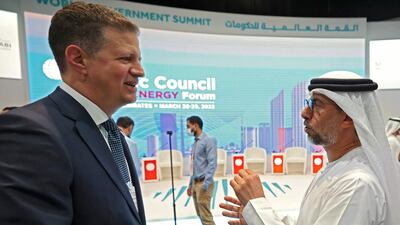
Mr Al Mazrouei talks to Crescent Petroleum chief executive Majid Jafar at the event. AFP -
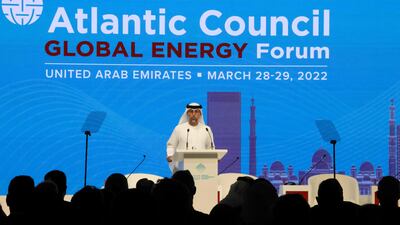
Mr Al Mazrouei has told the forum that the UAE will work within the framework of the Opec+ alliance to ensure the stability of the energy market. AFP


________________________
“If we take this approach we will reinforce our collective resilience, drive prosperity and deliver sustainable progress for all,” Dr Al Jaber said.
Demand for oil is up almost three million barrels per day over the last year and the market is tightening further as demand is expected to reach pre-pandemic levels by the fourth quarter of this year.
Divesting from energy resources that are driving the global economy will lead to a “systemic supply crunch that will erode economic growth".
“An unrealistic approach that ignores basic economics will lead to tighter markets that are even more exposed to geopolitical shocks,” Dr Al Jaber said.
“Put simply, we can’t, and must not unplug the current energy system before we have built a new one.”
Pressure on governments and industry for a greener economy and a drop in demand during the pandemic led to underinvestment into oil and gas infrastructure, restricting the ability of producers to increase capacity.
managing director and group chief executive, Adnoc
Total investment in the upstream sector of oil and gas fell 23 per cent below pre-coronavirus levels to $341 billion in 2021, while oil demand continued to rise globally amid robust economic recovery, according to an International Energy Agency (IEA) report.
Annual investment into oil and gas is $200bn below where it needs to be and that is just to keep up with demand through 2030, Dr Al Jaber said.
Prices of crude that shot up to just a notch under $140 per barrel amid Russia’s war in Ukraine are trading near $120, amid calls for oil producers to increase production. Last week, the IEA said its members were ready to release more oil into the market “if needed” to tackle soaring prices.
However, Dr Al Jaber said investments into the oil and gas sector are necessary for the longer-term security of energy markets and many countries around the world are realising this now.
“Others around the world including many of our friends in Europe and in the US are … starting to come to terms with these realities and are starting to accept those facts,” he said.
“The world is now pivoting policies to ensure that near-term energy security is not undermined by long-term goals. And they have now come to the same conclusion that we came to a while ago to hold back emissions, not progress.”

