


Europe's current imports of liquefied natural gas are sufficient to compensate for any shortfalls, should there be a stoppage in Russian supplies passing through Ukraine amid the geopolitical turmoil in eastern Europe, according to IHS Markit.
Volumes of Russian gas sent to Europe through Ukraine have already fallen significantly, reaching historic lows of 50 million cubic metres per day (cmpd) in January, less than half the levels from a year ago, IHS Markit said in a report.
While gas flows through Ukraine increased in February, they still remain 50 per cent less than the levels seen between 2015 and 2020. The EU depends on Russia for about a third of its gas supplies. Germany is the biggest buyer of Russian gas while Italy, Austria and Slovakia are most dependent on Ukraine transit gas, consultancy Wood Mackenzie has said.
“Europe is already experiencing a ‘quasi-curtailment’ of Russia gas flows,” said Michael Stoppard, chief strategist, global gas, at IHS Markit. “The result is a European gas import picture that is starkly different from a year ago. One where LNG imports have ramped up to fill the gap.”
European LNG regasification hit record levels last month, averaging 363 million cmpd between January 1 and January 19, growing 142 per cent year-on-year, research by S&P Global Platts found. The figure was also higher than the 351 million cmpd seen in November 2019, which was a record month for LNG regasification in Europe.
LNG imports to Europe increased to 34 per cent of total supply for the whole of January to reach 490 million cmpd, while Russian pipeline supply dropped to 17 per cent, the report said. LNG imports from the US rose to a record high of 245 million cmpd.
The trend is continuing this month, with LNG imports for the first three days of February averaging 605 million cmpd.
"Warmer temperatures in Asia prompted LNG traders to reroute cargoes to take advantage of higher prices in Europe, temporarily reducing European buyers’ requirements of Russian imports. That though has now reversed with the arrival of cold weather lifting Asian spot LNG prices," Wood Mackenzie said.
chief strategist, global gas, IHS Markit
Geopolitical tensions in eastern Europe are escalating rapidly, with fears of an imminent Russian invasion of Ukraine. Russia has amassed about 100,000 troops on the Ukrainian border, but insists it has no intention of invading the country. On Sunday, the US dispatched additional troops to Poland in a sign of support for its Nato allies.
-
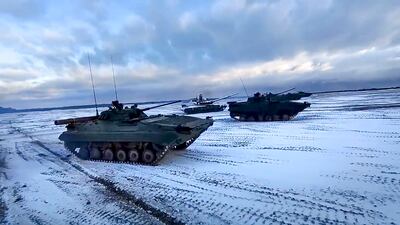
Russian and Belarus troops held joint combat training at firing ranges in Belarus as tensions remain high under the looming threat of war with Ukraine. AP Photo -

A soldier drives an armoured vehicle at Brestsky firing range, Belarus. AP Photo -
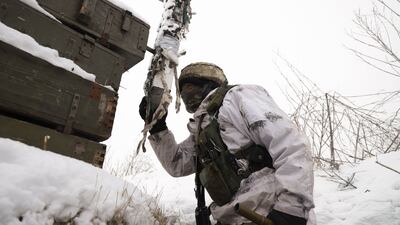
A Ukrainian serviceman carries out checks not far from the pro-Russian militant-controlled city of Donetsk, Ukraine. EPA -
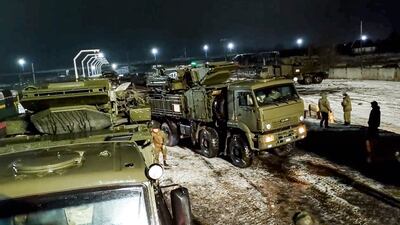
A Russian military vehicle drives off a railway platform after arriving in Belarus. AP Photo -
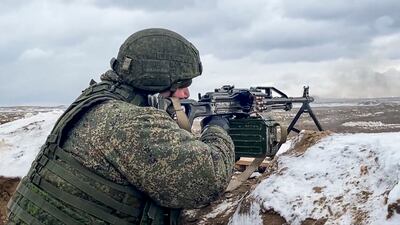
A soldier takes aim during a Russian and Belarusian military drill at Brestsky firing range. AP Photo -

A Ukrainian serviceman repairs a shelter near Donetsk, Ukraine. EPA -
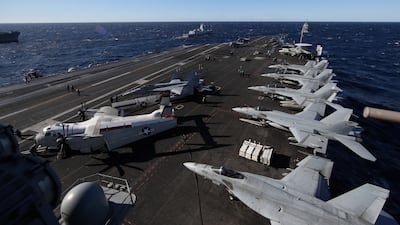
Aircraft are lined up on 'USS Harry S Truman' in the Adriatic Sea. The Truman strike group is operating under Nato command and control along with several other Nato allies for co-ordinated maritime manoeuvres, anti-submarine warfare training and long-range training. Reuters -
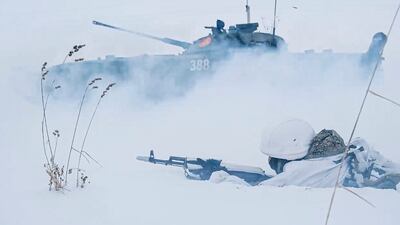
Russian soldiers attend the Yurginsky training ground in the Kemerovo region, Russia. AP Photo -
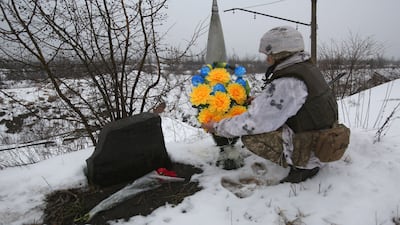
A Ukrainian serviceman lays flowers where one of his friends was killed in 2017 near Avdiivka. Anatolii Stepanov / AFP -

A Ukrainian serviceman stands guard in a dugout on the frontline with the Russia-backed separatists near Avdiivka. AFP -
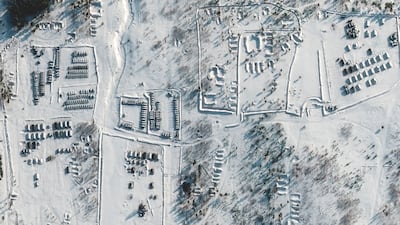
This satellite image shows troops gathered at a training ground in Pogonovo, Russia. AP Photo


While the stoppage of Russian pipeline flows through Ukraine will not present a threat to physical supplies, it would likely put further pressure on prices as LNG volumes are pulled away from other markets, the IHS report stated.
“So far, this is more of a price crisis than a physical supply crisis," said Shankari Srinivasan, vice president of IHS Markit. “While gas supply is sufficient to meet most market needs through the end of the winter heating season, high prices are already leading to closures of some industry and furloughing of workers in Europe.”
The report also cautioned that if Russian pipeline flows completely stopped through all routes going into Europe, it would create an "immediate supply deficit that LNG alone could not compensate for".
“Under an extreme, if highly unlikely, scenario where all Russian pipe flows were cut off, the tightness of global LNG supply and limited spare European LNG regasification capacity means that other supply levers would be needed to close the gap,” said Mr Stoppard.
“Extra coal and nuclear power generation capacity — either in the form of mothballed capacity being brought back online, resorting to strategic reserves or delayed plant closures — along with additional drawdowns of gas from storage would all be required.”
If there was a complete halt to all gas imports from Russia due to heightened tensions, it might "prove impossible to find alternative volumes to meet 28 per cent of annual demand" in Europe, Wood Mackenzie said.
"Were all gas flows to stop today, existing gas storage would run out in six weeks. Demand destruction would be massive and if disruption was prolonged, gas inventory couldn’t be rebuilt through the summer," the consultancy added.
"We’d be facing a catastrophic situation of close to zero gas in storage for next winter. This scenario highlights how dependent Europe has become on Russian gas and the critical role diplomacy and commercial sensibilities have to play to ensure supplies keep flowing."

