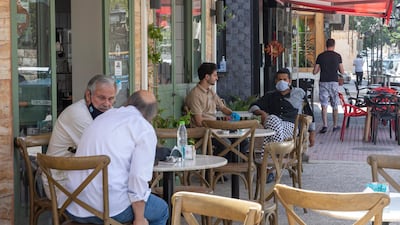
People sit at an Amman restaurant that reopened to the public on June 6 as Jordan lifted strict coronavirus restrictions after more than two months. Jordan raised $1.75 billion through a double tranche eurobond. EPA
People sit at an Amman restaurant that reopened to the public on June 6 as Jordan lifted strict coronavirus restrictions after more than two months. Jordan raised $1.75 billion through a double tranch

Jordan issues $1.75bn double tranche eurobond to boost finances amid Covid-19 pandemic


Fareed Rahman
  • English
  • Arabic

Jordan raised $1.75 billion (Dh6.42bn) from a double tranche eurobond at competitive rates to help the country cope with the economic fallout of the coronavirus pandemic.

A tranche of $500 million at 4.95 per cent over a 5-year maturity and another of $1.25bn at 5.85 per cent over a 10-year maturity, were oversubscribed more than 6.25 times after attracting bids worth over $6.25bn, the kingdom's ministry of finance said in a statement.

“The oversubscription and relatively low interest rate of Jordan’s eurobonds is a testament to its fiscal stability, as well as high confidence amongst the international community on Jordan’s positive economic trajectory particularly in light of its swift and decisive Covid response,” Jordan’s finance minister Mohammad Al Ississ said.

The government will use funds from the issuance to cover a $1.25bn eurobond maturing in October. It will also use some of the money raised to inject liquidity for the private sector by paying arrears accumulated by present and previous governments, Mr Al Ississ added. The arrears relate to money owed to hospitals, pharmaceuticals, energy, and contractors.

Jordan, whose economy relies heavily on foreign aid and grants, is projected to contract 3.7 per cent due to the impact of the pandemic, according to the International Monetary Fund. The government estimates the economy will shrink 3 per cent.

The kingdom was one of the first countries to close its airport in the Middle East and implemented a strict lockdown to prevent the spread of Covid-19. Jordan registered 1,132 Covid-19 infections to date and 9 deaths, according to the Johns Hopkins University, which is tracking the pandemic.

"Our decision to go to foreign markets was based on ensuring that we keep local financing within banks and other facilities available for the private sector at affordable rates, particularly in light of the liquidity crunch created by the coronavirus,” Mr Al Ississ said.

The finance ministry also said the rates were significantly lower than Jordan’s last eurobond issuance of 2017 and recent issuances by regional countries of similar ratings.

In May, Egypt issued a $2bn eurobond due 2050 at a yield of 8.875 per cent, $1.25bn in four-year notes at a yield of 5.75 per cent and $1.75bn in bonds due 2032 at 7.625 per cent. Bahrain also issued a 5-year and 10-year eurobond at 6.250 per cent and 7.375 per cent respectively.

In March, the IMF approved a $1.3bn four-year loan to the kingdom, which hosts more than a million refugees from Syria and other countries. The facility aims to help the country secure lower servicing costs for the $42bn in public debt that the country holds, which has spiralled in the last decade as a result of the spillover of regional conflicts on its economy.

In May, the IMF approved an additional $396m as part of a request for emergency financial assistance under the Rapid Financing Instrument to help cushion the impact of Covid-19 on the kingdom.

Mercer, the investment consulting arm of US services company Marsh & McLennan, expects its wealth division to at least double its assets under management (AUM) in the Middle East as wealth in the region continues to grow despite economic headwinds, a company official said.

Mercer Wealth, which globally has $160 billion in AUM, plans to boost its AUM in the region to $2-$3bn in the next 2-3 years from the present $1bn, said Yasir AbuShaban, a Dubai-based principal with Mercer Wealth.

Within the next two to three years, we are looking at reaching $2 to $3 billion as a conservative estimate and we do see an opportunity to do so,” said Mr AbuShaban.

Mercer does not directly make investments, but allocates clients’ money they have discretion to, to professional asset managers. They also provide advice to clients.

“We have buying power. We can negotiate on their (client’s) behalf with asset managers to provide them lower fees than they otherwise would have to get on their own,” he added.

Mercer Wealth’s clients include sovereign wealth funds, family offices, and insurance companies among others.

From its office in Dubai, Mercer also looks after Africa, India and Turkey, where they also see opportunity for growth.

Wealth creation in Middle East and Africa (MEA) grew 8.5 per cent to $8.1 trillion last year from $7.5tn in 2015, higher than last year’s global average of 6 per cent and the second-highest growth in a region after Asia-Pacific which grew 9.9 per cent, according to consultancy Boston Consulting Group (BCG). In the region, where wealth grew just 1.9 per cent in 2015 compared with 2014, a pickup in oil prices has helped in wealth generation.

BCG is forecasting MEA wealth will rise to $12tn by 2021, growing at an annual average of 8 per cent.

Drivers of wealth generation in the region will be split evenly between new wealth creation and growth of performance of existing assets, according to BCG.

Another general trend in the region is clients’ looking for a comprehensive approach to investing, according to Mr AbuShaban.

“Institutional investors or some of the families are seeing a slowdown in the available capital they have to invest and in that sense they are looking at optimizing the way they manage their portfolios and making sure they are not investing haphazardly and different parts of their investment are working together,” said Mr AbuShaban.

Some clients also have a higher appetite for risk, given the low interest-rate environment that does not provide enough yield for some institutional investors. These clients are keen to invest in illiquid assets, such as private equity and infrastructure.

“What we have seen is a desire for higher returns in what has been a low-return environment specifically in various fixed income or bonds,” he said.

“In this environment, we have seen a de facto increase in the risk that clients are taking in things like illiquid investments, private equity investments, infrastructure and private debt, those kind of investments were higher illiquidity results in incrementally higher returns.”

The Abu Dhabi Investment Authority, one of the largest sovereign wealth funds, said in its 2016 report that has gradually increased its exposure in direct private equity and private credit transactions, mainly in Asian markets and especially in China and India. The authority’s private equity department focused on structured equities owing to “their defensive characteristics.”

Ten tax points to be aware of in 2026

1. Domestic VAT refund amendments: request your refund within five years

If a business does not apply for the refund on time, they lose their credit.

2. E-invoicing in the UAE

Businesses should continue preparing for the implementation of e-invoicing in the UAE, with 2026 a preparation and transition period ahead of phased mandatory adoption. 

3. More tax audits

Tax authorities are increasingly using data already available across multiple filings to identify audit risks. 

4. More beneficial VAT and excise tax penalty regime

Tax disputes are expected to become more frequent and more structured, with clearer administrative objection and appeal processes. The UAE has adopted a new penalty regime for VAT and excise disputes, which now mirrors the penalty regime for corporate tax.

5. Greater emphasis on statutory audit

There is a greater need for the accuracy of financial statements. The International Financial Reporting Standards standards need to be strictly adhered to and, as a result, the quality of the audits will need to increase.

6. Further transfer pricing enforcement

Transfer pricing enforcement, which refers to the practice of establishing prices for internal transactions between related entities, is expected to broaden in scope. The UAE will shortly open the possibility to negotiate advance pricing agreements, or essentially rulings for transfer pricing purposes. 

7. Limited time periods for audits

Recent amendments also introduce a default five-year limitation period for tax audits and assessments, subject to specific statutory exceptions. While the standard audit and assessment period is five years, this may be extended to up to 15 years in cases involving fraud or tax evasion. 

8. Pillar 2 implementation 

Many multinational groups will begin to feel the practical effect of the Domestic Minimum Top-Up Tax (DMTT), the UAE's implementation of the OECD’s global minimum tax under Pillar 2. While the rules apply for financial years starting on or after January 1, 2025, it is 2026 that marks the transition to an operational phase.

9. Reduced compliance obligations for imported goods and services

Businesses that apply the reverse-charge mechanism for VAT purposes in the UAE may benefit from reduced compliance obligations. 

10. Substance and CbC reporting focus

Tax authorities are expected to continue strengthening the enforcement of economic substance and Country-by-Country (CbC) reporting frameworks. In the UAE, these regimes are increasingly being used as risk-assessment tools, providing tax authorities with a comprehensive view of multinational groups’ global footprints and enabling them to assess whether profits are aligned with real economic activity. 

Contributed by Thomas Vanhee and Hend Rashwan, Aurifer

Explainer: Tanween Design Programme

Non-profit arts studio Tashkeel launched this annual initiative with the intention of supporting budding designers in the UAE. This year, three talents were chosen from hundreds of applicants to be a part of the sixth creative development programme. These are architect Abdulla Al Mulla, interior designer Lana El Samman and graphic designer Yara Habib.

The trio have been guided by experts from the industry over the course of nine months, as they developed their own products that merge their unique styles with traditional elements of Emirati design. This includes laboratory sessions, experimental and collaborative practice, investigation of new business models and evaluation.

It is led by British contemporary design project specialist Helen Voce and mentor Kevin Badni, and offers participants access to experts from across the world, including the likes of UK designer Gareth Neal and multidisciplinary designer and entrepreneur, Sheikh Salem Al Qassimi.

The final pieces are being revealed in a worldwide limited-edition release on the first day of Downtown Designs at Dubai Design Week 2019. Tashkeel will be at stand E31 at the exhibition.

Lisa Ball-Lechgar, deputy director of Tashkeel, said: “The diversity and calibre of the applicants this year … is reflective of the dynamic change that the UAE art and design industry is witnessing, with young creators resolute in making their bold design ideas a reality.”

MATCH INFO

Jersey 147 (20 overs) 

UAE 112 (19.2 overs)

Jersey win by 35 runs

The five pillars of Islam
Timeline

2012-2015

The company offers payments/bribes to win key contracts in the Middle East

May 2017

The UK SFO officially opens investigation into Petrofac’s use of agents, corruption, and potential bribery to secure contracts

September 2021

Petrofac pleads guilty to seven counts of failing to prevent bribery under the UK Bribery Act

October 2021

Court fines Petrofac £77 million for bribery. Former executive receives a two-year suspended sentence 

December 2024

Petrofac enters into comprehensive restructuring to strengthen the financial position of the group

May 2025

The High Court of England and Wales approves the company’s restructuring plan

July 2025

The Court of Appeal issues a judgment challenging parts of the restructuring plan

August 2025

Petrofac issues a business update to execute the restructuring and confirms it will appeal the Court of Appeal decision

October 2025

Petrofac loses a major TenneT offshore wind contract worth €13 billion. Holding company files for administration in the UK. Petrofac delisted from the London Stock Exchange

November 2025

180 Petrofac employees laid off in the UAE

Key developments

All times UTC 4

Two products to make at home

Toilet cleaner

1 cup baking soda 

1 cup castile soap

10-20 drops of lemon essential oil (or another oil of your choice) 

Method:

1. Mix the baking soda and castile soap until you get a nice consistency.

2. Add the essential oil to the mix.

Air Freshener

100ml water 

5 drops of the essential oil of your choice (note: lavender is a nice one for this) 

Method:

1. Add water and oil to spray bottle to store.

2. Shake well before use. 

Indoor cricket in a nutshell

Indoor cricket in a nutshell
Indoor Cricket World Cup - Sept 16-20, Insportz, Dubai

16 Indoor cricket matches are 16 overs per side
8 There are eight players per team
9 There have been nine Indoor Cricket World Cups for men. Australia have won every one.
5 Five runs are deducted from the score when a wickets falls
4 Batsmen bat in pairs, facing four overs per partnership

Scoring In indoor cricket, runs are scored by way of both physical and bonus runs. Physical runs are scored by both batsmen completing a run from one crease to the other. Bonus runs are scored when the ball hits a net in different zones, but only when at least one physical run is score.

Zones

A Front net, behind the striker and wicketkeeper: 0 runs
B Side nets, between the striker and halfway down the pitch: 1 run
C Side nets between halfway and the bowlers end: 2 runs
D Back net: 4 runs on the bounce, 6 runs on the full

Name: Peter Dicce

Title: Assistant dean of students and director of athletics

Favourite sport: soccer

Favourite team: Bayern Munich

Favourite player: Franz Beckenbauer

Favourite activity in Abu Dhabi: scuba diving in the Northern Emirates 


Blackpink World Tour [Born Pink] In Cinemas

Starring: Rose, Jisoo, Jennie, Lisa

Directors: Min Geun, Oh Yoon-Dong

Rating: 3/5

Tamkeen's offering
  • Option 1: 70% in year 1, 50% in year 2, 30% in year 3
  • Option 2: 50% across three years
  • Option 3: 30% across five years 
Boulder shooting victims

• Denny Strong, 20
• Neven Stanisic, 23
• Rikki Olds, 25
• Tralona Bartkowiak, 49
• Suzanne Fountain, 59
• Teri Leiker, 51
• Eric Talley, 51
• Kevin Mahoney, 61
• Lynn Murray, 62
• Jody Waters, 65
