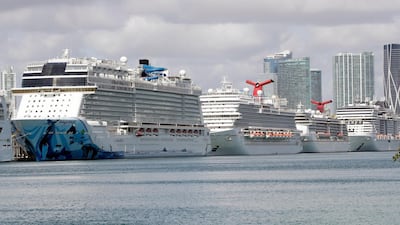
A line of cruise ships are docked at PortMiami in Miami in March this year. Cruise liners are preparing to set sail once more after being confined to docks during the coronavirus pandemic, but some passengers remain wary of their ability to maintain social distancing guidelines. AP Photo
A line of cruise ships are docked at PortMiami in Miami in March this year. Cruise liners are preparing to set sail once more after being confined to docks during the coronavirus pandemic, but some pa

Cruise companies prepare to set sail again but rough seas await


  • English
  • Arabic

Some cruise lines are hoping to set sail later this summer but with images of coronavirus-ravaged ships still fresh in many minds, the industry could face years of choppy water ahead.

The global cruise industry expected to carry 32 million passengers and take in $71 billion (Dh260.7bn) in revenue this year. That will fall by at least 50 per cent this year, says Euromonitor International, a consulting firm.

The industry took three years to recover from the 2009 recession; this time, it will take longer, Euromonitor analyst Alex Jarman said.

“Unlike the previous downturn, the pandemic has put the safety of cruises into question,” Jarman said.

Cruise lines stopped sailing in mid-March after several high-profile outbreaks at sea. More than 600 people fell ill aboard Carnival's Diamond Princess while it was quarantined off the coast of Japan, for example. Fourteen passengers died.

Christina Kerby was trapped aboard a Holland America cruise ship in February after several ports in Asia refused to allow it to dock.

“I will take a cruise again someday," said Kerby, of Alameda, California. "Just not anytime soon.”

Since they stopped sailing, Carnival, Royal Caribbean International and Norwegian Cruise Line – which control 75 per cent of the market – have furloughed thousands of staff and obtained billions of dollars in bank loans to stay afloat. Major cruise companies weren’t eligible for US government loans because they’re incorporated overseas.

Norwegian warned of a possible bankruptcy in early May, but then raised $2.2bn through a sale of stock and debt. It now says it can withstand a shutdown for as long as 18 months. Smaller operators could have more trouble, experts say. Virgin Voyages, a new cruise line owned by Richard Branson's Virgin Group, has twice postponed its first sailing. Virgin Australia – an airline in which Mr Branson holds a stake – filed for bankruptcy protection in April.

The US Centers for Disease Control has prohibited cruises in US waters until July 24. Operators in Europe and Asia could sail sooner; some German river cruises resumed last week. But most big cruise lines are using this time to refine their plans, upgrade their ships and figure out how to resume safely.

Norwegian says it’s installing medical-grade air filters on its ships and adding medical staff, for example. Carnival is raising the temperature in its washers and dryers to make sure napkins and sheets are fully sanitised.

Cruise companies are talking to US regulators, to foreign ports and to each other, said Brian Salerno, senior vice president for maritime policy at the Cruise Lines International Association, a trade group that represents 95 per cent of ocean cruise companies. That doesn’t always happen in the fiercely competitive business.

“A safety failure for one affects them all,” Mr Salerno said

Most cruise lines haven’t announced their exact plans for reopening, even though they’re accepting bookings. But some smaller companies are giving a glimpse into the future.

"People who know and love cruising will be back,"

Windstar Cruises, which operates six ships — the largest of which carries 342 passengers — hopes to resume cruises in Tahiti in September. Among other things, the company plans to stagger boarding times to keep passengers apart; expand dining times and space diners out; serve passengers instead of offering buffets; and require crew to wear masks and train them to recognize COVID-19 symptoms.

Windstar’s chief marketing officer Betsy O’Rourke said the company expects bookings for 2020 to start picking up soon. Bookings for 2021 are already ahead of where they were this time last year.

“People who know and love cruising will be back,” she said. “They have confidence in us to operate safely.”

But some cruise lovers say they’re just not ready.

Jonathan Adkins is a self-described “cruise junkie” who has been on more than 25 cruises. This year, he had booked a Caribbean cruise in March and a European cruise in July.

But the pandemic cooled his enthusiasm. Mr Adkins doesn’t want to share tight spaces until there’s a Covid-19 vaccine. And he thinks cruise companies have handled the crisis poorly.

“I’m not comfortable doing business with them for a while,” said Mr Adkins, who heads a traffic safety organisation in Washington. He doesn’t think he’ll cruise again until 2022.

Experts say getting new passengers interested in cruising could be even more daunting. Kishana Taylor, a postdoctoral fellow who studies the influenza virus, was already wary of cruise ships because of norovirus outbreaks. Cruising just doesn't make sense to her, she says, even though she loves the ocean.

Tara Smith, a professor of epidemiology at Kent State University, says she's not sure how cruises can protect passengers but still be fun. Pools and dance floors can't be too crowded, for example. Even if ships reduce capacity, droplets can spread between passengers. They could test passengers as they get on board, but they would need to get rapid and accurate results.

“It all seems like a logistical nightmare to me,” she said.

Robert Kwortnik, an associate professor at Cornell University who studies the cruise industry, thinks the industry will make some long-term changes to get back on its feet. Cruise companies will have to make health and safety a major part of their marketing, for example.

More liberal cancellation policies could also stick. Passengers used to lose their deposit if they canceled within a month of a cruise, he said. Now, companies are allowing them to cancel even two days before. That helps ensure people will cancel if they’re sick, he said.

For now, cruise lines are offering big discounts. Brian McLaren, who leads the cruise division for the Liberty Travel agency, said it’s common to see 20 per cent discounts, or $200 off per person. Mr McLaren said bookings for 2021 cruises are solid, partly because people with cruises this spring have been rebooking.

Joe Schreck of Jacksonville, Florida is doesn’t need convincing. As a workplace health and safety specialist, he says he’s seen how well social distancing guidelines can work, and he trusts cruise ships to take the right precautions.

“Life is too short to worry about stuff like this,” he said. “You have to enjoy the time you have.”

He’s booked on a cruise to the Bahamas in August.

Mercer, the investment consulting arm of US services company Marsh & McLennan, expects its wealth division to at least double its assets under management (AUM) in the Middle East as wealth in the region continues to grow despite economic headwinds, a company official said.

Mercer Wealth, which globally has $160 billion in AUM, plans to boost its AUM in the region to $2-$3bn in the next 2-3 years from the present $1bn, said Yasir AbuShaban, a Dubai-based principal with Mercer Wealth.

Within the next two to three years, we are looking at reaching $2 to $3 billion as a conservative estimate and we do see an opportunity to do so,” said Mr AbuShaban.

Mercer does not directly make investments, but allocates clients’ money they have discretion to, to professional asset managers. They also provide advice to clients.

“We have buying power. We can negotiate on their (client’s) behalf with asset managers to provide them lower fees than they otherwise would have to get on their own,” he added.

Mercer Wealth’s clients include sovereign wealth funds, family offices, and insurance companies among others.

From its office in Dubai, Mercer also looks after Africa, India and Turkey, where they also see opportunity for growth.

Wealth creation in Middle East and Africa (MEA) grew 8.5 per cent to $8.1 trillion last year from $7.5tn in 2015, higher than last year’s global average of 6 per cent and the second-highest growth in a region after Asia-Pacific which grew 9.9 per cent, according to consultancy Boston Consulting Group (BCG). In the region, where wealth grew just 1.9 per cent in 2015 compared with 2014, a pickup in oil prices has helped in wealth generation.

BCG is forecasting MEA wealth will rise to $12tn by 2021, growing at an annual average of 8 per cent.

Drivers of wealth generation in the region will be split evenly between new wealth creation and growth of performance of existing assets, according to BCG.

Another general trend in the region is clients’ looking for a comprehensive approach to investing, according to Mr AbuShaban.

“Institutional investors or some of the families are seeing a slowdown in the available capital they have to invest and in that sense they are looking at optimizing the way they manage their portfolios and making sure they are not investing haphazardly and different parts of their investment are working together,” said Mr AbuShaban.

Some clients also have a higher appetite for risk, given the low interest-rate environment that does not provide enough yield for some institutional investors. These clients are keen to invest in illiquid assets, such as private equity and infrastructure.

“What we have seen is a desire for higher returns in what has been a low-return environment specifically in various fixed income or bonds,” he said.

“In this environment, we have seen a de facto increase in the risk that clients are taking in things like illiquid investments, private equity investments, infrastructure and private debt, those kind of investments were higher illiquidity results in incrementally higher returns.”

The Abu Dhabi Investment Authority, one of the largest sovereign wealth funds, said in its 2016 report that has gradually increased its exposure in direct private equity and private credit transactions, mainly in Asian markets and especially in China and India. The authority’s private equity department focused on structured equities owing to “their defensive characteristics.”

Key facilities
  • Olympic-size swimming pool with a split bulkhead for multi-use configurations, including water polo and 50m/25m training lanes
  • Premier League-standard football pitch
  • 400m Olympic running track
  • NBA-spec basketball court with auditorium
  • 600-seat auditorium
  • Spaces for historical and cultural exploration
  • An elevated football field that doubles as a helipad
  • Specialist robotics and science laboratories
  • AR and VR-enabled learning centres
  • Disruption Lab and Research Centre for developing entrepreneurial skills
if you go

The flights
The closest international airport to the TMB trail is Geneva (just over an hour’s drive from the French ski town of Chamonix where most people start and end the walk). Direct flights from the UAE to Geneva are available with Etihad and Emirates from about Dh2,790 including taxes.

The trek
The Tour du Mont Blanc takes about 10 to 14 days to complete if walked in its entirety, but by using the services of a tour operator such as Raw Travel, a shorter “highlights” version allows you to complete the best of the route in a week, from Dh6,750 per person. The trails are blocked by snow from about late October to early May. Most people walk in July and August, but be warned that trails are often uncomfortably busy at this time and it can be very hot. The prime months are June and September.


What can you do?

Document everything immediately; including dates, times, locations and witnesses

Seek professional advice from a legal expert

You can report an incident to HR or an immediate supervisor

You can use the Ministry of Human Resources and Emiratisation’s dedicated hotline

In criminal cases, you can contact the police for additional support

THREE
%3Cp%3EDirector%3A%20Nayla%20Al%20Khaja%3C%2Fp%3E%0A%3Cp%3EStarring%3A%20Jefferson%20Hall%2C%20Faten%20Ahmed%2C%20Noura%20Alabed%2C%20Saud%20Alzarooni%3C%2Fp%3E%0A%3Cp%3ERating%3A%203.5%2F5%3C%2Fp%3E%0A

Our Time Has Come
Alyssa Ayres, Oxford University Press

COMPANY%20PROFILE
%3Cp%3E%3Cstrong%3EName%3A%20%3C%2Fstrong%3EElmawkaa%3Cbr%3E%3Cstrong%3EBased%3A%3C%2Fstrong%3E%20Hub71%2C%20Abu%20Dhabi%3Cbr%3E%3Cstrong%3EFounders%3A%3C%2Fstrong%3E%20Ebrahem%20Anwar%2C%20Mahmoud%20Habib%20and%20Mohamed%20Thabet%3Cbr%3E%3Cstrong%3ESector%3A%3C%2Fstrong%3E%20PropTech%3Cbr%3E%3Cstrong%3ETotal%20funding%3A%3C%2Fstrong%3E%20%24400%2C000%3Cbr%3E%3Cstrong%3EInvestors%3A%20%3C%2Fstrong%3E500%20Startups%2C%20Flat6Labs%20and%20angel%20investors%3Cbr%3E%3Cstrong%3ENumber%20of%20employees%3A%3C%2Fstrong%3E%2012%3Cbr%3E%3C%2Fp%3E%0A
The five pillars of Islam

1. Fasting 

2. Prayer 

3. Hajj 

4. Shahada 

5. Zakat 

Results

Ashraf Ghani 50.64 per cent

Abdullah Abdullah 39.52 per cent

Gulbuddin Hekmatyar 3.85 per cent

Rahmatullah Nabil 1.8 per cent

Wicked
Director: Jon M Chu
Stars: Cynthia Erivo, Ariana Grande, Jonathan Bailey
Rating: 4/5
Mina Cup winners

Under 12 – Minerva Academy

Under 14 – Unam Pumas

Under 16 – Fursan Hispania

Under 18 – Madenat

Cryopreservation: A timeline
  1. Keyhole surgery under general anaesthetic
  2. Ovarian tissue surgically removed
  3. Tissue processed in a high-tech facility
  4. Tissue re-implanted at a time of the patient’s choosing
  5. Full hormone production regained within 4-6 months
