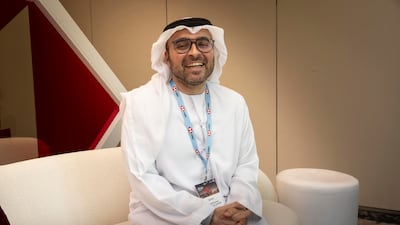

No planned foreign direct investment in the UAE has been cancelled this year, despite the uncertainties created by the US-Iran war, a senior government official has said.
The overall stock of FDI in the UAE this year might be fractionally lower than the record levels achieved in 2025, as global investors assess the impact of conflict in the region. However, the Emirates remains firmly on course to achieve its 2031 FDI targets, Mohammad Abdulrahman Alhawi, Undersecretary of the UAE Ministry of Investment, told The National in an interview on Tuesday.
“Everyone we've spoken to has said: 'We haven't cancelled our plans. We are just either waiting, or we're delaying a little bit, or we're decreasing the quantum a little bit but the country is capable of making up,'” Mr Alhawi said on the sidelines of the 10th HSBC Future Forum in Dubai.

“Very understandable [that] people will wait and see how the conflict is resolved.”
The good thing, Mr Alhawi said, is that even though the conflict been going on since late February, it has helped investors better understand the resilience of the UAE and the capabilities of its government in dealing with a crisis.
“I think that's the message that our investors have received over time and I think, maybe not immediately but in the next few years, that will definitely be a positive thing, as more investment is coming,” he said.
FDI into the UAE rose by about 6 per cent last year to a record $48.24 billion, the ninth highest total in the world, according to the UN Conference on Trade and Development (Unctad) data.
The Emirates was also the top recipient of FDI in the Middle East, ahead of Saudi Arabia, which ranked 13th, Unctad said in its World Investment Conference 2026 report released in July.
The UAE has maintained consistent FDI inflow momentum over the past few years and was expected to continue on the growth trajectory this year before the war-driven disruption to economy and trade.
Like its peers in the six-member economic bloc of the Gulf Co-operation Council and its Arab neighbours, the UAE has faced a wave of missile and drone attacks, but Mr Alhawi said it remains “100 per cent” on target to the achieve the $65 billion annual FDI targets by 2031.
“You'll have some years when it'll grow slightly less or slightly more,” he said. “But now that we've reached the $40 billion [plus] range, we expect to keep that for a couple more years before jumping to the next level, which is the $65 billion range, which is where we want to be.”
While various governments at the emirate level are incentivising investors to boost FDI inflows, the UAE federal government is focused on investing in its own economy.
Special attention is being paid to developing ports and related infrastructure on the East Coast, as well as improving and expanding rail connectivity, and oil and gas pipeline infrastructure.
“Now, that investment does two things: one, it shows our confidence in our economy, and two, it shows that we're building different routes and paths for our main value proposition, which is being a logistical hub,” Mr Alhawi said.
“We're investing in the right places, which means the investors that are already here can see the impact this will have and they will see it over the next year or so.”
Partnerships with investors
The UAE is more than capable of executing those projects on its own but it is seeking participation of foreign investors in these schemes to make them a part of the UAE growth story.
Mr Alhawi said the Ministry of Investment is bringing capital together and is in talks with investors over joint ventures. Options for global investors to team up with the UAE sovereign wealth funds, as well as family offices, are also open, he said.
“We're super open,” Mr Alhawi said. “I mean, we can build infrastructure ourselves if we want to, but building it with partners makes it makes it more efficient, makes it better, makes it more long term.
“We'd love to have partners wherever we can and we've seen actually quite an influx of people saying, ‘Oh, you're building infrastructure, so let's work with you’, which is great. A very positive sign.”
Infrastructure pipeline
Investment in infrastructure is among the central planks of the UAE’s economic diversification agenda and Mr Alhawi said the scale of investment required for East Coast projects is significant.
HSBC estimates the UAE project finance pipeline is in excess of $190 billion in funding to build the planned the infrastructure projects.
The UAE accounts for about 22 per cent of the broader Middle East, North Africa and Turkey region infrastructure project pipeline of $872 billion, data from HSBC's New Networks of Capital: Meant Infrastructure report indicates.
“The ultimate risk is the government, and here we are talking about the large-scale projects [such as] the Al Maktoum [International] Airport ... the Dubai sewage system ... and what is happening in Fujairah [projects],” Mohamed Al Marzooqi, chief executive of HSBC UAE told The National.
“So, these are the paymasters and I don't think we have even touched the surface, to be honest, when it comes to tapping into those financing solutions.”
The easiest solution, he said, would be to tap the loan market and financial institutions in the country. They are all “hungry for quality assets 100 per cent here in the UAE”.
HSBC, Mr Al Marzooqi said, is not only willing to leverage its own balance sheet, it can also help structure deals in many other ways for project owners and investors.

Opportunity knocks
The sheer size of the MENAT pipeline underpins the scale of the region’s medium and long-term investment potential despite geopolitical headwinds, HSBC said in the report released on Tuesday.
Even with a “complex global and regional operating environment”, international businesses and institutional investors expect the region to remain and infrastructure investment destination and flows of capital will continue over the rest of the decade, the lender said.
The HSBC-commissioned analysis of MEED data has identified the $872-billion pipeline of individual project packages within a wider $1.4 trillion planned and unawarded infrastructure pipeline.
The value of planned but unawarded infrastructure projects and programmes increased by 54 per cent between January 2023 and January 2026, from $792 billion to $1.22 trillion,” data shows
“Infrastructure planning activity has continued this year, with the pipeline increasing a further 15 per cent to $1.4tn between January and October 2026,” the HSBC report said.

