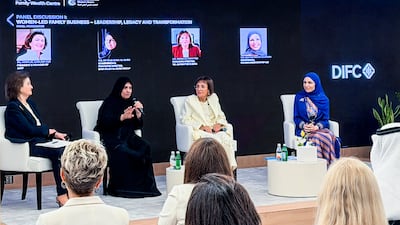

Gulf family businesses are entering a period of generational transition that could give women a bigger role in ownership, investment and executive decision-making, experts have said.
The question facing family enterprises is no longer simply who will lead them next, but “who will receive the preparation, responsibility and trust to lead them forward”, Abdullah Jefri, division director for the Gulf at the International Finance Corporation, the World Bank's private investment arm, said at an event in Dubai on Monday.
“Across the GCC [Gulf Co-operation Council], a new generation of highly educated women is ready to lead and many are already doing so with distinction,” Mr Jefri said.
He said women play important roles in family enterprises but the opportunity was to broaden those positions to include leading business units, guiding investment decisions and serving on family councils and boards.
“For family enterprises, women's leadership is not only a matter of inclusion, it is a matter of competitiveness, continuity and legacy,” he said.
Mr Jefri highlighted the UAE’s efforts to advance women’s economic empowerment, including its Gender Balance Centre for Excellence and Knowledge Exchange, established with the World Bank in 2022.
But barriers remain. Women remain underrepresented on corporate boards across the Gulf. A 2026 GCC Board Gender Index found that women held 7 per cent of board seats at listed companies across the region, although the UAE led with 15 per cent.
AI in family businesses
Speaking at the same event, Haifa Al Kaylani, founder and president of the Arab International Women’s Forum, said women were bringing new perspectives to leadership, governance and intergenerational stewardship, including greater attention to innovation, sustainability and talent development.
She said the ability of family businesses to remain competitive in a global economy increasingly shaped by artificial intelligence would depend on women participating as owners, investors, innovators, successors and executives.
Discussions also highlighted how technology is changing the way family businesses operate.
Raja Al Gurg, chairperson of the Easa Saleh Al Gurg Group, said the company was deploying AI agents across the business, including for a sales co-ordination system that allows employees to obtain immediate reports and information without relying on individual staff members. An AI-enabled human resources system is also being used to answer employees’ questions about company policies and procedures.
The company is prioritising AI applications that can demonstrate measurable value through higher revenue, improved cash conversion, lower costs or greater efficiency, Ms Al Gurg said.

