


The International Monetary Fund has raised its global economic growth forecast for this year on milder-than-expected tariff increases and private sector resilience to tariff pressures.
With fragilities and risks abounding, the weaker US dollar has both amplified the tariff shock and supported global trade, the Washington-based multilateral lender said in its latest World Economic Outlook report on Tuesday.
The fund said it expects global output to grow by 3.2 per cent in 2025 – up from its July forecast of 3 per cent – and 3.1 per cent in 2026, unchanged from its previous estimate.
Global headline inflation is forecast to dip to 4.2 per cent this year and 3.7 per cent in 2026, almost unchanged since the previous forecast.
The IMF increased its forecast for economic growth the in the US, the world's biggest economy, while it kept growth projections for China unchanged.
Economic forecasts for the Middle East were revised slightly higher, driven by growth in Saudi Arabia, the region's biggest economy.
'Steady but fragile'
Although the global economy has remained steady so far in the face of Trump administration's push to levy tariffs on its trading partners, a new degree of uncertainty now prevails in trade patterns.
“The global outlook as we see it is steady but fragile,” IMF chief economist Pierre-Olivier Gourinchas told reporters.
The latest report is the second straight upgrade in which the fund has raised its forecast for the global economy after President Donald Trump's tariff announcement in April.
IMF chief economist
Still, should the forecasts hold up, it would mark a decline from last year's annual growth rate of 3.3 per cent and remain below the pre-pandemic average of 3.7 per cent.
“Bottom line: not as bad as we feared, but worse than we anticipated a year ago, and worse than we need,” Mr Gourinchas said.
Minor upgrade for US
The IMF said it projects the US economy to grow at a 2.0 per cent rate in 2025 and 2.1 per cent in 2026. The upwards revision reflects lower tariff rates, a fiscal boost from the passage of the One Big Beautiful Bill Act, and easing of financial conditions, although the fund said it still represents a significant slowdown from 2024.
The US economy has so far remained resilient to tariff-driven higher prices that are expected to filter through the economy, posting GDP growth of 3.8 per cent in the second quarter following an import-driven contraction in the first quarter.
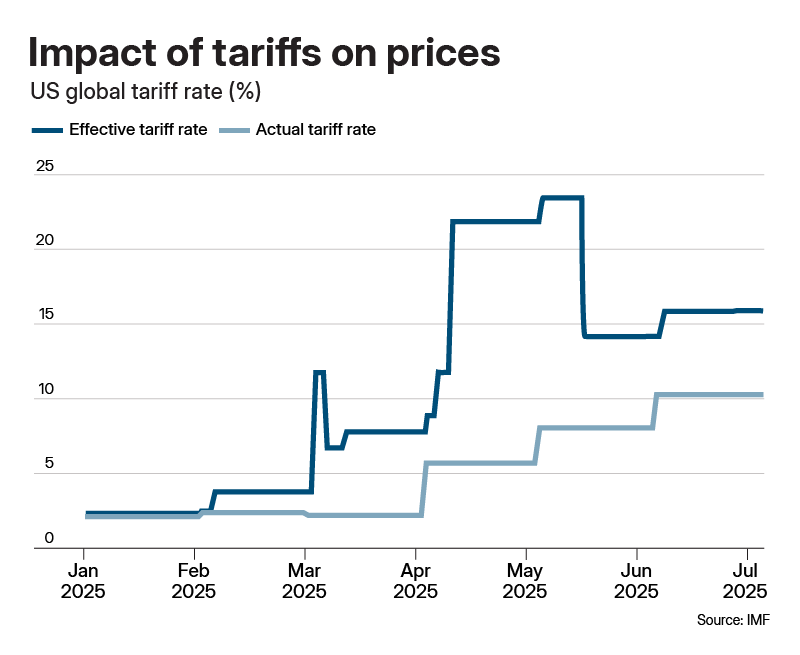
The IMF anticipates inflation to pick up in the US in the second half this year as higher prices are passed on to consumers.
Saudi Arabia drives Mena outlook
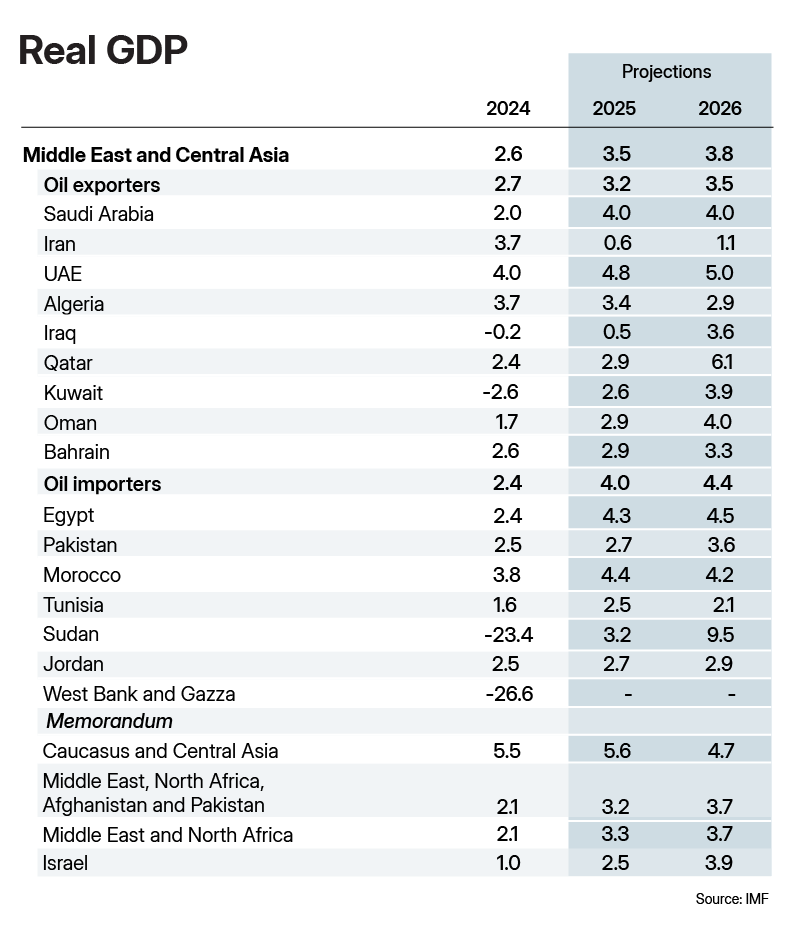
The fund slightly raised its forecast for the Middle East and North Africa, which is projected to grow 3.3 per cent rate in 2025 and 3.7 per cent in 2026, up 0.1 and 0.3 percentage points from July estimates, respectively.
The revision was driven by growth in Saudi Arabia, the Arab world's largest economy, which is forecast to grow at a 4 per cent pace this year and next, up 0.4 and 0.1 percentage points, respectively, because of Opec+'s unwinding of voluntary oil production cuts.
The regional forecast is also expected to benefit from stronger-than-expected first-half economic performance in Egypt, the most populous Arab nation.
Despite the Middle East's limited exposure to new US tariffs, the IMF's growth projections are cumulatively 0.8 percentage points lower this year and the next due to the indirect effects of weaker world demand on commodity prices, it said.
The UAE economy is expected to grow by 4.8 per cent in 2025 and 5 per cent in 2026, unchanged from the projects during the fund's mission to the Emirates earlier this month.
The fund will release its full outlook for the Middle East next week in Dubai.
Euro area and India
The surge of investment in artificial intelligence, fiscal policy in the euro area and China have also helped support the global economy this year despite shifting trade patterns and economic headwinds.
India, where a 50 per cent tariff rate imposed by the US came into effect in August, is expected to record growth of 6.6 per cent this year due to a strong first quarter, offsetting the tariffs' impact.
Growth in the euro area is estimated at 1.2 per cent in 2025 and 1.1 per cent in 2026, a decrease from the fund's 2024 forecast, due to higher tariffs and elevated uncertainty only marginally offset by strong private consumption in Germany and robust economic performance in Ireland.
The UK, the second-largest economy in Europe, is expected to grow by 1.3 per cent each in 2025 and 2026.
Tariff uncertainty
Despite the revised outlook, Mr Gourinchas said it would be “premature” to assume there have not been any effects from the tariff shock.
“There is trade policy uncertainty that remains. The deals are not all sealed. There could still be tensions,” Mr Gourinchas said.
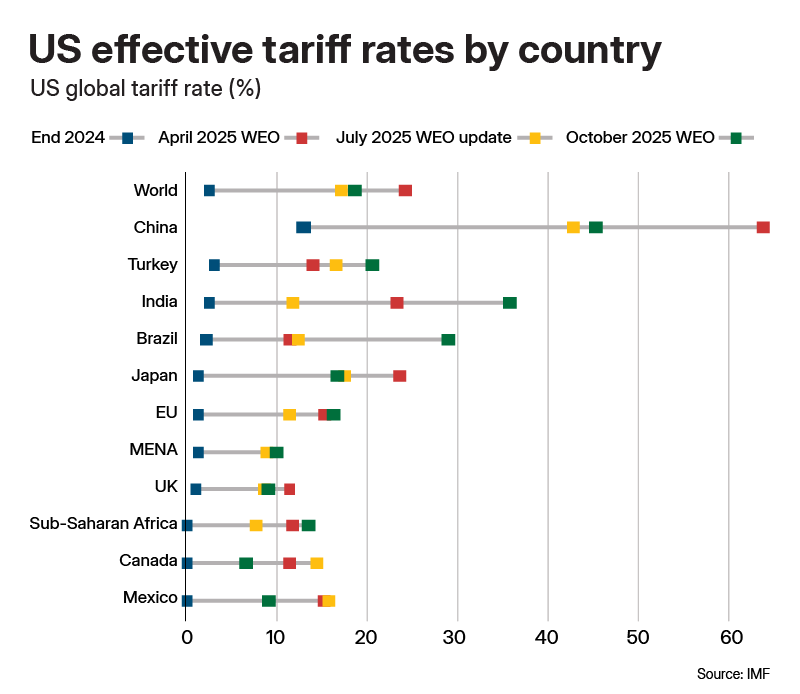
This week's meetings began under fresh trade threats between the US and China. Beijing last week announced new export restrictions on critical minerals, prompting a furious Mr Trump to announce a new 100 per cent tariff on China. US markets rebounded on Monday after a sell-off no Friday after Mr Trump softened his rhetoric over the weekend.
The developments added another wrinkle to negotiations between the US and China, which had previously agreed to lower their high tariff rates set on each other earlier this year. Mr Trump also cast doubt over whether he would meet Chinese President Xi Jinping this month.
"The most recent announcements last week make us realise that trade uncertainty is still with us," Mr Gourinchas said.
And while the US has announced trade deals with the UK, Japan, the EU and others, Mr Trump has yet to close deals with Canada and Mexico – the two largest US trade partners.
AI warning
The IMF on Tuesday also delivered a warning on artificial intelligence, whose promised productivity gains have pushed US markets to record-highs this year.
US private investment grew to $109.1 billion in 2024, according to data from Stanford University. And AI start-ups in the first half of this year raised $104.3 billion in the US, almost matching the total investment for 2024, PitchBook data showed.
The fund noted risks to the AI boom, arguing that there could be a market correction if AI hype is not justified, and that the investment surge could add to price pressures in the US.
“If the AI investment boom is not all hype … some of this will translate in productivity gains that would be good for the global economy,” Mr Gourinchas said.
Should trade tensions be resolved and AI hype does pan out, global output could increase by up to 1 percentage point, he added.
Central bank independence
The fund also made a call for the protection of central bank independence, as Mr Trump continues to seek greater control over the Federal Reserve.
While not naming the Fed in its report, the fund said protecting central bank independence is critical for economic stability, warning that losing such credibility could lead to higher interest rates and tighter monetary policy.
Mr Trump has made consistent efforts this year to reshape the Fed to his liking that includes a legal battle over his attempt to oust a sitting Federal Reserve governor.
The US President has repeatedly pressured the Fed to dramatically lower rates this year to help service the nation's debt – a concept known as fiscal dominance. The Fed has so far defied those calls.
“Seeking to influence the central bank to keep policy rates low or tolerating surprise inflation may appear to ease the near-term fiscal arithmetic, but it is eventually self-defeating,” the fund said.

