A rendering of the Ras Al Hekma development plans. Photo: Egyptian Ministry of Housing

UAE's $35bn investment to develop Ras Al Hekma provides lifeline for Egypt's economy


Kamal Tabikha
  • English
  • Arabic

A deal between Egypt and the UAE to develop the coastal city of Ras Al Hekma, under which Cairo will receive $35 billion, will provide a big boost to the country's economy, analysts say.

The deal, signed between Egypt’s government and the Abu Dhabi Developments Holding Company (ADQ) on Friday, comes as the North African country continues to struggle with a foreign exchange crunch.

In turn, this has brought much of its import-reliant industries to a grinding halt and raised the cost of living to unprecedented heights.

A total of $150 billion will be invested to develop Ras Al Hekma into a “fully functional urban community and not just a beach resort”, Egyptian Prime Minister Mostafa Madbouly said.

He did not specify when the project would be completed.

An ADQ-led consortium acquired the rights to develop 130 million square metres along Egypt’s north coast from the Egyptian government, in exchange for $24 billion, the company said.

Additionally, $11 billion of Emirati deposits in Egypt’s central bank would be relinquished to allow “for investment in prime projects across Egypt to support its economic growth and development”, said ADQ.

Egypt’s government will keep a 35 per cent stake in the development, work on which will start in early 2025, ADQ said.

“This deal is huge for Egypt, especially when coupled with the expected agreement with the IMF [International Monetary Fund] that will undoubtedly be facilitated by this agreement,” Monica Malik, chief economist at Abu Dhabi Commercial Bank, told The National.

The first tranche of the investment, amounting to $10 billion, will be deposited into Egypt’s central bank within a week of Friday, Mr Madbouly said, adding that the second tranche of $14 billion will be deposited within two months.

The sheer size of the investment – the largest in Egypt’s history – is expected to narrow the gap between the Egyptian pound’s official exchange rate, 31 pounds to the dollar, and the rate on the country’s parallel markets, which went up to 72 pounds in late January.

Unifying the exchange rate was a key request from the IMF, which is currently in discussions with Egypt for another round of funding, the country’s fourth since 2016.

Following a failure by Egypt’s banks and other financial institutions to secure dollars needed for imports, companies have since 2022 increasingly turned to the black market for foreign currency, which resulted in the sharp rise in the parallel exchange rate.

“The cash deposits really are substantial and the largest in the country’s history. Previously, the largest direct investment that Egypt had received was in the financial year 2007/2008 and it was a sum of around $13 billion,” said Ahmed Ghoneim, a professor of economics at Cairo University.

“So, it is safe to say that they will give the country some breathing room for two or three years.”

The timing of the deposits is particularly fortuitous, as it will probably result in a drop in the price of food items ahead of the holy month of Ramadan, which is set to begin around March 10, said Mr Ghoneim.

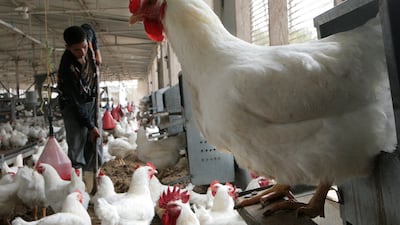
  • An Egyptian worker cleans a chicken farm near Jamasa city, 170km north of Cairo. AFP
    An Egyptian worker cleans a chicken farm near Jamasa city, 170km north of Cairo. AFP
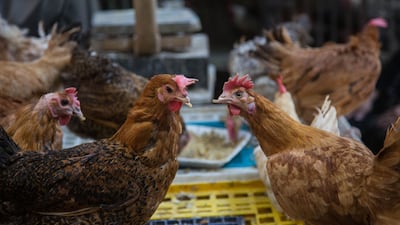
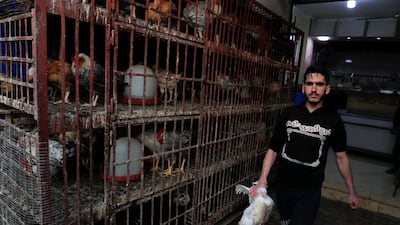
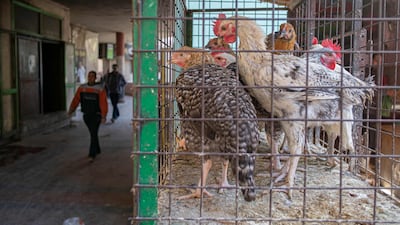
  • Live chickens for sale in Cairo. Their price has risen sharply in line with global food inflation. Bloomberg
    Live chickens for sale in Cairo. Their price has risen sharply in line with global food inflation. Bloomberg
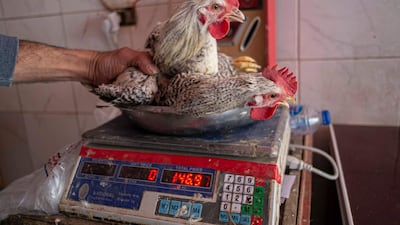
  • A vendor weighs a chicken at a shop in the Egyptian capital. AFP
    A vendor weighs a chicken at a shop in the Egyptian capital. AFP
  • This chicken might prove too expensive for many Egyptians to buy. AFP
    This chicken might prove too expensive for many Egyptians to buy. AFP
  • Livestock reared in Al-Arish city. Reuters
    Livestock reared in Al-Arish city. Reuters
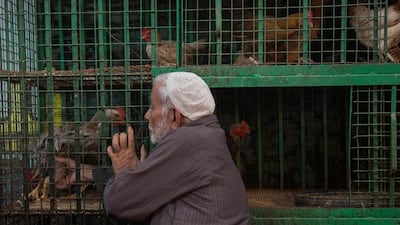
  • The market is hardly thriving since prices have soared. AFP
    The market is hardly thriving since prices have soared. AFP
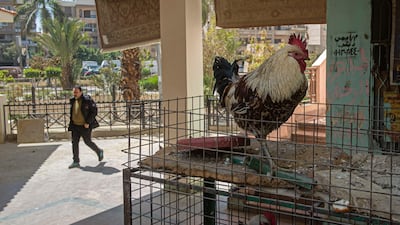
  • A vendor fetches a live chicken from a cage in the Nasr city district of Cairo. Bloomberg
    A vendor fetches a live chicken from a cage in the Nasr city district of Cairo. Bloomberg

Ramadan is typically marked by high consumption among Egypt's Muslim majority.

“One immediate benefit of the deposits will be that imports will be cleared much more easily, which will result in an immediate drop in food prices, especially ones sold under government welfare initiatives. This is particularly important as the population gears for Ramadan when their consumption increases,” Mr Ghoneim told The National.

“I will say that the drop will be random in the first few weeks, which is what we are seeing now. Markets are really unstable at the moment because they were preparing for different scenarios and mind you, the deposit has not even been made yet. Once it is secured, food prices will inevitably come down.”

Currency stability

The investments will also cushion the blow of an imminent devaluation of the Egyptian pound, another key request from the IMF, analysts said.

“The timing and amount is essential as Egypt will need significant FX liquidity ahead of an EGP devaluation. Unifying the EGP official rate with the parallel market rate will likely be a key component of the IMF deal and economic rebalancing,” Ms Malik said.

There had been fears that a devaluation at a time when the country’s foreign reserves were low would further increase the parallel exchange rate, however, those have largely abated in light of the Emirati investments.

A black market currency trader told The National that the exchange rate fell from 65 pounds to the dollar on Friday to 49 on Sunday. He attributes this to the Ras Al Hekma deal, in addition to an continuing state crackdown on dollar transactions outside official channels.

Over the past month, dozens of currency traders have been arrested for “illegal transactions”, according to the Egyptian Interior Ministry.

Additionally, hundreds of social media posts from members of the public allege that police stopped and searched them outside banks all over the country, immediately after they had withdrawn cash from dollar accounts.

The cash was confiscated and some account holders were imprisoned under charges of illegally trading foreign currency, according to the posts.

Reforms remain key

While the latest deal will support Egypt's economy, experts have cautioned that debt payments this year, at just over $32 billion, will eat a large chunk of the investment.

Mr Ghoneim advises the Egyptian government to restructure its economy to prioritise productive enterprises that generate foreign currency, as well as reducing its industries’ heavy reliance on imported components by manufacturing more of them locally.

“Without serious reform, we will be back in the same place in two or three years and it will all have been for nothing,” he said.

“No more construction, no more roads – the road network is quite impressive as it is. The focus needs to be on productive enterprises.”


What is Reform?

Reform is a right-wing, populist party led by Nigel Farage, a former MEP who won a seat in the House of Commons last year at his eighth attempt and a prominent figure in the campaign for the UK to leave the European Union.

It was founded in 2018 and originally called the Brexit Party.

Many of its members previously belonged to UKIP or the mainstream Conservatives.

After Brexit took place, the party focused on the reformation of British democracy.

Former Tory deputy chairman Lee Anderson became its first MP after defecting in March 2024.

The party gained support from Elon Musk, and had hoped the tech billionaire would make a £100m donation. However, Mr Musk changed his mind and called for Mr Farage to step down as leader in a row involving the US tycoon's support for far-right figurehead Tommy Robinson who is in prison for contempt of court.

Mercer, the investment consulting arm of US services company Marsh & McLennan, expects its wealth division to at least double its assets under management (AUM) in the Middle East as wealth in the region continues to grow despite economic headwinds, a company official said.

Mercer Wealth, which globally has $160 billion in AUM, plans to boost its AUM in the region to $2-$3bn in the next 2-3 years from the present $1bn, said Yasir AbuShaban, a Dubai-based principal with Mercer Wealth.

Within the next two to three years, we are looking at reaching $2 to $3 billion as a conservative estimate and we do see an opportunity to do so,” said Mr AbuShaban.

Mercer does not directly make investments, but allocates clients’ money they have discretion to, to professional asset managers. They also provide advice to clients.

“We have buying power. We can negotiate on their (client’s) behalf with asset managers to provide them lower fees than they otherwise would have to get on their own,” he added.

Mercer Wealth’s clients include sovereign wealth funds, family offices, and insurance companies among others.

From its office in Dubai, Mercer also looks after Africa, India and Turkey, where they also see opportunity for growth.

Wealth creation in Middle East and Africa (MEA) grew 8.5 per cent to $8.1 trillion last year from $7.5tn in 2015, higher than last year’s global average of 6 per cent and the second-highest growth in a region after Asia-Pacific which grew 9.9 per cent, according to consultancy Boston Consulting Group (BCG). In the region, where wealth grew just 1.9 per cent in 2015 compared with 2014, a pickup in oil prices has helped in wealth generation.

BCG is forecasting MEA wealth will rise to $12tn by 2021, growing at an annual average of 8 per cent.

Drivers of wealth generation in the region will be split evenly between new wealth creation and growth of performance of existing assets, according to BCG.

Another general trend in the region is clients’ looking for a comprehensive approach to investing, according to Mr AbuShaban.

“Institutional investors or some of the families are seeing a slowdown in the available capital they have to invest and in that sense they are looking at optimizing the way they manage their portfolios and making sure they are not investing haphazardly and different parts of their investment are working together,” said Mr AbuShaban.

Some clients also have a higher appetite for risk, given the low interest-rate environment that does not provide enough yield for some institutional investors. These clients are keen to invest in illiquid assets, such as private equity and infrastructure.

“What we have seen is a desire for higher returns in what has been a low-return environment specifically in various fixed income or bonds,” he said.

“In this environment, we have seen a de facto increase in the risk that clients are taking in things like illiquid investments, private equity investments, infrastructure and private debt, those kind of investments were higher illiquidity results in incrementally higher returns.”

The Abu Dhabi Investment Authority, one of the largest sovereign wealth funds, said in its 2016 report that has gradually increased its exposure in direct private equity and private credit transactions, mainly in Asian markets and especially in China and India. The authority’s private equity department focused on structured equities owing to “their defensive characteristics.”

Five expert hiking tips
    Always check the weather forecast before setting off Make sure you have plenty of water Set off early to avoid sudden weather changes in the afternoon Wear appropriate clothing and footwear Take your litter home with you
Western Region Asia Cup T20 Qualifier

Sun Feb 23 – Thu Feb 27, Al Amerat, Oman

The two finalists advance to the Asia qualifier in Malaysia in August


Group A

Bahrain, Maldives, Oman, Qatar

Group B

UAE, Iran, Kuwait, Saudi Arabia


UAE group fixtures

Sunday Feb 23, 9.30am, v Iran

Monday Feb 25, 1pm, v Kuwait

Tuesday Feb 26, 9.30am, v Saudi


UAE squad

Ahmed Raza, Rohan Mustafa, Alishan Sharafu, Ansh Tandon, Vriitya Aravind, Junaid Siddique, Waheed Ahmed, Karthik Meiyappan, Basil Hameed, Mohammed Usman, Mohammed Ayaz, Zahoor Khan, Chirag Suri, Sultan Ahmed

BACK%20TO%20ALEXANDRIA
%3Cp%3E%3Cstrong%3EDirector%3A%20%3C%2Fstrong%3ETamer%20Ruggli%3C%2Fp%3E%0A%3Cp%3E%3Cstrong%3EStarring%3A%20%3C%2Fstrong%3ENadine%20Labaki%2C%20Fanny%20Ardant%3C%2Fp%3E%0A%3Cp%3E%3Cstrong%3ERating%3A%20%3C%2Fstrong%3E3.5%2F5%3C%2Fp%3E%0A

THE SPECS

Touareg Highline

Engine: 3.0-litre, V6

Transmission: 8-speed automatic

Power: 340hp

Torque: 450Nm

Price: Dh239,312

THE SPECS


Engine: 1.5-litre


Transmission: 6-speed automatic


Power: 110 horsepower 


Torque: 147Nm 


Price: From Dh59,700 


On sale: now  

 
Updated: February 27, 2024, 1:59 PM