

Israel is no stranger to armed conflicts and full-scale wars.
However, unlike the previous conflicts, the war in Gaza is expected to take a heavy toll on the country’s economy, in the short and long term, according to economists and analysts.
A further escalation of the conflict could result in a downgrade of Israel’s sovereign debt rating, global credit rating agencies such as Fitch Ratings, Moody’s Investors Services and S&P have warned in recent days.
S&P has already lowered Israel’s credit outlook to negative, from stable, citing the risk that the conflict could broaden, with a more pronounced effect on the economy.
“The negative outlook reflects the risk that the … war could spread more widely or affect Israel’s credit metrics more negatively than we expect,” the rating agency said in a note.
Last month, Moody's placed the government of Israel's “A1" long-term foreign currency and local currency issuer ratings on review for downgrade. Previously, the outlook was stable.
It expects that a prolonged conflict waged on several fronts will have a severe and lasting impact on Israel’s economy.
“While a short-lived conflict could still have credit impact, the longer lasting and more severe the military conflict, the greater its impact is likely to be on policy effectiveness, public finances and the economy,” the rating agency said in a recent report.
Meanwhile, Fitch has warned that a major escalation could result in a negative rating action.
“This [the current war] could take the form of a wider and longer conflict, resulting in a sustained fiscal drain, both from higher spending and lower tax collection, as well as loss of human and material capital and severe economic disruption,” it said.
The war began on October 7, when Hamas operatives attacked southern Israel, killing about 1,400 people and taking more than 200 hostages.
Israel retaliated with air strikes and a total siege of the enclave, with the Palestinian death toll currently at about 9,500.
-
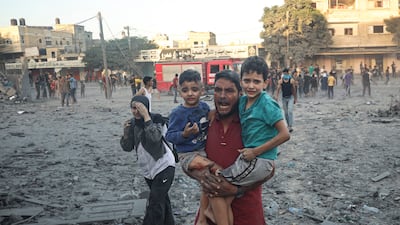
Palestinians cry as they walk away after an area hit by Israeli missiles in Rafah, the Gaza Strip. AP -
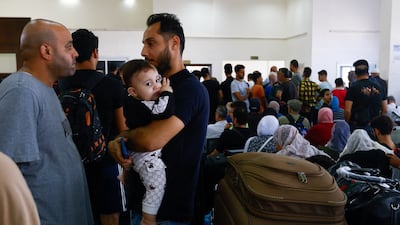
Palestinians with foreign passports wait for permission to leave Gaza at the Rafah border crossing with Egypt. Reuters -
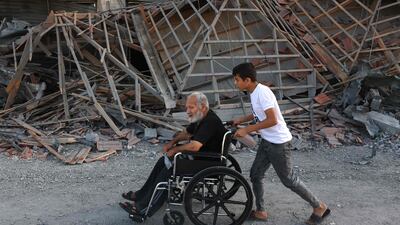
A Palestinian boy pushes a man on a wheelchair past debris in Rafah. AFP -

A paramedic holds an injured bird as he searches through buildings destroyed during Israeli air raids in Khan Younis, in the southern Gaza Strip. Getty Images -

Israeli soldiers take part in ground operations at a location given as Gaza. Reuters -
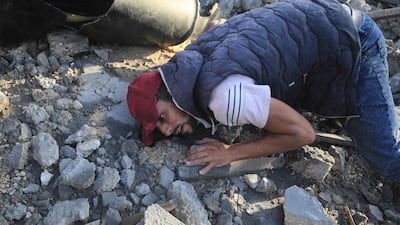
A man listens for any potential sounds of life following an Israeli air strike on the Maghazi refugee camp in Gaza. AFP -
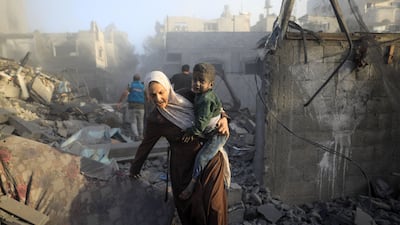
People flee after Israeli air strikes on the Maghazi refugee camp. AFP -

An Israeli soldier arranges artillery shells near the border with the Gaza Strip. AFP -

Relatives and friends of those kidnapped during the October 7 Hamas attack hold photos of their loved ones during a protest calling for their return outside Israel's parliament. AP -
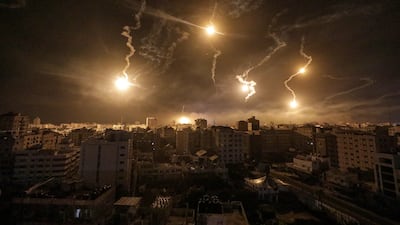
Israeli flares illuminate the sky over west Gaza in the northern Gaza Strip. EPA -
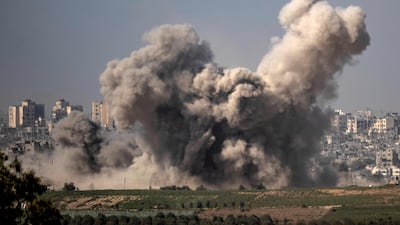
Smoke rises from northern Gaza after Israeli pounded the besieged enclave. AFP -

Ambulances queue at the Rafah border as they wait to cross into Gaza to transport the injured back to Egypt for treatment. Getty Images -

Women cry as one of them holds an injured toddler outside Shuhada Al Aqsa hospital after an Israeli bombardment of Deir Balah, in the central Gaza Strip. AFP -
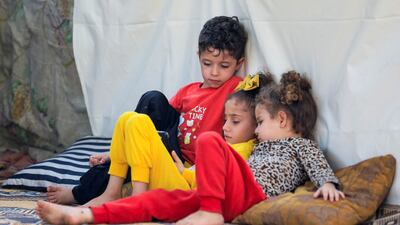
Displaced Palestinian children sit in a makeshift shelter at Al Shifa hospital, amid the Israel-Gaza war. Reuters -
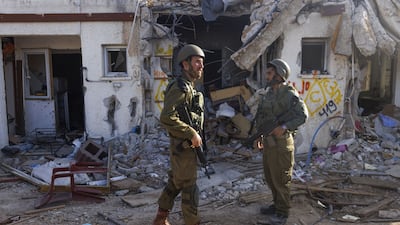
Israeli soldiers patrol outside a house destroyed during fighting with Hamas militants, in the kibbutz of Kfar Aza. Bloomberg -

Palestinians from Bureij refugee camp use Salah Al Din street as they flee the southern Gaza Strip. AP -
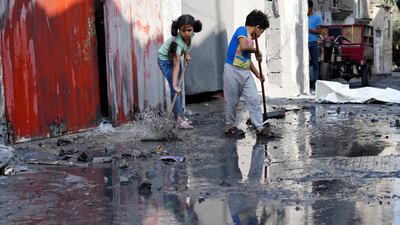
Palestinian children clean up outside their home after Israel struck Maghazi refugee camp in the Gaza Strip. AP -
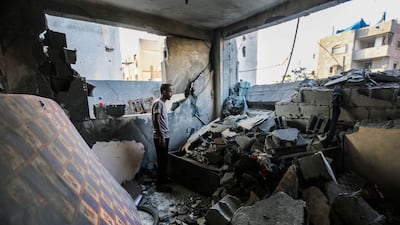
Khan Younis residents search through buildings destroyed during Israeli air raids. Getty Images -
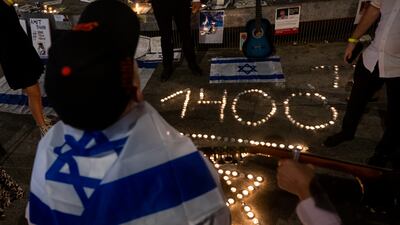
People take part in a candlelight vigil in Dizengoff Square, in Tel Aviv. Getty Images -
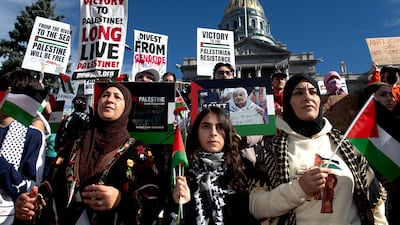
Demonstrators rally in support of Palestinians in Denver, Colorado. AFP -

Galya David, the mother of hostage Evyatar David, takes part in the 'Bring them home' event organised by the Greek Israeli Community in Athens. EPA -

Lebanese parademics show the blood-stained high-vis jackets of four of their colleagues wounded after their ambulances were hit in a strike on the Lebanese town of Tayr Harfa. AFP -
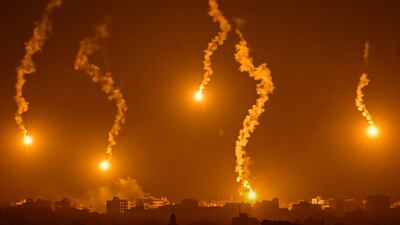
Flares are dropped by Israeli forces above Gaza, as seen from Sderot, near the border with the Palestinian enclave. AFP -

Israeli forces at a position along the the border with Gaza. AFP -

Palestinians search for bodies and survivors at Magazi refugee camp in Gaza after an Israeli air strike. Reuters -

Leaflets are dropped by the Israeli army over Gaza city asking people to evacuate towards the south of the Palestinian enclave. AFP -
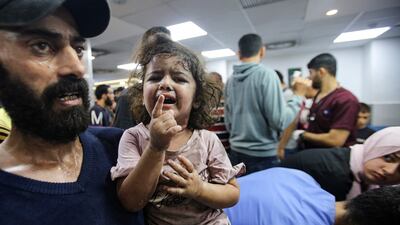
An injured toddler awaits treatment at the emergency ward of Al-Shifa Hospital following an Israeli strike, in Gaza city. AFP -

A Palestinian man wails amid a search for casualties after an Israeli strike on houses, at Magazi refugee camp, Gaza. Reuters -
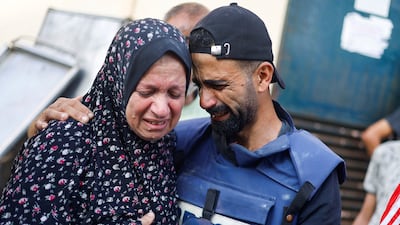
Anadolu news agency cameraman Mohammed El Aloul pictured after several of his children and siblings were killed in Israeli strikes. Reuters -

Israeli soldiers walk past debris and damaged buildings at a location given as Gaza by Israel's military. Reuters -

Protesters rally outside the White House in support of Palestinians in Gaza, Washington. Reuters -
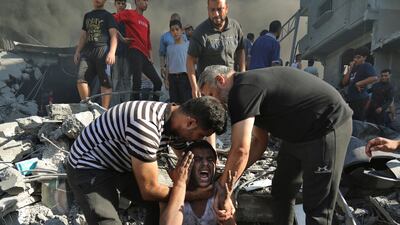
A man mourns after losing relatives following an Israeli air strike in Gaza city. AP -
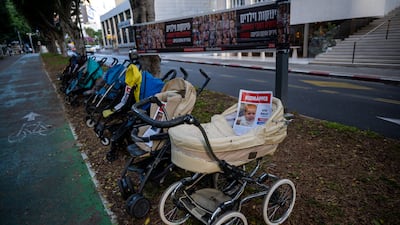
An art installation of prams with the faces of kidnapped children on display in Tel Aviv. Getty Images -

An Israeli woman calls for a ceasefire in the Gaza Strip. AP -

A Palestinian man stands on a collapsed building following a strike by the Israeli military on Khan Yunis in the southern Gaza Strip. AFP -
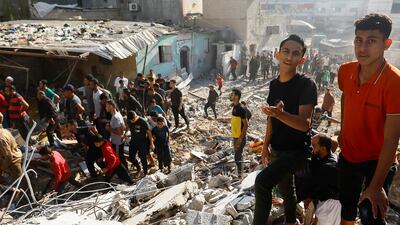
Palestinians gather at the site of Israeli strikes on a residential building in Khan Younis. Reuters -

Thousands of civilians, both Palestinians and Israelis, have died since October 7, 2023. AFP -

A Palestinian woman sits in the rubble as rescuers look for her relatives following the Israeli bombardment of Khan Younis. AFP -
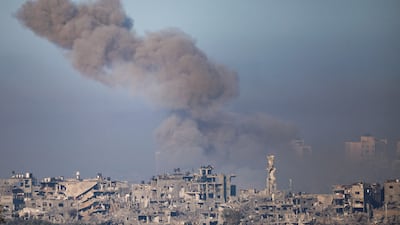
Smoke rises from Gaza as the conflict between Israel and Palestinian group Hamas continues. Reuters -

Mourners at the funeral of Druze Israeli Lt Col Salman Habaka in the village of Yanuh Jat, northern Israel. AP -
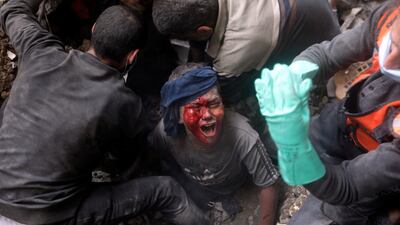
A Palestinian boy pulled from the rubble of a building following an Israeli air attack on Bureij refugee camp, in the Gaza Strip. AP -

A survivor calls from Nasser Hospital in Khan Younis following Israeli air attacks. EPA -
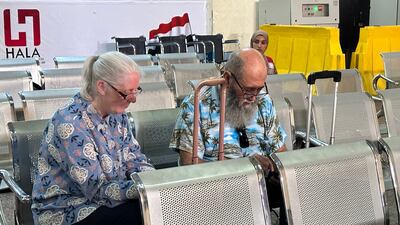
People wait on the Egyptian side of the border after passing the Rafah border crossing between the Gaza Strip and Egypt. EPA -
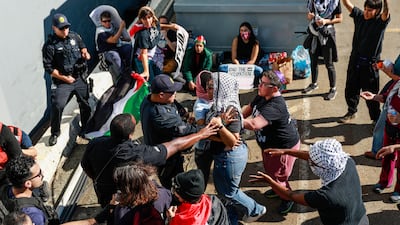
Pro-Palestinian supporters during a demonstration near a US military transport vessel at the Port of Oakland in California. AP


Israel also launched attacks against southern Lebanon this weekend, raising fears that the conflict could engulf the region and affect the growth of regional economies.
Tech and tourism to be hit hard
The war will significantly affect the Israeli economy through strained labour supply, as well as lower investment and capital inflows, said the Institute of International Finance.
Despite Israel’s robust economic foundation with ample foreign exchange reserves, low inflation, current account surpluses and modest debt, the latest war could inflict a heavy burden on the economy, said Garbis Iradian, chief economist for the Mena region and Central Asia at the IIF.
“A full-scale ground attack of Gaza could spiral into larger [and] prolonged regional war,” he warned.
Such a scenario is expected to significantly affect the economy through lower private consumption, investment, and net exports, which would be aggravated by the strained labour supply, as the government has mobilised about 350,000 reservists – about 8 per cent of the working population.
A large departure of the labour force will damage several sectors of the economy, including the technology sector, the main driver of growth, according to analysts.
Private consumption and investment could fall significantly amid uncertainty and security concerns.
Moreover, an expansion of the war against Hezbollah or Iran could also cause significant damage to Israel’s infrastructure, in addition to further loss of life.
“The immediate impact [of mobilising reservists] will be a downturn in output as production capacity constraints begin to bind, particularly in sectors with a high proportion of younger workers, such as the high-tech sector,” Elliot Garside, an economist at Oxford Economics told The National.
“We expect the impact on the tourism sector to be concentrated in weaker tourism exports, which will spill over to higher unemployment and slower investment growth.
“Our preliminary estimates are that the combined loss to travel and transport services exports will be around 4 billion Israeli shekels [$1 billion] in 2023, and a 12-billion shekel loss during 2024. This represents a 0.3 per cent loss to 2023 gross domestic product and 0.7 per cent in 2024, heightening the trade deficit.”
The economy has recovered relatively swiftly from past episodes of violent conflict and its dynamism benefits from a diversified high-tech sector as the main engine of growth, said Moody's.
However, this conflict is more severe than the previous episodes of violence.
“As a result, there is a risk of a diversion of resources, drop in investment and loss of confidence, which would undermine Israel's economic outlook,” Moody’s said in a recent report.
Israel spends about 4.5 per cent of its GDP on defence, considerably more than other Organisation for Economic Co-operation and Development countries.
While defence spending has declined as a share of GDP over the past two decades, it has typically increased during episodes of violence in the past. Moody’s expects higher defence spending to add to the fiscal deficit.
“We expect a contraction in the Israeli economy by at least 4 per cent in the fourth quarter of this year, and a contraction of at least 5 per cent for the whole of 2024,” said Mr Iradian.
US bank JP Morgan has also lowered its fourth-quarter economic forecast for Israel and has estimated that its seasonally adjusted GDP may shrink by 11 per cent when compared with the third quarter.
The lender’s estimates are among the most pessimistic from Wall Street analysts so far.
However, the lender still expects Israel’s GDP to grow by 2.5 per cent this year and by 2 per cent in 2024.
Against the backdrop of the war, the Bank of Israel's Research Department revised its forecast and now expects the economy to expand by 2.3 per cent in 2023 and by 2.8 per cent next year.
The central bank has proactively placed certain measures to combat the situation but analysts say the depth and duration of the impact on its economy remains uncertain.
The Bank of Israel’s baseline scenario assumes a war that lasts one to six months and is focused mainly on Gaza.
Risks “might still skewed to the downside”, JP Morgan analysts wrote in a note on October 27.
They added that “gauging the impact of the war on Israel’s economy remains difficult both due to still very high uncertainty about the scale and duration of the conflict and the lack of high-frequency data at hand”.
Israel’s recent conflicts, including one with Hamas in 2014 that lasted about seven weeks and involved a ground assault on the territory and a 2006 war with Lebanon-based Hezbollah, “barely affected activity”, they said.
However, the current war “has had a much larger impact on domestic security and confidence”.
Since the outbreak of the war on October 7, the Israeli shekel has depreciated by 4 per cent against the US dollar.
The IIF expects that the Bank of Israel will be able to prevent further significant depreciation given its large net external creditor position (since foreign assets far exceed foreign liabilities).
Foreign exchange reserves managed by the central bank exceeded $200 billion, or 38 per cent of GDP, as of the end of September.
However, a sharp decline in exports would shift the current account from a surplus of about 2 per cent of GDP to a deficit of 2.5 per cent this year, it said.
Such a deficit, combined with the deterioration in non-resident inflows – including lower foreign direct investment and portfolio flows – would lead to a fall in official reserves from about $200 billion to the region of $150 billion by the end of 2024, the IIF said.
Israel's foreign debt stands at about 30 per cent of GDP, much lower than most emerging economies.
Looking ahead, the 2023-2024 national budget that was approved before the war will probably be amended, with substantially more spending allocated to defence and much less tax revenue due to the expected contraction in the economy next year.
There will also be an impact with 300,000 reservists on standby and the workforce directly impacted by the need for fighters.
“We expect the fiscal deficit to widen from 2.3 per cent of GDP in 2023 to 4.5 per cent of GDP in 2024 in our limited war scenario, and a deficit of at least 6 per cent of GDP in our prolonged war scenario,” said Mr Iradian.
Counting the cost of war
According to Israeli Finance Minister Bezalel Smotrich, if the war lasts for six months, then the cost would amount to about $45 billion, which is equivalent to 10 per cent of GDP.
“It's hard to know how large the impact has been on GDP so far but around half of businesses reported in a recent survey that they expect revenues to drop by 50 per cent in October,” Liam Peach, senior emerging markets economist at Capital Economics, said.
“Activity will bounce back in November and early next year but it looks to us, at this stage, that GDP in Israel may decline by around 2 per cent – seasonally adjusted, quarter on quarter – in the fourth quarter as a whole.”
Meanwhile, Oxford Economics has downgraded the GDP growth forecast for Israel to 1.9 per cent, from 2.9 per cent for 2023, and 2.2 per cent, from 3.1 per cent for 2024, as the war continues.
“The deepest contraction in economic activity will be seen in the fourth quarter of 2023, although the impacts will still be intense during the beginning of next year,” Mr Garside said.
The Economist Intelligence Unit expects a short but sharp recession, with a significant contraction in the final quarter of 2023.
This will be followed by an initially tentative recovery that will gather pace only in the second half of 2024, with economic performance normalising in 2025.
“In the near term, expect total shutdowns in some sectors followed by a slow return to normality,” said Pat Thaker, editorial director for the Middle East and Africa at the EIU.
“For instance, Chevron shut down its offshore Tamar gasfield and the EMG pipeline that sends Israeli gas for processing in Egypt shortly after war broke out, although the larger Leviathan field continues to operate.
“Educational settings and businesses are beginning to open up, but to a limited extent. Consumer sentiment remains extremely poor and many businesses will remain affected by severe manpower shortages,” she said.

