


Non-oil growth in Saudi Arabia will remain close to 5 per cent in 2023, spurred by strong domestic demand despite lower overall growth caused by additional oil production cuts, according to the International Monetary Fund.
Non-oil growth in the Arab world’s largest economy has accelerated since 2021, averaging 4.8 per cent in 2022, Amine Mati, an assistant director, and Sidra Rehman, an economist, both in the IMF’s Middle East and Central Asia department, said in a staff report on Thursday.
Saudi Arabia’s non-oil revenue doubled in just four years after value-added tax rate increases and high regulatory compliance, while non-oil exports reached a record $84.4 billion in 2022, according to the research note.
Shares of manufacturing and services increased by 15 per cent over the past 20 years and the kingdom’s tourism sector is contributing 4.5 per cent to gross domestic product, the note added.
“The economy’s non-oil growth has been spurred by strong domestic demand, particularly private non-oil investment,” the authors said.
“Sustaining this performance requires pursuing sound macroeconomic policies and maintaining the reform momentum, irrespective of developments in oil markets.”
Saudi Arabia is pushing to diversify its economy away from oil to develop new sectors that can help it boost its non-oil economic growth.
Its economy expanded 8.7 per cent in 2022, the highest annual growth rate among the world’s 20 biggest economies, driven by a rise in oil prices and strong performance of its non-oil private sector.
It has carried growth momentum forward, albeit at a slower pace. Gross domestic product grew by 1.1 per cent in the second quarter of this year, boosted by a sharp expansion in the country’s non-oil sector as the kingdom continues to pursue its diversification goals.
The non-oil sector grew 5.5 per cent in the three-month period to the end of June compared with the same period in 2022, according to the General Authority for Statistics.
Earlier this year, Saudi Arabia received the biggest downgrade in economic growth forecast among the G20 economies by the IMF.
The kingdom’s economy is forecast to grow by 1.9 per cent this year, instead of 3.1 per cent as previously projected, largely a reflection of oil production cuts and lower oil prices.
Growth in the kingdom is expected to pick up to 2.8 per cent in 2024, the IMF said in its latest World Economic Outlook update.
Saudi Arabia unveils Expo 2030 bid - in pictures
-
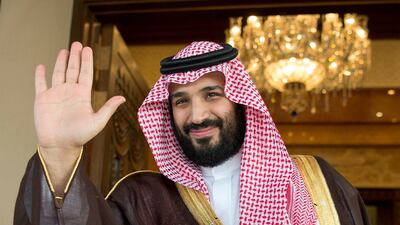
Saudi Crown Prince Mohammed bin Salman is overseeing the kingdom's Vision 2030 economic reform agenda. Reuters -
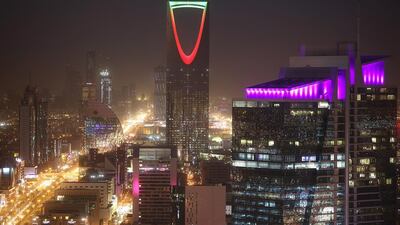
Riyadh will be ready to welcome 120 million visitors if the Saudi capital is chosen to host Expo 2030, say officials. Bloomberg -
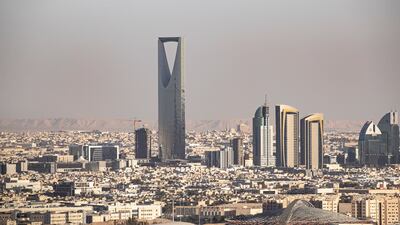
The Riyadh skyline. Saudi Arabia’s non-oil revenue has doubled in four years, according to the IMF. EPA -
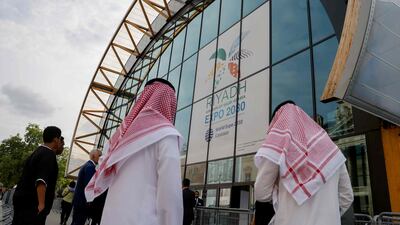
Guests arrive at the Grand Palais Ephemere for the Riyadh 2030 reception event to promote the city's candidacy for Expo 2030, in Paris. AFP -
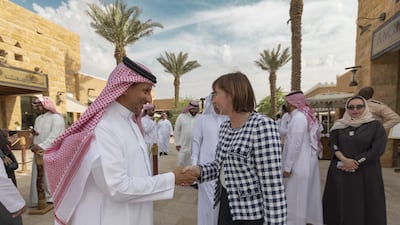
Saudi Minister of Tourism Ahmed Al Khateeb with Eva Descarrega, permanent delegate for Andorra to UN cultural agency Unesco. -
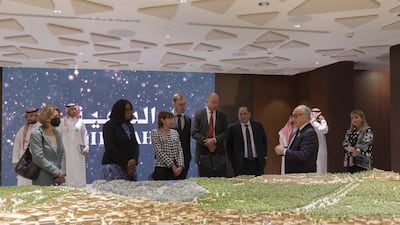
Officials from the Bureau International des Expositions, which oversees the World Expo, with Jerry Inzerillo, chief executive of Diriyah Gate Development Authority, near Riyadh. -

Saudi Arabia has outlined ambitious plans to develop the capital, including the flagship New Murabba project. SPA -
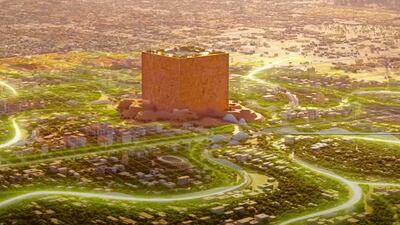
The project will cover 19 square kilometres, centred on a large cube-shaped structure, rendered above, known as the Mukaab. -
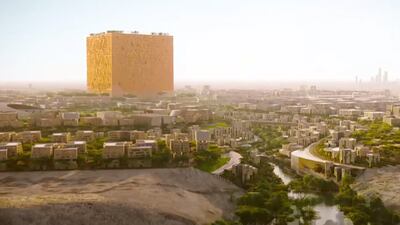
The New Murabba Development Company's project will include a museum, a technology and design university, a multipurpose immersive theatre and more than 80 cultural and entertainment venues. -
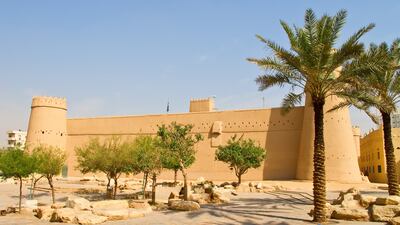
The historic Al Masmak fort in Riyadh is one of the city's current tourist attractions and home to a museum. Getty -
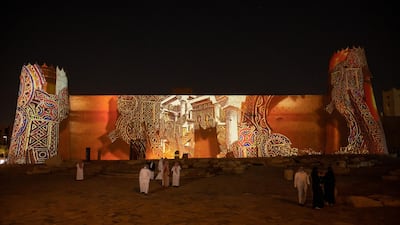
Work by Saudi artist Ali Al Ruzaiza projected on Masmak Fort during the Noor Riyadh festival. Photo: Noor Riyadh -

Football legend Lionel Messi and his wife Antonela Roccuzzo visiting Diriyah in May. AFP -
The kingdom recently launched a new carrier, Riyadh Air. Photo: Riyadh Air


Saudi Arabia’s growth outlook remains positive and its strong non-oil economic growth momentum is expected to continue despite global headwinds, the IMF said earlier this month in its annual review of the country’s economy.
The kingdom’s economic transformation, “commendable reforms” and higher oil prices have propelled growth, the fund said. It has managed to bring unemployment to record lows, contained inflation and maintain strong external and fiscal buffers.
Two reforms are playing a key role in Saudi Arabia’s economic transformation, the latest IMF staff report said.
This includes labour market reforms, with the share of Saudi citizens in high-skilled jobs increasing to 42 per cent in 2022 from 32 per cent in 2016, the fund said.
Female workforce participation has also doubled over the past four years, reaching 37 per cent and surpassing the Vision 2030 target of 30 per cent, it added.
Digitalisation is another key reform, with the digital sector’s contribution to the kingdom’s overall growth increasing to 15 per cent in 2022 from 0.2 per cent in 2016. This has bolstered the financial sector’s resilience, government efficiency and financial inclusion, the IMF report noted.
Diversification is also being driven by improvements in the regulatory and business environment, according to the fund.
As a result of a new set of laws to promote entrepreneurship, protect investors’ rights, and reduce the costs of doing business, new investment deals and licences grew by 95 per cent and 267 per cent, respectively, in 2022, the report said.

In addition, the kingdom’s sovereign wealth fund, the Public Investment Fund, has been using capital, including to help stimulate private sector investment, it added.
One of the world’s largest sovereign wealth funds, the PIF is at the centre of the Saudi Vision 2030 initiative to diversify the country’s economy from hydrocarbons. Since 2017, the PIF has established 84 companies in 13 sectors.
The fund is investing heavily to build projects in the kingdom. It is mandated to pump $40 billion to $50 billion into the local economy to generate jobs and boost the non-oil economic base of the country.
“Challenges ahead include making sure large projects generate returns and boost productivity, which are vital for sustained economic growth and will help further diversify the economy,” the report’s authors said.
“There is a need to continue ongoing efforts to foster a more conducive environment for innovation and invest in workforce skills that complement the diversification agenda.”
The IMF also recommended streamlining the fees and taxes faced by businesses, particularly at local and city levels, to further boost private sector development.
The fund added that rigorous monitoring and evaluation can help minimise risks from targeted interventions and industrial policies, ensuring that these policies attain the intended benefits.

