

Egypt has reappointed Hassan Abdalla as acting central bank governor but without giving him a full four-year term, leaving the reins of monetary policy in the hands of a veteran financier who has overseen several rounds of devaluation and probably needs to let the pound weaken further.
Mr Abdalla, 63, gets a one-year term extension, according to an announcement in the Official Gazette, after taking over in an acting capacity following the surprise resignation of Tarek Amer in August 2022.
Mr Abdalla previously held senior positions at the Arab African International Bank and is also the founder of Panther Associates, a boutique financial advisory company.
The short extension creates some uncertainty for investors after Mr Abdalla presided over policies that helped Egypt secure a $3 billion loan from the International Monetary Fund.
But his approach also left the market on edge as the country grapples with record inflation amid the worst foreign currency crunch in years.
Moody’s Investors Service said last week it is continuing a review for a downgrade of Egypt’s non-investment grade rating – which began in May – as it weighs progress on the government’s reform agenda against factors including evidence of a further weakening in external liquidity.
Mr Abdalla represented change from his predecessor, who long supported a stable pound.
But while the new governor moved to allow the currency to weaken by more than a third against the dollar during his time in the job, his stewardship has so far fallen short of delivering on promises to let the market determine the exchange rate.
Mr Abdalla inherited many challenges as the North African nation, that is one of the world’s largest wheat buyers, confronted a spiralling economic crisis in the wake of Russia’s invasion of Ukraine.
Pressure has, again, been intensifying on the pound as Egypt struggles to secure foreign direct investment and inflows into its local debt market.
Analysts widely expect another devaluation but not before authorities build up sufficient foreign exchange buffers to manage the transition.
Under Mr Abdalla, the central bank raised interest rates sharply three times, taking them past their peak during Egypt’s 2016-2017 currency crisis.
Still, the 19.25 per cent benchmark remains more than 17 percentage points below inflation.
While Mr Abdalla suggested in a rare public speech in April that higher borrowing costs could do little to contain inflation caused by supply issues, the IMF has said authorities should “use the monetary policy instruments” at their disposal – especially interest rates – to cool prices.
The new governor enjoys stronger backing from the business community than his predecessor, who led the central bank for about seven years and championed policies that propped up the pound.
The challenge for Mr Abdalla is to win over investors and the fund, which delayed the first review of the country’s rescue programme that was expected to be completed in March.
It has been waiting for authorities to make good on reforms, including genuine currency flexibility.
Mr Abdalla helped to make headway with the fund after his initial appointment. Meeting some IMF demands, the central bank cancelled some subsidised lending programmes and moved others to the Finance Ministry, steps that led to the approval of Egypt’s loan.
But the pound has been kept stable for months, maintaining a discrepancy with the local black market where it is available at a weaker level than at banks.
Concerns about inflation and social stability in the country of more than 104 million people may be putting constraints on policy.
Egypt remains mindful of risks since a cost-of-living crisis helped trigger the Arab Spring uprisings a little over a decade ago.
Egypt's ancient temple of Abu Simbel – in pictures
-
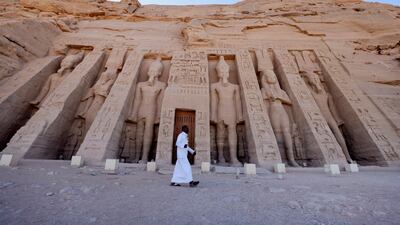
Egyptian guard Abd El Sayed at the Abu Simbel temple in Aswan, Egypt. All photos by Reuters -
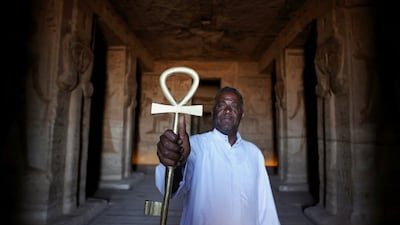
Mr El Sayed with the key to the temple -

Inside the temple, which dates back 3,200 years -
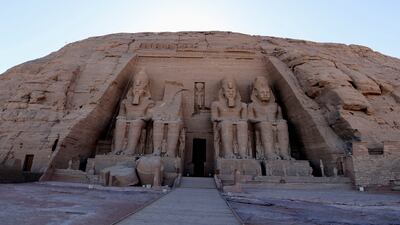
It is located near the upper reaches of the Nile river -
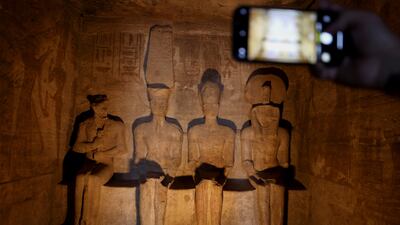
Statues of Pharaoh Ramses II, second right, and Amun, the god of light, second left, in the inner sanctum of the temple -
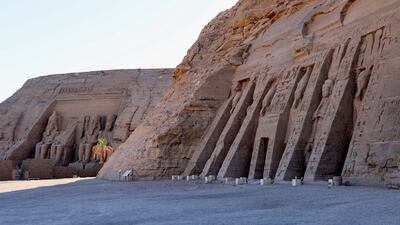
The temple is dedicated to Ramses II and his wife Nefertiti -
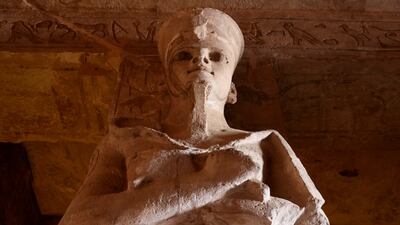
In the 1960s, a Unesco-led appeal saw the temple dismantled and rebuilt on higher ground to save it from flooding


Mr Abdalla’s urgent priority is still to secure enough foreign exchange to ease a debilitating hard currency crunch and clear a backlog of dollar requests from importers and other companies.
Shortages of consumer goods started to ease during Mr Abdalla’s tenure as he scaled back measures that kept some commodities stuck at Egypt’s ports for months and imposed controls on imports that made scarcity worse.
But for now, not all businesses have access to hard currency from banks, partly due to the hoarding of dollars by companies and people worried about a potential new devaluation.

