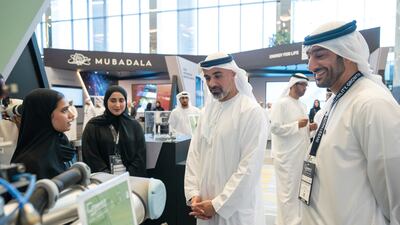
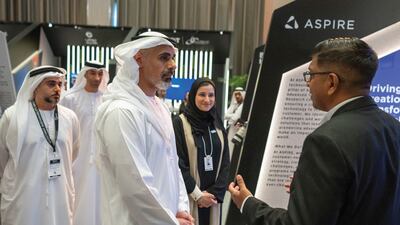
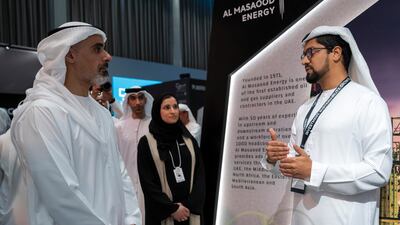
The UAE is launching a series of initiatives including setting up new industrial units to increase industrial exports and boost the sector’s contribution to the national economy, Dr Sultan Al Jaber, Minister of Industry and Advanced Technology, has said.
With the initiatives launched last year, the UAE has already managed to increase the industrial sector’s contribution to national gross domestic product to Dh182 billion ($50 billion), a 38 per cent increase from Dh132 billion in 2020, Dr Al Jaber said in his key note speech at the second Make it in the Emirates forum in Abu Dhabi.
The value of the UAE’s industrial exports rose to Dh175 billion last year, a 49 per cent increase from 2020 on the back of the National Strategy for Industry and Advanced Technology launched by the ministry, he said.
This year, the UAE plans to “increase the value of purchase agreements for local manufacturers and industrial investments by more than Dh10 billion, taking the total value of products targeted for localisation to Dh120 billion”, Dr Al Jaber told delegates on Wednesday.
Last year, national companies including Adnoc announced investment of Dh110 billion over the next decade to purchase 300 products from local manufacturers.
“I am pleased to share with you that in the first year alone, 28 per cent of these offtake agreements have been implemented, representing a total value of Dh31 billion,” Dr Al Jaber said. “This is an outstanding achievement.”
The Arab world’s second-largest economy also plans to launch more than 30 “innovative industrial projects” valued at about Dh6 billion.
“These projects include pioneering initiatives such as setting up the first hydrogen electrolyser plant in the UAE,” he said.
The UAE launched its broader industrial strategy, Operation 300bn, in 2021, which aims to position the country as an industrial centre by 2031. The 10-year strategy focuses on increasing industry’s contribution to GDP to Dh300 billion by 2031, from Dh133 billion in 2021.
The strategy focuses on boosting production in 11 priority areas, supporting the growth of national industry, attracting foreign investment, modernising legislation and ensuring availability of dedicated financing for industrial companies.
The Ministry of Industry and Advanced Technology, which was created in 2020 to increase the competitiveness of products made in the UAE, is leading Operation 300bn.
The Make it in the Emirates campaign encourages local and international investors to manufacture and export products from the UAE.
The UAE has also been expanding its In Country Value (ICV) programme that aims to boost private-sector participation in the economy, diversify output and localise critical parts of the supply chain.
State energy company Adnoc is allocating more than Dh20 billion for the purchase of structures and metal products “exclusively from national factories, an initiative that will provide more opportunities to manufacture of products such as cables and pipes”, Dr Al Jaber said.
Last year, the ICV programme redirected Dh53 billion into the national economy, a 25 per cent rise from a year earlier.
The UAE, which is hosting Cop28 this year, is also adopting “a new standard” within the national ICV programme called “Green ICV, to encourage sustainability practices and motivate companies to reduce emissions”, said Dr Al Jaber, who is also Cop28 President-designate.
The industrial sector in the UAE has grown rapidly over the last few years, despite a global economic slowdown. The government is also accelerating the adoption of Fourth Industrial Revolution technologies in the sector under the UAE Industry 4.0 programme.
In 2022, the ministry supported a further 175 factories in developing a road map for their technological transformations, bringing the total number to 275.
It aims to unveil more than 1,000 technological projects by 2031, raise advanced technology exports to Dh15 billion and increase the GDP of advanced technology to Dh110 billion.
The ministry has also taken several steps to improve the ease of doing business and ensuring the industrial sector's access to financing.
This year, First Abu Dhabi Bank, the biggest lender in the UAE by assets, will allocate competitive financing solutions for industrial sector companies. Mashreq is also joining the financing initiative with a Dh1 billion funding commitment to the industrial sector, Dr Al Jaber said.
This financing is on top of the funding being provided by Emirates Development Bank, which last year completed financing deals worth Dh3 billion to support and enable the Make it in the Emirates initiative.
The ministry also aims to provide “5,000 sustainable job opportunities for UAE nationals in the industrial sector through the Industrialist Programme”, with the support of Nafis and the Ministry of Human Resources and Emiratisation, he added.
The bio
Favourite book: Kane and Abel by Jeffrey Archer
Favourite quote: “The world makes way for the man who knows where he is going.” - Ralph Waldo Emerson, American essayist
Favourite Authors: Arab poet Abu At-Tayyib Al-Mutanabbi
Favourite Emirati food: Luqaimat, a deep-fried dough soaked in date syrup
Hobbies: Reading and drawing
Jeff Buckley: From Hallelujah To The Last Goodbye
By Dave Lory with Jim Irvin
War 2
Director: Ayan Mukerji
Stars: Hrithik Roshan, NTR, Kiara Advani, Ashutosh Rana
Rating: 2/5
The%C2%A0specs%20
%3Cp%3E%3Cstrong%3EEngine%3A%20%3C%2Fstrong%3E3.5-litre%2C%20twin-turbo%20V6%0D%3Cbr%3E%3Cstrong%3ETransmission%3A%20%3C%2Fstrong%3E10-speed%20auto%0D%3Cbr%3E%3Cstrong%3EPower%3A%20%3C%2Fstrong%3E410hp%0D%3Cbr%3E%3Cstrong%3ETorque%3A%20%3C%2Fstrong%3E495Nm%0D%3Cbr%3E%3Cstrong%3EPrice%3A%20%3C%2Fstrong%3Estarts%20from%20Dh495%2C000%20(Dh610%2C000%20for%20the%20F-Sport%20launch%20edition%20tested)%0D%3Cbr%3E%3Cstrong%3EOn%20sale%3A%20%3C%2Fstrong%3Enow%3C%2Fp%3E%0A
Conflict, drought, famine
Estimates of the number of deaths caused by the famine range from 400,000 to 1 million, according to a document prepared for the UK House of Lords in 2024.
It has been claimed that the policies of the Ethiopian government, which took control after deposing Emperor Haile Selassie in a military-led revolution in 1974, contributed to the scale of the famine.
Dr Miriam Bradley, senior lecturer in humanitarian studies at the University of Manchester, has argued that, by the early 1980s, “several government policies combined to cause, rather than prevent, a famine which lasted from 1983 to 1985. Mengistu’s government imposed Stalinist-model agricultural policies involving forced collectivisation and villagisation [relocation of communities into planned villages].
The West became aware of the catastrophe through a series of BBC News reports by journalist Michael Buerk in October 1984 describing a “biblical famine” and containing graphic images of thousands of people, including children, facing starvation.
Band Aid
Bob Geldof, singer with the Irish rock group The Boomtown Rats, formed Band Aid in response to the horrific images shown in the news broadcasts.
With Midge Ure of the band Ultravox, he wrote the hit charity single Do They Know it’s Christmas in December 1984, featuring a string of high-profile musicians.
Following the single’s success, the idea to stage a rock concert evolved.
Live Aid was a series of simultaneous concerts that took place at Wembley Stadium in London, John F Kennedy Stadium in Philadelphia, the US, and at various other venues across the world.
The combined event was broadcast to an estimated worldwide audience of 1.5 billion.
'The worst thing you can eat'
Trans fat is typically found in fried and baked goods, but you may be consuming more than you think.
Powdered coffee creamer, microwave popcorn and virtually anything processed with a crust is likely to contain it, as this guide from Mayo Clinic outlines:
Baked goods - Most cakes, cookies, pie crusts and crackers contain shortening, which is usually made from partially hydrogenated vegetable oil. Ready-made frosting is another source of trans fat.
Snacks - Potato, corn and tortilla chips often contain trans fat. And while popcorn can be a healthy snack, many types of packaged or microwave popcorn use trans fat to help cook or flavour the popcorn.
Fried food - Foods that require deep frying — french fries, doughnuts and fried chicken — can contain trans fat from the oil used in the cooking process.
Refrigerator dough - Products such as canned biscuits and cinnamon rolls often contain trans fat, as do frozen pizza crusts.
Creamer and margarine - Nondairy coffee creamer and stick margarines also may contain partially hydrogenated vegetable oils.
Formula%204%20Italian%20Championship%202023%20calendar
%3Cp%3EApril%2021-23%3A%20Imola%3Cbr%3EMay%205-7%3A%20Misano%3Cbr%3EMay%2026-28%3A%20SPA-Francorchamps%3Cbr%3EJune%2023-25%3A%20Monza%3Cbr%3EJuly%2021-23%3A%20Paul%20Ricard%3Cbr%3ESept%2029-Oct%201%3A%20Mugello%3Cbr%3EOct%2013-15%3A%20Vallelunga%3C%2Fp%3E%0A
Ten tax points to be aware of in 2026
1. Domestic VAT refund amendments: request your refund within five years
If a business does not apply for the refund on time, they lose their credit.
2. E-invoicing in the UAE
Businesses should continue preparing for the implementation of e-invoicing in the UAE, with 2026 a preparation and transition period ahead of phased mandatory adoption.
3. More tax audits
Tax authorities are increasingly using data already available across multiple filings to identify audit risks.
4. More beneficial VAT and excise tax penalty regime
Tax disputes are expected to become more frequent and more structured, with clearer administrative objection and appeal processes. The UAE has adopted a new penalty regime for VAT and excise disputes, which now mirrors the penalty regime for corporate tax.
5. Greater emphasis on statutory audit
There is a greater need for the accuracy of financial statements. The International Financial Reporting Standards standards need to be strictly adhered to and, as a result, the quality of the audits will need to increase.
6. Further transfer pricing enforcement
Transfer pricing enforcement, which refers to the practice of establishing prices for internal transactions between related entities, is expected to broaden in scope. The UAE will shortly open the possibility to negotiate advance pricing agreements, or essentially rulings for transfer pricing purposes.
7. Limited time periods for audits
Recent amendments also introduce a default five-year limitation period for tax audits and assessments, subject to specific statutory exceptions. While the standard audit and assessment period is five years, this may be extended to up to 15 years in cases involving fraud or tax evasion.
8. Pillar 2 implementation
Many multinational groups will begin to feel the practical effect of the Domestic Minimum Top-Up Tax (DMTT), the UAE's implementation of the OECD’s global minimum tax under Pillar 2. While the rules apply for financial years starting on or after January 1, 2025, it is 2026 that marks the transition to an operational phase.
9. Reduced compliance obligations for imported goods and services
Businesses that apply the reverse-charge mechanism for VAT purposes in the UAE may benefit from reduced compliance obligations.
10. Substance and CbC reporting focus
Tax authorities are expected to continue strengthening the enforcement of economic substance and Country-by-Country (CbC) reporting frameworks. In the UAE, these regimes are increasingly being used as risk-assessment tools, providing tax authorities with a comprehensive view of multinational groups’ global footprints and enabling them to assess whether profits are aligned with real economic activity.
Contributed by Thomas Vanhee and Hend Rashwan, Aurifer
Racecard
6.30pm: The Madjani Stakes (PA) Group 3 Dh175,000 (Dirt) 1,900m
7.05pm: Maiden (TB) Dh165,000 (D) 1,400m
7.40pm: Maiden (TB) Dh165,000 (D) 1,600m
8.15pm: Handicap (TB) Dh190,000 (D) 1,200m
8.50pm: Dubai Creek Mile (TB) Listed Dh265,000 (D) 1,600m
9.25pm: Handicap (TB) Dh190,000 (D) 1,600m
The National selections
6.30pm: Chaddad
7.05pm: Down On Da Bayou
7.40pm: Mass Media
8.15pm: Rafal
8.50pm: Yulong Warrior
9.25pm: Chiefdom