
Countries in debt distress such as Zambia and Sri Lanka turning to the International Monetary Fund for financial help are facing unprecedented delays to secure bailouts as China and Western economies clash over how to provide debt relief.
IMF funding is often the sole financial lifeline available to countries in a debt crunch, and key to unlocking other financing sources, with delays putting pressure on government finances, companies and populations.
For Zambia, it took 271 days between reaching a $1.3 billion staff-level agreement with the IMF — a preliminary financing deal usually agreed during a country visit — and the fund's executive board signing off, a prerequisite for actual disbursements.
The first African country to default in the Covid-19 pandemic era in 2020, Zambia's continuing debt relief negotiations involving China have been closely watched by other countries as a test case for the major emerging market lender.
Though staff agreements can be reached without financing assurances, the IMF board needs them to approve the programme. These are guarantees that sovereign lenders — and to some extent commercial creditors — will negotiate a restructuring in line with the IMF's debt sustainability analysis, providing relief and financing when needed.
Sri Lanka has been waiting for 182 days to finalise a bailout after a $2.9 billion September staff level deal while Ghana, having defaulted on its overseas debt in December following a preliminary IMF deal, has yet to get board approval 80 days later.
This compares to a median of 55 days it took low and middle-income countries over the last decade to go from preliminary deal to board sign-off, public data from over 80 cases compiled by Reuters shows.
These delays have been caused by a number of reasons, but debt experts mainly point to the fact that China is still reluctant to offer debt relief in comparable terms with other external creditors.
Chinese Premier Li Keqiang said on Wednesday the country was willing to “constructively” participate in solving debt problems of relevant countries under a multilateral framework. But Beijing has always emphasised all creditors should follow the principle of “joint action, fair burden” in debt settlements.
An IMF representative said it was a “very small number of countries” that suffered “significant delays,” acknowledging this was in particular where there was a need to restructure debt owed to official bilateral lenders.
However, the time from staff level agreement to lending approval had remained “broadly consistent for a vast majority of countries,” the representative added.
Besides members of the Paris Club of creditor nations such as the US, France and Japan, cash-strapped nations now have to rework loans with lenders such as India, Saudi Arabia, South Africa and Kuwait — but first and foremost China.
Beijing is the largest bilateral creditor to developing nations, extending $138 billion in new loans between 2010 and 2021, according to World Bank data.
For countries such as Sri Lanka facing shortages of food, fuel and medicines as well as painful reforms to alleviate a debt crisis after years of economic mismanagement, the delays can be devastating. The war in Ukraine added pressure as global commodity prices soared.
“Sri Lanka going beyond March without an IMF programme will be challenging for us,” said the country's State Minister of Finance Sehan Semasinghe.
“We need the programme to justify the reforms that need to be made for the economic stabilisation process.”
After the Covid-19 pandemic raised pressure on highly-indebted economies, the Group of 20 economies launched in 2020 the Common Framework, a platform designed to help low-income nations restructure sovereign debt. For the first time, China joined a multilateral effort aimed at reworking sovereign debt.
Chad, Ethiopia and Zambia signed up in early 2021. Chad secured a deal in November with its creditors, including Swiss commodities trader Glencore, an outcome without debt reduction that some analysts said undermined the Common Framework efforts. Ethiopia's progress was delayed by civil war, and Ghana joined the platform earlier this year.
-

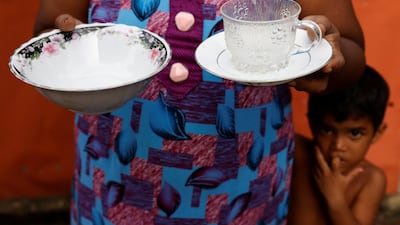
Nilanthi Gunasekera, 49, holds her family’s last remaining handful of dried fish. She is one of the millions of Sri Lankans battling a sharp decline in living standards. All photos: Reuters -

Dilhani Wathsala, 14, eating lunch cooked by Gunasekera, her mother. 'Before the economic crisis, we ate well and we served meat or fish to our kids at least three or four times a week. Now fish is out of the reach of our family and so is meat,' said Gunasekera. -
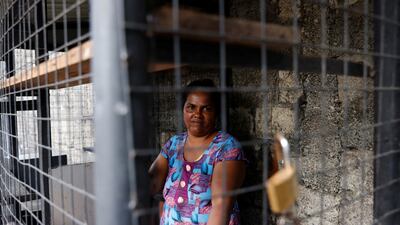
'We had a good business at our kiosk,' said food kiosk owner Chandra Thushari Peiris, 42. 'Since we used to eat the leftovers from our kiosk we didn't have any problem with food.' -
'But during the pandemic, and more so the present economic crisis, we didn't get any customers. Although we want to restart we don't have any capital,' Ms Peiris said. -

'Our water and electricity supplies were disconnected during the Covid-19 crisis but still we had food,' said road sweeper W.M. Irangani, 58, 'but this is far, far worse,' she said. -

Ms Irangani added: 'I am scared to borrow as I have no way of repaying. Already I am in huge debt. I only pray that this economic crisis improves for all and we have enough food to eat.' -
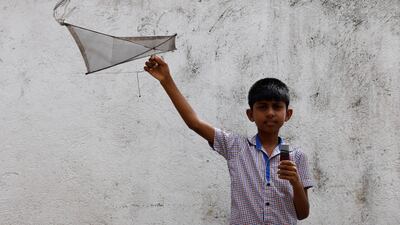
Oshada Fernando, 11, plays with a kite his uncle made for him. 'With the economic crisis we haven't bought any toys for our son,' said his mother, 42-year-old Anusha Priyadarshini. -
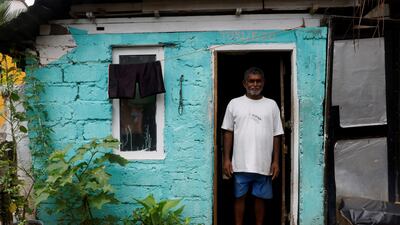
'Just a couple of months back some robbers broke into our house and stole the small gas cylinder and the cooker we had,' said Vidyathipathige Nihal, 62. -
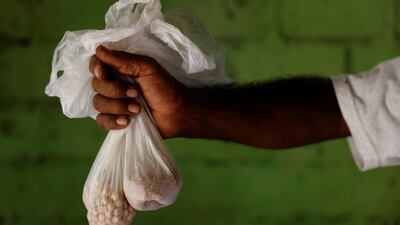
Mr Nihal, holding two small bags of chickpeas and rice, the only grain his family currently has, is now forced to cook with firewood. -
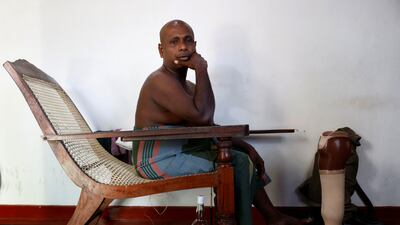
'I joined the Sri Lanka Army in 1989, and in 1992 I lost my leg to a land mine,' said retired soldier Saman Priyantha, 51. -

Mr Priantha said he is receiving a pension but it is not enough to feed and look after his family of five. -

"I am a heart patient and have to take medicine every day," said Manel Peiris, 68. "Hospitals used to issue medicine for three months. But ... hospitals don't have medicine and so we are asked to buy from pharmacies." -

She said that sometimes her husband has to borrow or get an advance from his workplace to buy the medicine. -

'For the last two years, I have sewn clothes for a kids' clothing shop,' said K.P.R. Priyadarshani, 54, who lives with her 16-year-old son Ramika Lakdin. -

Ms Priyadarshani said that with the onset of the economic crisis, people don't have money to buy food, let alone clothes. -

Sivaraja Sanjeewan, 31, takes a bath at a public well at Wanathamulla, Colombo. -

Auto rickshaw driver Mr Sanjeewan said: 'We have a tap water connection but it's very difficult to pay water and electricity bills in addition to the rising costs of food. So now I bathe in a public well more often to save money." -

As desperation grows, the government is seeking a multi-billion-dollar bailout in talks with the IMF, but major financial assistance is still months away, so few Sri Lankans are expecting to see light at the end of the tunnel soon.


In a recent letter sent to Sri Lanka, a non-Common Framework country due to its middle-income status, China's Export-Import Bank offered a two-year debt moratorium, raising concerns over how much of a hit Beijing was prepared to take.
“The question remains whether China is willing to accept a real extension of maturities that locks in a concessional interest rate for a long period of time,” said Brad Setser, senior fellow for international economics at the Council on Foreign Relations, in Washington.
Gregory Smith, emerging markets fund manager at London-based M&G Investments, said China had a legacy of providing debt relief “but it typically involves maturity extensions or temporary freeze in interest payments”, while face-value reductions in the principal are rare.
Unlike the Paris Club, Chinese lenders tackle restructuring or cancellation on a loan-by-loan basis rather than for the entire portfolio, according to a working paper of the China Africa Research Initiative, which found 1,000 Chinese loans commitments in 49 African countries since 2000.
Adding another layer of complexity to these debt talks, the Common Framework doesn't lay out precise rules on how a debt restructuring with bilateral creditors should work.
The IMF recognised that “greater clarity on the different steps and timelines” is vital, as well as clear mechanisms to enforce the comparability of treatment.
For Mr Setser, time is slipping away for Zambia.
“If there isn't an agreement at least on the basic outlines of the financial terms of restructuring in Zambia by this quarter, it'll be time to declare the Common Framework a failure,” he said.

