A woman walks out of a currency exchange shop in the Zamalek district of Cairo. AFP

IMF and Egypt agree to take steps to reach staff-level agreement on rescue loan soon


Deepthi Nair
  • English
  • Arabic

The International Monetary Fund (IMF) and Egypt have agreed to finalise work to reach a staff-level agreement on a loan “very soon”, the multilateral lender said on Saturday.

“IMF staff and the Egyptian authorities have held very productive in-person discussions on the margins of the IMF and World Bank annual meetings and made substantial progress on all policies,” Gerry Rice, director of communications at the IMF, said.

“The implementation of the authorities’ comprehensive structural reform agenda would gradually enhance the competitiveness of the economy, reduce the role of the state in the economy, level the playing field for the private sector, improve the business climate and foster transition towards a greener economy.”

The Arab world’s third-largest economy is seeking a new loan for up to $8 billion as part of an economic restructuring programme to be agreed with the IMF.

The North African country has been hit hard by the fallout from the Russia-Ukraine war, forcing the government to respond with a series of austerity measures as well as additional spending to shield the poor against higher food prices.

Higher energy prices and supply chain disruptions caused by the Covid-19 pandemic are also combining to raise the price of food items, especially wheat-based products such as bread, a main staple for most of its 104 million population.

Egypt, where about 30 per cent of the population lives below the poverty line, buys 80 per cent of its wheat imports — 13 million tonnes in 2021 — from Russia and Ukraine.

The Arab world’s most populous nation has approached the IMF twice before, seeking help since 2016, when it secured a $12bn loan as part of a far-reaching reform programme that featured a devaluation of its currency, the lifting of state subsidies on essential services and the introduction of a wide range of taxes.

The measures triggered a wave of price increases that hit the middle and working classes the hardest, but won accolades from donors and international financial agencies.

In 2020, Egypt received a $5.2bn standby arrangement from the IMF along with $2.8bn under the lender’s Rapid Financing Instrument to cope with the fallout from the pandemic.

Meanwhile, Egypt’s Gulf allies pledged as much as $22bn in April this year to help the country cope with the effects of the war in Ukraine. The aid from Qatar, Saudi Arabia and the UAE will come in the form of central bank deposits and investments.

The government has made “substantial progress” on a continued fiscal consolidation path that will safeguard public debt sustainability and ensure a steady decline of the debt-to-GDP ratio over the medium term, the IMF said.

It has also worked on additional fiscal and related structural policies that will further expand the social safety net for the most vulnerable, improve the budget composition and enhance fiscal transparency.

“Egyptian authorities have made substantial progress on monetary and exchange rate policies that would anchor inflation expectations, improve monetary policy transmission, improve the functioning of the foreign exchange market and bolster Egypt’s external resilience,” the Washington-based fund said.

“This would enable Egypt to gradually and sustainably rebuild foreign reserves.”

Also affected by the Russia-Ukraine war is Egypt’s vital tourism sector that contributes more than 10 per cent of its gross domestic product.

Although tourist numbers are back to healthy levels after the slump caused by the pandemic, Egypt is still feeling the pinch from the loss of Russian and Ukrainian tourists, who normally account for 30 per cent of its foreign visitors.

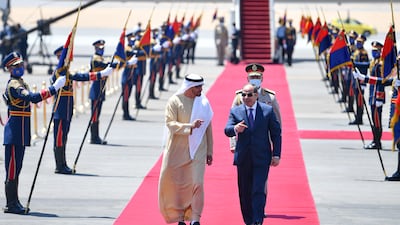
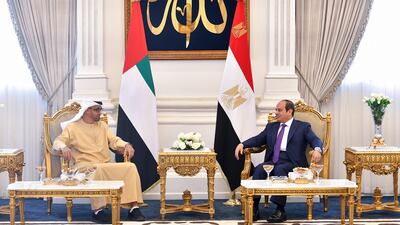
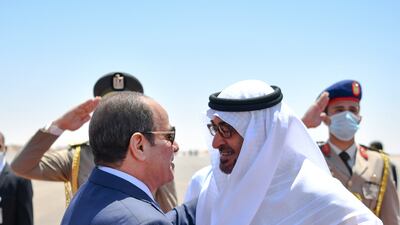
President Sheikh Mohamed with Abdel Fattah El Sisi in Egypt — in pictures

  • President Sheikh Mohamed is received by Abdel Fattah El Sisi, President of Egypt, on arrival at Al Alamein. All photos: Presidential Court
    President Sheikh Mohamed is received by Abdel Fattah El Sisi, President of Egypt, on arrival at Al Alamein. All photos: Presidential Court
  • Sheikh Mohamed and Abdel Fattah El Sisi stand for the national anthem at Al Alamein.
    Sheikh Mohamed and Abdel Fattah El Sisi stand for the national anthem at Al Alamein.
  • The leaders discussed bilateral co-operation and the many opportunities to grow and enhance the strategic partnership between the UAE and Egypt.
    The leaders discussed bilateral co-operation and the many opportunities to grow and enhance the strategic partnership between the UAE and Egypt.
  • They also exchanged views on several issues, dossiers of common concern and the latest regional and international developments.
    They also exchanged views on several issues, dossiers of common concern and the latest regional and international developments.

Since March, the Egyptian pound has depreciated by about 20 per cent.

Its value is expected to further slide in the remainder of the year — from the current 19.60 Egyptian pounds to the dollar to around 22 to 23 Egyptian pounds to the dollar by the beginning of next year.

A shortage of US dollars, partially caused by a soaring import bill and the flight of billions of dollars from Egypt’s once lucrative debt market, has hit local industries hard.


Cryopreservation: A timeline
  1. Keyhole surgery under general anaesthetic
  2. Ovarian tissue surgically removed
  3. Tissue processed in a high-tech facility
  4. Tissue re-implanted at a time of the patient’s choosing
  5. Full hormone production regained within 4-6 months
RESULTS

Lightweight (female)
Sara El Bakkali bt Anisha Kadka
Bantamweight
Mohammed Adil Al Debi bt Moaz Abdelgawad
Welterweight
Amir Boureslan bt Mahmoud Zanouny
Featherweight
Mohammed Al Katheeri bt Abrorbek Madaminbekov
Super featherweight
Ibrahem Bilal bt Emad Arafa
Middleweight
Ahmed Abdolaziz bt Imad Essassi
Bantamweight (female)
Ilham Bourakkadi bt Milena Martinou
Welterweight
Mohamed Mardi bt Noureddine El Agouti
Middleweight
Nabil Ouach bt Ymad Atrous
Welterweight
Nouredine Samir bt Marlon Ribeiro
Super welterweight
Brad Stanton bt Mohamed El Boukhari

MATCH INFO

Uefa Champions League semi-final, second leg result:

Ajax 2-3 Tottenham

Tottenham advance on away goals rule after tie ends 3-3 on aggregate

Final: June 1, Madrid

Tips to avoid getting scammed

1) Beware of cheques presented late on Thursday

2) Visit an RTA centre to change registration only after receiving payment

3) Be aware of people asking to test drive the car alone

4) Try not to close the sale at night

5) Don't be rushed into a sale 

6) Call 901 if you see any suspicious behaviour

Teaching your child to save

Pre-school (three - five years)

You can’t yet talk about investing or borrowing, but introduce a “classic” money bank and start putting gifts and allowances away. When the child wants a specific toy, have them save for it and help them track their progress.

Early childhood (six - eight years)

Replace the money bank with three jars labelled ‘saving’, ‘spending’ and ‘sharing’. Have the child divide their allowance into the three jars each week and explain their choices in splitting their pocket money. A guide could be 25 per cent saving, 50 per cent spending, 25 per cent for charity and gift-giving.

Middle childhood (nine - 11 years)

Open a bank savings account and help your child establish a budget and set a savings goal. Introduce the notion of ‘paying yourself first’ by putting away savings as soon as your allowance is paid.

Young teens (12 - 14 years)

Change your child’s allowance from weekly to monthly and help them pinpoint long-range goals such as a trip, so they can start longer-term saving and find new ways to increase their saving.

Teenage (15 - 18 years)

Discuss mutual expectations about university costs and identify what they can help fund and set goals. Don’t pay for everything, so they can experience the pride of contributing.

Young adulthood (19 - 22 years)

Discuss post-graduation plans and future life goals, quantify expenses such as first apartment, work wardrobe, holidays and help them continue to save towards these goals.

* JP Morgan Private Bank 

Ten tax points to be aware of in 2026

1. Domestic VAT refund amendments: request your refund within five years

If a business does not apply for the refund on time, they lose their credit.

2. E-invoicing in the UAE

Businesses should continue preparing for the implementation of e-invoicing in the UAE, with 2026 a preparation and transition period ahead of phased mandatory adoption. 

3. More tax audits

Tax authorities are increasingly using data already available across multiple filings to identify audit risks. 

4. More beneficial VAT and excise tax penalty regime

Tax disputes are expected to become more frequent and more structured, with clearer administrative objection and appeal processes. The UAE has adopted a new penalty regime for VAT and excise disputes, which now mirrors the penalty regime for corporate tax.

5. Greater emphasis on statutory audit

There is a greater need for the accuracy of financial statements. The International Financial Reporting Standards standards need to be strictly adhered to and, as a result, the quality of the audits will need to increase.

6. Further transfer pricing enforcement

Transfer pricing enforcement, which refers to the practice of establishing prices for internal transactions between related entities, is expected to broaden in scope. The UAE will shortly open the possibility to negotiate advance pricing agreements, or essentially rulings for transfer pricing purposes. 

7. Limited time periods for audits

Recent amendments also introduce a default five-year limitation period for tax audits and assessments, subject to specific statutory exceptions. While the standard audit and assessment period is five years, this may be extended to up to 15 years in cases involving fraud or tax evasion. 

8. Pillar 2 implementation 

Many multinational groups will begin to feel the practical effect of the Domestic Minimum Top-Up Tax (DMTT), the UAE's implementation of the OECD’s global minimum tax under Pillar 2. While the rules apply for financial years starting on or after January 1, 2025, it is 2026 that marks the transition to an operational phase.

9. Reduced compliance obligations for imported goods and services

Businesses that apply the reverse-charge mechanism for VAT purposes in the UAE may benefit from reduced compliance obligations. 

10. Substance and CbC reporting focus

Tax authorities are expected to continue strengthening the enforcement of economic substance and Country-by-Country (CbC) reporting frameworks. In the UAE, these regimes are increasingly being used as risk-assessment tools, providing tax authorities with a comprehensive view of multinational groups’ global footprints and enabling them to assess whether profits are aligned with real economic activity. 

Contributed by Thomas Vanhee and Hend Rashwan, Aurifer

Mercer, the investment consulting arm of US services company Marsh & McLennan, expects its wealth division to at least double its assets under management (AUM) in the Middle East as wealth in the region continues to grow despite economic headwinds, a company official said.

Mercer Wealth, which globally has $160 billion in AUM, plans to boost its AUM in the region to $2-$3bn in the next 2-3 years from the present $1bn, said Yasir AbuShaban, a Dubai-based principal with Mercer Wealth.

Within the next two to three years, we are looking at reaching $2 to $3 billion as a conservative estimate and we do see an opportunity to do so,” said Mr AbuShaban.

Mercer does not directly make investments, but allocates clients’ money they have discretion to, to professional asset managers. They also provide advice to clients.

“We have buying power. We can negotiate on their (client’s) behalf with asset managers to provide them lower fees than they otherwise would have to get on their own,” he added.

Mercer Wealth’s clients include sovereign wealth funds, family offices, and insurance companies among others.

From its office in Dubai, Mercer also looks after Africa, India and Turkey, where they also see opportunity for growth.

Wealth creation in Middle East and Africa (MEA) grew 8.5 per cent to $8.1 trillion last year from $7.5tn in 2015, higher than last year’s global average of 6 per cent and the second-highest growth in a region after Asia-Pacific which grew 9.9 per cent, according to consultancy Boston Consulting Group (BCG). In the region, where wealth grew just 1.9 per cent in 2015 compared with 2014, a pickup in oil prices has helped in wealth generation.

BCG is forecasting MEA wealth will rise to $12tn by 2021, growing at an annual average of 8 per cent.

Drivers of wealth generation in the region will be split evenly between new wealth creation and growth of performance of existing assets, according to BCG.

Another general trend in the region is clients’ looking for a comprehensive approach to investing, according to Mr AbuShaban.

“Institutional investors or some of the families are seeing a slowdown in the available capital they have to invest and in that sense they are looking at optimizing the way they manage their portfolios and making sure they are not investing haphazardly and different parts of their investment are working together,” said Mr AbuShaban.

Some clients also have a higher appetite for risk, given the low interest-rate environment that does not provide enough yield for some institutional investors. These clients are keen to invest in illiquid assets, such as private equity and infrastructure.

“What we have seen is a desire for higher returns in what has been a low-return environment specifically in various fixed income or bonds,” he said.

“In this environment, we have seen a de facto increase in the risk that clients are taking in things like illiquid investments, private equity investments, infrastructure and private debt, those kind of investments were higher illiquidity results in incrementally higher returns.”

The Abu Dhabi Investment Authority, one of the largest sovereign wealth funds, said in its 2016 report that has gradually increased its exposure in direct private equity and private credit transactions, mainly in Asian markets and especially in China and India. The authority’s private equity department focused on structured equities owing to “their defensive characteristics.”

How Alia's experiment will help humans get to Mars

Alia’s winning experiment examined how genes might change under the stresses caused by being in space, such as cosmic radiation and microgravity.

Her samples were placed in a machine on board the International Space Station. called a miniPCR thermal cycler, which can copy DNA multiple times.

After the samples were examined on return to Earth, scientists were able to successfully detect changes caused by being in space in the way DNA transmits instructions through proteins and other molecules in living organisms.

Although Alia’s samples were taken from nematode worms, the results have much bigger long term applications, especially for human space flight and long term missions, such as to Mars.

It also means that the first DNA experiments using human genomes can now be carried out on the ISS.


Abu Dhabi card

5pm: Handicap (TB) Dh100,000 2,400m

5.30pm: Wathba Stallions Cup Handicap (PA) Dh 70,000 2,200m

6pm: Abu Dhabi Fillies Classic Prestige (PA) Dh110,000 1,400m

6.30pm: Abu Dhabi Colts Classic Prestige (PA) Dh110,000 1,400m

7pm: Handicap (PA) Dh85,000 1,600m

7.30pm: Maiden (PA) Dh80,000 1,600m

The National selections:

5pm: Valcartier

5.30pm: AF Taraha

6pm: Dhafra

6.30pm: Maqam

7pm: AF Mekhbat

7.30pm: Ezz Al Rawasi  

Like a Fading Shadow

Antonio Muñoz Molina

Translated from the Spanish by Camilo A. Ramirez

Tuskar Rock Press (pp. 310)

The biog

Simon Nadim has completed 7,000 dives. 

The hardest dive in the UAE is the German U-boat 110m down off the Fujairah coast. 

As a child, he loved the documentaries of Jacques Cousteau

He also led a team that discovered the long-lost portion of the Ines oil tanker. 

If you are interested in diving, he runs the XR Hub Dive Centre in Fujairah


The specs

Engine: 6.2-litre supercharged V8

Power: 712hp at 6,100rpm

Torque: 881Nm at 4,800rpm

Transmission: 8-speed auto

Fuel consumption: 19.6 l/100km

Price: Dh380,000

On sale: now 

Key findings
  • Over a period of seven years, a team of scientists analysed dietary data from 50,000 North American adults.
  • Eating one or two meals a day was associated with a relative decrease in BMI, compared with three meals. Snacks count as a meal. Likewise, participants who ate more than three meals a day experienced an increase in BMI: the more meals a day, the greater the increase. 
  • People who ate breakfast experienced a relative decrease in their BMI compared with “breakfast-skippers”. 
  • Those who turned the eating day on its head to make breakfast the biggest meal of the day, did even better. 
  • But scrapping dinner altogether gave the best results. The study found that the BMI of subjects who had a long overnight fast (of 18 hours or more) decreased when compared even with those who had a medium overnight fast, of between 12 and 17 hours.
Avatar: Fire and Ash

Director: James Cameron

Starring: Sam Worthington, Sigourney Weaver, Zoe Saldana

Rating: 4.5/5

Updated: October 16, 2022, 9:25 AM