


Moody’s Investors Service placed Tunisia’s long-term foreign currency and local currency issuer ratings on review for downgrade.
Prior to this action, Tunisia’s rating was Caa1 with a negative outlook, the New York-based ratings agency said in a statement on Saturday.
“The decision to place the ratings on review for downgrade reflects our assessment that in the absence of timely agreement on a new International Monetary Fund programme, Tunisia’s increasingly elevated government liquidity risks and fragile external position raise the risk of default,” Moody’s said.
“Tunisia’s large fiscal and external imbalances and elevated refinancing risks represent significant credit weaknesses, which alongside social tensions have been exacerbated by the global implications of the Russia-Ukraine military conflict.”
The North African country was seeking to reach a deal with the IMF last month on a loan of between $2 billion and $4bn over three years, the central bank governor said.
Tunisia, which is suffering its worst financial crisis yet, is seeking an IMF loan to save public finances from collapse.
The country is struggling to revive its public finances as discontent grows over inflation running at nearly 9 per cent and a shortage of food in shops because the country cannot afford to pay for some imports.
The government and the Tunisian General Labour Union (UGTT) signed a deal last month to boost public sector wages by 5 per cent. But they did not announce any further agreement on reforms needed for an IMF bailout.
The IMF has signalled it will not move forward with a bailout sought by Tunis unless the government brings on board the UGTT, which says it has more than a million members and has previously shut down the economy with strikes.
Moody’s also placed the Central Bank of Tunisia’s Caa1 senior unsecured rating and Caa1 senior unsecured shelf rating on review for downgrade.
“The Central Bank of Tunisia is legally responsible for payments on the government’s bonds. These debt instruments are issued on behalf of the government,” the ratings agency said.
“Prior to this rating action, the Central Bank of Tunisia’s rating was Caa1 with a negative outlook.”
The review period will focus on evaluating the authorities’ progress in winning executive board approval for a new IMF programme, which is key to alleviating financing and external vulnerability risks, and ultimately social risks, before the end of the year, according to Moody’s.
It will also focus on the likelihood of the Tunisia government maintaining sufficient official financing sources in the coming years to avert a balance of payments or fiscal crisis with negative social implications, Moody’s added.
The agency estimated the government’s gross financing needs for this year at around 17 per cent of gross domestic product (GDP) and remaining above 15 per cent of GDP in 2023 as a result of rising debt amortisation payments and a still-high fiscal deficit.
Moody’s also expects Tunisia’s current account deficit to reach close to 10 per cent of GDP this year and remain around 8 per cent of GDP in 2023, from 5.9 per cent of GDP in 2021.
“In the absence of international market access at affordable costs and in view of domestic financing constraints, meeting these levels is achievable only through the concessional financing that would be unlocked by a new IMF programme,” Moody’s said.
“Beyond the financing provided by the IMF itself, further funds would likely be catalysed through a broad base of multilateral and bilateral partners.”
The IMF is likely to seek further reform commitments, including the restructuring of loss-making state-owned enterprises and the gradual phasing out of consumption subsidies in favour of more targeted financial transfers, the agency said.
“A downgrade of the rating would be likely if the sovereign were unable to secure in a timely manner multilateral financing, through the conclusion of an IMF agreement that is sustained and large enough to materially and durably ease liquidity pressures,” it added.
Tunisia struggles with food shortages - in pictures
-
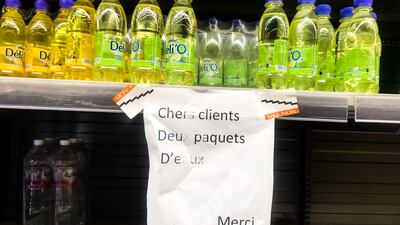
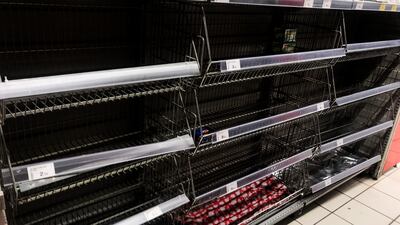
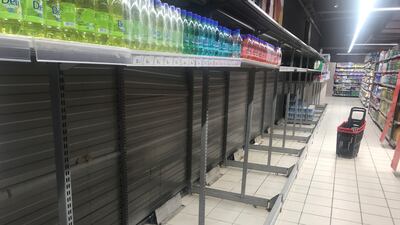
Empty shelves in a main supermarket in Tunis. Tunisian shops and supermarkets are struggling with massive shortages of basic food supplies such as cooking oil, sugar, coffee and bottled water. Ghaya Ben Mbarek for The National -
Shops have restricted their customers to buying a specific amount of supplies in an attempt to alleviate the worsening situation. Ghaya Ben Mbarek for The National -
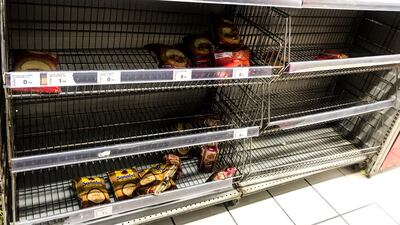
Most of the goods running short are state-subsidised, which analysts say highlights the growing dysfunction in the state-administered purchasing and distribution of food. They also say there is a growing black market in subsidised goods. Ghaya Ben Mbarek for The National -
For the past two weeks, coffee and tea have become the latest products to be scarce in supermarkets. Pictures have circulated online of empty shelves and brands limiting their sales to 100 grams per person. Ghaya Ben Mbarek for The National -
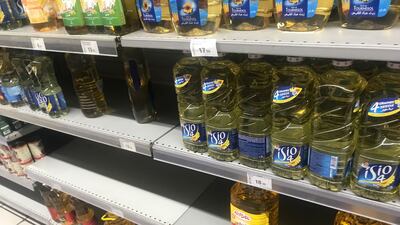
President Kais Saied and the Tunisian government have blamed the issue on traders monopolising control of basic goods and hoarders. Ghaya Ben Mbarek for The National -

A customer shops at a bakery in Tunis. Reuters -

Fruit for sale at Sidi Bahri market in Tunis. Reuters -
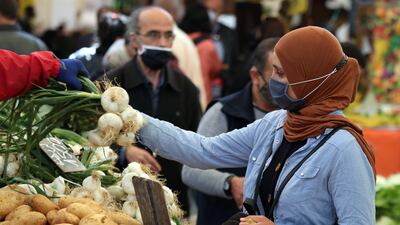
A Tunisian woman buys vegetables on the first day of the Muslim holy month of Ramadan at a market in Tunis, on April 13, 2021. EPA -

Sidi Bahri market in Tunis, on June 27, 2021. Reuters -

Vegetables for sale in Sidi Bahri market in Tunis. Reuters -
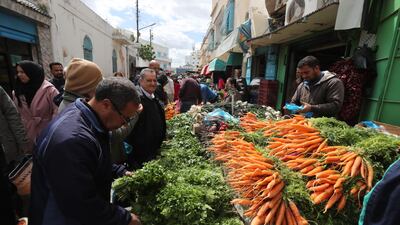
Tunisians buy fresh produce at a market on the first day of the Muslim fasting month of Ramadan in Tunis, on April 2. EPA -
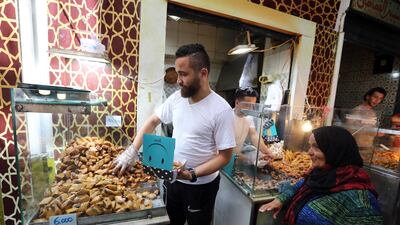
A man sells traditional cakes in his shop at the old city in Tunis, on July 1, 2022. EPA -
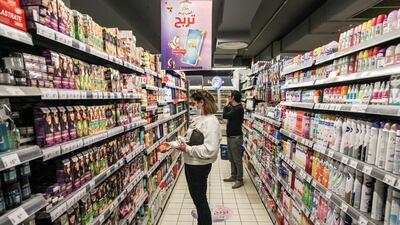
Shoppers browse products in a supermarket in the Ariana district of Tunis, on April 8. Turmoil triggered by rising food and energy prices is already gripping countries, including Sri Lanka, Egypt, Tunisia and Peru. Photo: Bloomberg -
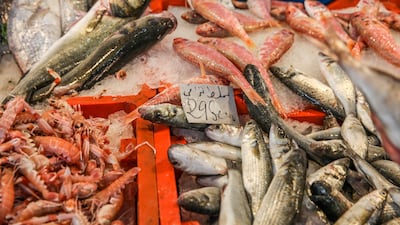
A Tunisian dinar price tag on a display of fresh fish at a fishmonger's shop in the Ariana district of Tunis, on April 8, 2022. Photo: Bloomberg -
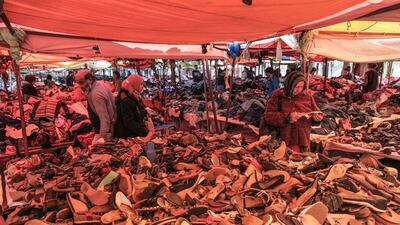
Shoppers browse shoes for sale at a second-hand clothing market in the Ettadhamen district of Tunis, on April 8, 2022. Photo: Bloomberg



