


The world needs far greater international co-operation to meet its climate commitments and a collaboration gap between countries can severely undermine climate progress, delaying net-zero targets by decades.
Nations around the globe must align actions and co-ordinate investments to scale up deployment and drive down costs across five key sectors: power, road transport, steel, hydrogen and agriculture, according to a report produced jointly by the International Energy Agency (IEA), the International Renewable Energy Agency (Irena) and the UN.
Together, these sectors account for about 60 per cent of global greenhouse gas emissions and could deliver the bulk of the emission reductions needed by 2030 that would make a significant contribution to limiting global warming to a maximum of 1.5°C in line with the Paris Agreement goals, the Breakthrough Agenda, as the report is known, said.
Against the backdrop of the current energy crisis and looming global food shortages, the report has set out the agenda of 25 collaborative actions for global leaders attending Cop27 in Egypt that could help boost the production of clean power, electric vehicles, low-carbon steel and hydrogen.
These steps could help make sustainable farming a cheaper option and provide food security to billions of people around the world.
“We are in the midst of the first truly global energy crisis, with devastating knock-on consequences across the world economy, especially in developing countries. Only by speeding up the transition to clean sustainable energy can we achieve lasting energy security,” said IEA executive director Fatih Birol.
“Through international collaboration, we can make the transition quicker, cheaper and easier for everyone,” as without this, the transition to net-zero emissions will be “much more challenging”, he added.
Global leaders are pushing for a net-zero transition by 2050 and to meet the Paris Agreement goal to limit global warming to 1.5°C above pre-industrial levels.
There is a stronger emphasis on building a greener and more sustainable economy as the world emerges from the pandemic. Governments around the globe have committed to cutting their carbon footprint and have set ambitious targets to meet global climate action goals.
Climate change could cost the global economy $178 trillion over the next 50 years, or a 7.6 per cent cut to the global gross domestic product in 2070, if left unchecked, a June report by Deloitte showed.
However, if global leaders unite and meet the net-zero goals, the global economy could gain $43tn in the next 50 years, giving global GDP a 3.8 per cent boost in 2070, the report found.
The joint report from the IEA, Irena and the UN said that, in addition to delivering on emissions reductions, global leaders also need to ensure a faster and cheaper transition, while boosting job growth.
The report, released before the Global Clean Energy Action Forum to be held in the US from September 21 to 23, has put forward 25 recommendations for policymakers.
These recommendations range from demonstrating and testing flexible low-carbon power systems to increasing renewables, creating cross-border super-grids this decade, reducing emissions and improving energy security.
They also call for setting up new international centres of expertise to channel finance and technical assistance to help coal-producing countries transition, mobilise investment in charging infrastructure and standards to boost the recyclability of batteries and supercharging.
The report also underlined some of the achievements already made in recent years, including a 130 per cent increase in renewable capacity in the past decade, as opposed to a 24 per cent growth of non-renewable sources over the same period.
However, the power sector needs to deliver an additional renewable capacity of 630 gigawatts for solar and 30 gigawatts of wind each year by 2030, four times the current annual increase.
It called on governments to increase the scale, co-ordination and accessibility of international support for the power sector transition, reassess the opportunities for cross-border and regional power interconnection and agree to higher minimum energy performance standards for high energy-consuming appliances.
Within the road transport sector, zero-emissions vehicles accounted for about 9 per cent of global car sales in 2021, a ratio that needs to reach 60 per cent by 2030 and be supported by a 10-fold increase in public charging infrastructure.
-

Engineers carry solar panels on to the roof of a property in Barcelona in September 2022. Spain and other Mediterranean countries have generated record amounts of power from wind and solar farms. Bloomberg -
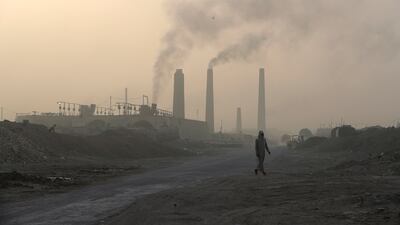
Smoke rises from brick factory stacks in Nahrawan, Baghdad. Tackling emissions from heavy industry is crucial to tackling global warming. Reuters -

A boy stands near a flock of sheep as a sandstorm approaches in the Syrian countryside of Tabqa. Syria is among the countries most vulnerable and poorly prepared for climate change, which is expected to worsen. AFP -

Mountains of smouldering rubbish at the Bhalswa landfill in New Delhi, India. Reuters -
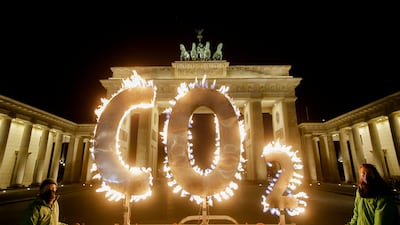
Greenpeace activists take part in a climate change protest in front of the Brandenburg Gate in Berlin in May. AP -
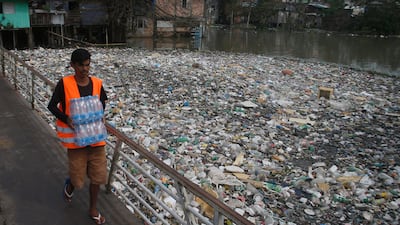
A man carries water bottles across the heavily polluted Negro River in Manaus, Brazil. About 35 tonnes of rubbish are removed daily from the river. AP -
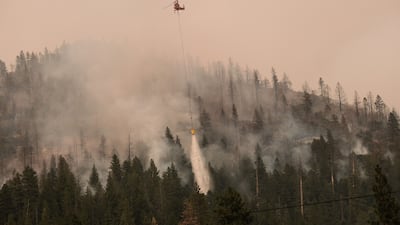
A helicopter drops water on a brush fire in California. Bloomberg -
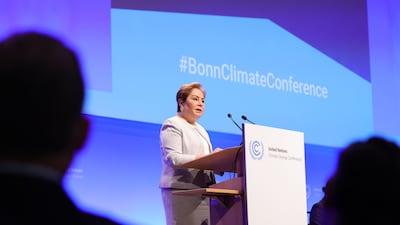
UN climate chief Patricia Espinosa speaks on the opening day of the Bonn climate change conference in Germany. Getty -

Activists take part in a demonstration to raise awareness of global warming, during an event to mark World Environment Day in Kolkata. AFP -
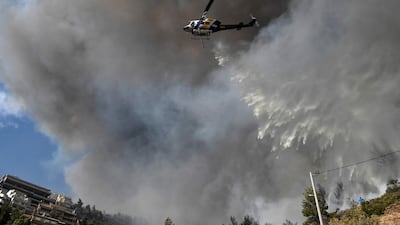
A helicopter drops water on a bushfire near a residential district in Athens. The fire forced residents to flee. AFP -
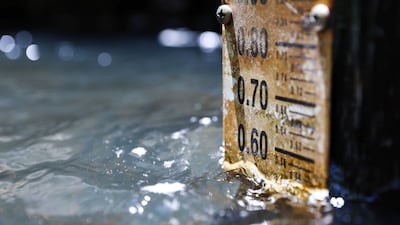
A gauge measures water levels in the Rio Nambe river, in New Mexico. Ninety per cent of the state is experiencing extreme drought. Getty -

Afghan refugees search for recyclable material from heaps of rubbish in Karachi, Pakistan. AP -

A climate activist ties herself to the net during the semi-final tennis match between Croatia's Marin Cilic and Norway's Casper Ruud at the French Open in Roland Garros in Paris. AP -

A dance group performs at a climate summit in Stockholm, Sweden. Getty -

US climate envoy John Kerry talks to a delegate at the Stockholm 50 climate summit. Getty -
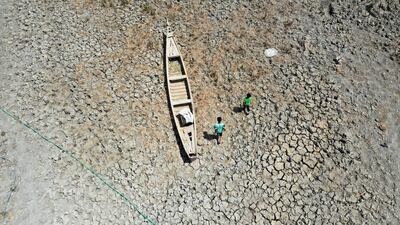
A boat is stranded during low tide at the Chebayesh marsh in Dhi Qar province, Iraq. Reuters -
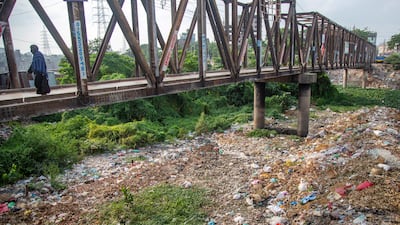
A woman crosses a polluted river in Dhaka, Bangladesh. EPA -
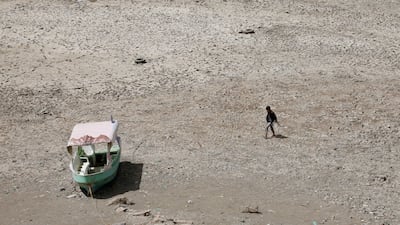
A man walks past an abandoned boat in the bed of a drought-affected reservoir on the outskirts of Sana'a, Yemen. EPA


The report called for an agreement on a common definition and target dates by which all new road vehicles will be net zero, with a 2035 target for cars and vans and one in the 2040s for heavy-duty vehicles, and mobilising investment in charging infrastructure.
Production of renewable and low-carbon hydrogen will need to increase from less than one million tonnes in 2020 to about 150 million tonnes by 2030, doubling each year.
Similarly, the production of low-carbon steel, which currently stands at less than one million tonnes today, needs to rise to more than 100 million tonnes by the end of this decade to deliver a reduction in the emissions intensity of 30 per cent, the report said.
Agriculture and related land use account for about 20 per cent of global emissions and the sector requires a ramp-up of investment in research and development of new technologies to improve yield and stop deforestation, it added.
“The energy and climate crisis has exposed the weaknesses and vulnerabilities of a system heavily reliant on fuels of the 20th century,” said Francesco La Camera, director general of Irena.
“Advancing the transition to renewables is a strategic choice to bring affordable energy, jobs, economic growth and a cleaner environment to the people on the ground.”

