Oman’s January-June period fiscal improvement was driven by a 54 per cent annual increase in government revenue. Silvia Razgova / The National

Oman poised to post first yearly fiscal surplus in a decade in 2022, Fitch says


Alkesh Sharma
  • English
  • Arabic

Oman, which recorded a budget surplus of 784 million Omani rials ($2 billion) in the first half of the year, is poised to post its first yearly fiscal surplus in a decade in 2022, according to Fitch Solutions.

The sultanate's 12-month fiscal surplus is expected to amount to 6.5 per cent of its total gross domestic product this year, Fitch estimates.

Revenue will rise further in the second half of the year because of high energy prices, it said.

“We expect that expenditure growth will remain moderate due to authorities’ commitment to fiscal consolidation,” Fitch said.

Oman’s January-June period budget surplus was driven by a 54 per cent annual increase in government revenue, supported by a more than 40 per cent jump in oil revenue and a nearly 138 per cent increase in gas revenue.

Oman’s average oil price of $87 a barrel for [the first half of 2022] is below the average Brent oil price [of $105.85 a barrel] as Oman’s budgeted oil price is lagged by approximately three months, Fitch said.

“An increase in Oman’s average oil price in the coming months will lead to more growth in its hydrocarbon revenue [in the second half], supporting overall revenue growth which we forecast at 41.3 per cent in 2022.”

Oil prices, which rose by 67 per cent in 2021, continued to increase this year as the Russia-Ukraine conflict led to supply concerns in the market. While prices have dropped in recent days on demand concerns amid growing fears of a recession, they remain near the $90-to-$100 a barrel mark.

Sultan Haitham, Ruler of Oman, earlier this year said that the country planned to use revenue from rising oil prices to reduce its public debt and support spending on government projects, while ensuring inflation does not affect basic commodity prices.

Oman, a relatively small crude producer compared with its Gulf neighbours, is more sensitive to oil-price swings and was hit hard by the coronavirus pandemic.

However, higher oil prices, along with fiscal reforms, helped to narrow government deficit.

The country's public debt reduced to 18.6bn rials at the end of July, from 20.8bn rials at the end of 2021, in line with government efforts to reduce debt servicing cost, Fitch said.

Debt is further projected to decrease to 17.5bn rials towards the end of the year, the report said. This will bring Oman’s debt to GDP ratio to 47.5 per cent in 2022, down from 67.3 per cent last year.

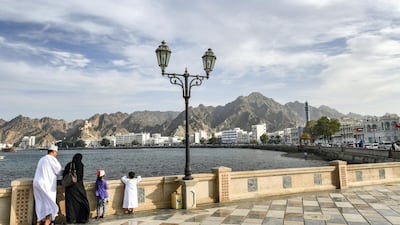
  • An Omani family stands by the waterfront in the Mutrah area of the capital Muscat. AFP
    An Omani family stands by the waterfront in the Mutrah area of the capital Muscat. AFP
  • A general view inside the Sultan Qaboos Grand Mosque in Muscat, Oman. EPA
    A general view inside the Sultan Qaboos Grand Mosque in Muscat, Oman. EPA
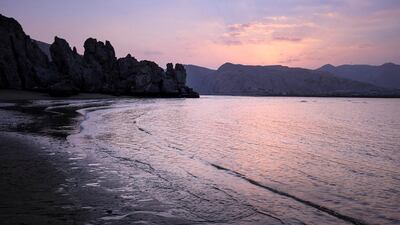
  • Yitti beach at sunset. Reem Mohammed/The National
    Yitti beach at sunset. Reem Mohammed/The National
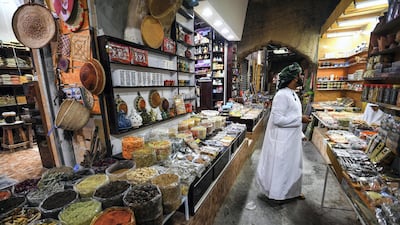
  • An Omani shopping at the souq in the city of Nizwa, about 160 kilometres southwest of the capital Muscat. AFP
    An Omani shopping at the souq in the city of Nizwa, about 160 kilometres southwest of the capital Muscat. AFP
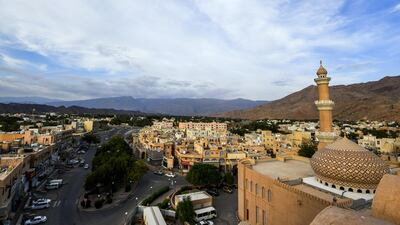
  • A view of the city of Nizwa from the walls of the 17th-century fortification of the same name, about 160 kilometres southwest of the capital Muscat. AFP
    A view of the city of Nizwa from the walls of the 17th-century fortification of the same name, about 160 kilometres southwest of the capital Muscat. AFP
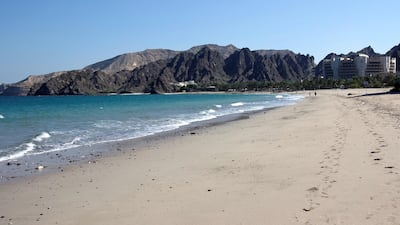
  • Al Bustan beach, Muscat. Charlotte Mayhew/ The National
    Al Bustan beach, Muscat. Charlotte Mayhew/ The National
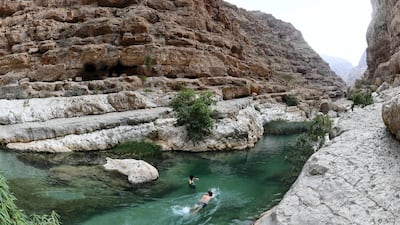
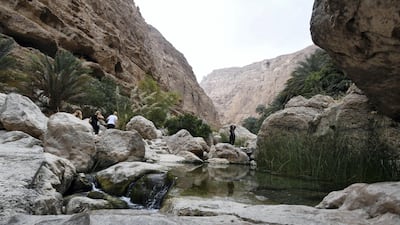
  • Tourists swim at Wadi Shab in the Sharqiyah region near the Omani capital Muscat. AFP
    Tourists swim at Wadi Shab in the Sharqiyah region near the Omani capital Muscat. AFP
  • A tourist lifts up a boy as they visit waterfalls at Ayn Athum in Salalah, Dhofar province, Oman. REUTERS
    A tourist lifts up a boy as they visit waterfalls at Ayn Athum in Salalah, Dhofar province, Oman. REUTERS
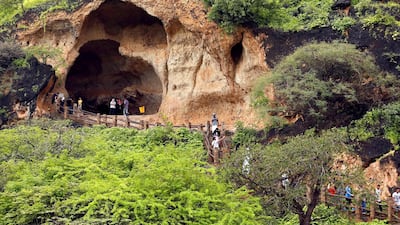
  • Tourists visit a cave at Ain Razat, a water spring in Salalah, Dhofar province, Oman. REUTERS
    Tourists visit a cave at Ain Razat, a water spring in Salalah, Dhofar province, Oman. REUTERS
  • Tourists swim at Wadi Shab in the Sharqiyah region near the Omani capital Muscat. AFP
    Tourists swim at Wadi Shab in the Sharqiyah region near the Omani capital Muscat. AFP

Oman’s expenditure growth is expected to moderate in the second half, in line with authorities’ fiscal consolidation efforts.

“The data release showed an increase of 8.6 per cent in total expenditure, on the back of additional fuel and food subsidies due to soaring prices,” Fitch said.

“We expect that spending growth will decelerate in the second half as global commodity prices start decreasing, reducing pressure on total expenditures, which we forecast at 5.1 per cent in 2022.”

Besides oil, tourism is another major contributor to the state exchequer.

Oman has attracted more than half of the targeted 3bn rials in tourism investments planned between 2021 and 2023 as part of its development scheme, it said this month.

Last month, Fitch Solutions maintained a positive outlook for tourism recovery in Oman during 2022 and 2023, with stronger growth projected in the medium term between 2024 to 2026.


'Nope'
%3Cp%3E%3Cstrong%3EDirector%3A%3C%2Fstrong%3E%20Jordan%20Peele%0D%3Cbr%3E%3Cstrong%3EStars%3A%3C%2Fstrong%3E%20Daniel%20Kaluuya%2C%20Keke%20Palmer%2C%20Brandon%20Perea%2C%20Steven%20Yeun%0D%3Cbr%3E%3Cstrong%3ERating%3A%3C%2Fstrong%3E%203.5%2F5%3C%2Fp%3E%0A

Mercer, the investment consulting arm of US services company Marsh & McLennan, expects its wealth division to at least double its assets under management (AUM) in the Middle East as wealth in the region continues to grow despite economic headwinds, a company official said.

Mercer Wealth, which globally has $160 billion in AUM, plans to boost its AUM in the region to $2-$3bn in the next 2-3 years from the present $1bn, said Yasir AbuShaban, a Dubai-based principal with Mercer Wealth.

Within the next two to three years, we are looking at reaching $2 to $3 billion as a conservative estimate and we do see an opportunity to do so,” said Mr AbuShaban.

Mercer does not directly make investments, but allocates clients’ money they have discretion to, to professional asset managers. They also provide advice to clients.

“We have buying power. We can negotiate on their (client’s) behalf with asset managers to provide them lower fees than they otherwise would have to get on their own,” he added.

Mercer Wealth’s clients include sovereign wealth funds, family offices, and insurance companies among others.

From its office in Dubai, Mercer also looks after Africa, India and Turkey, where they also see opportunity for growth.

Wealth creation in Middle East and Africa (MEA) grew 8.5 per cent to $8.1 trillion last year from $7.5tn in 2015, higher than last year’s global average of 6 per cent and the second-highest growth in a region after Asia-Pacific which grew 9.9 per cent, according to consultancy Boston Consulting Group (BCG). In the region, where wealth grew just 1.9 per cent in 2015 compared with 2014, a pickup in oil prices has helped in wealth generation.

BCG is forecasting MEA wealth will rise to $12tn by 2021, growing at an annual average of 8 per cent.

Drivers of wealth generation in the region will be split evenly between new wealth creation and growth of performance of existing assets, according to BCG.

Another general trend in the region is clients’ looking for a comprehensive approach to investing, according to Mr AbuShaban.

“Institutional investors or some of the families are seeing a slowdown in the available capital they have to invest and in that sense they are looking at optimizing the way they manage their portfolios and making sure they are not investing haphazardly and different parts of their investment are working together,” said Mr AbuShaban.

Some clients also have a higher appetite for risk, given the low interest-rate environment that does not provide enough yield for some institutional investors. These clients are keen to invest in illiquid assets, such as private equity and infrastructure.

“What we have seen is a desire for higher returns in what has been a low-return environment specifically in various fixed income or bonds,” he said.

“In this environment, we have seen a de facto increase in the risk that clients are taking in things like illiquid investments, private equity investments, infrastructure and private debt, those kind of investments were higher illiquidity results in incrementally higher returns.”

The Abu Dhabi Investment Authority, one of the largest sovereign wealth funds, said in its 2016 report that has gradually increased its exposure in direct private equity and private credit transactions, mainly in Asian markets and especially in China and India. The authority’s private equity department focused on structured equities owing to “their defensive characteristics.”

Top 10 most polluted cities
  1. Bhiwadi, India
  2. Ghaziabad, India
  3. Hotan, China
  4. Delhi, India
  5. Jaunpur, India
  6. Faisalabad, Pakistan
  7. Noida, India
  8. Bahawalpur, Pakistan
  9. Peshawar, Pakistan
  10. Bagpat, India
Updated: August 09, 2022, 3:30 AM