


The rising risk of a recession, broad-based inflation and subsequent interest rate increases are weighing on the economic recovery that will force the International Monetary Fund to downgrade its global economic growth projections again for this year and the next.
Recent economic indicators imply a “weak second quarter and we will be projecting a further downgrade” to both 2022 and 2023 global growth in the World Economic Outlook Update, which will be released later this month, said Kristalina Georgieva, managing director of the IMF.
“Indeed, the outlook remains extremely uncertain. Think of how further disruption in the natural gas supply to Europe could plunge many economies into recession and trigger a global energy crisis. This is just one of the factors that could worsen an already difficult situation,” Ms Georgieva said in a blog post published on Wednesday.
“It is going to be a tough 2022 — and possibly an even tougher 2023, with increased risk of recession.”
In April, the fund lowered its growth forecast for the global economy to 3.6 per cent in 2022 and 2023, revising it down 0.8 and 0.2 percentage points from its January forecast, respectively.
-
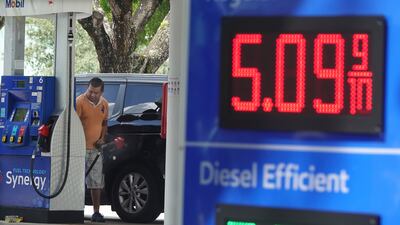
For the first time ever, the price for a gallon of regular petrol has hit more than $5. AP -

US President Joe Biden speaks about the economy and inflation at the Port of Los Angeles in California. AFP -
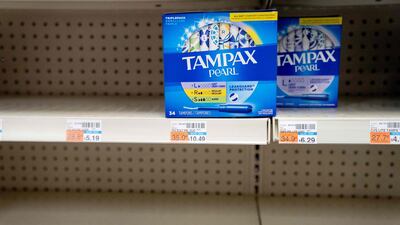
Tampons have reportedly been in short supply in stores across the US due to global supply chain issues. AFP -

Pay rates displayed at a Taco Bell fast food outlet in Sacramento, after the California minimum wage was increased due to inflation. AP -
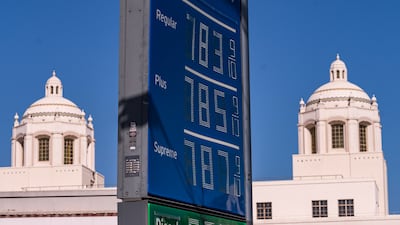
Various grades of petrol, with prices above $7 per gallon, are displayed at a Chevron gas station in central Los Angeles, California. AP -

The rising cost of items including clothing, food, petrol and cars is hitting Americans' pockets, despite historically low unemployment. AFP -
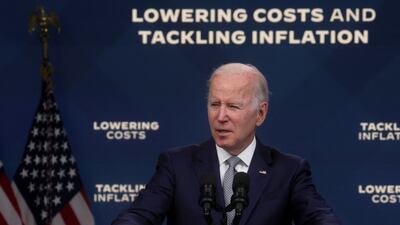
Mr Biden announces plans to fight inflation and lower costs. Reuters -
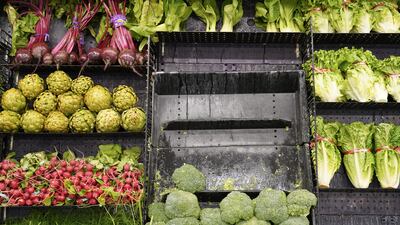
Supermarkets across the US are struggling to keep shelves stocked because of supply chain issues. Willy Lowry / The National -
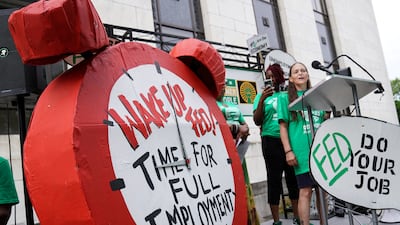
Protesters with the Centre for Popular Democracy stage a demonstration in support of employment rights in June 2022. Reuters -

Diners in San Francisco, California. With prices so high, many US consumers say they are cutting back on eating out. AFP -

Bags of purchases from a Dollar Tree store in Jackson, Mississippi. The company sells items at $1. AP -

Volunteers gather food to hand out at a West Texas Food Bank drive-through in Odessa, Texas. Bloomberg -

A hiring poster at a Chipotle fast food restaurant in Los Angeles, California. US unemployment stands at 3.6 per cent, about 0.1 per cent above a 50-year low in 2019. EPA -

Supermarket shoppers in Rosemead, California. High food prices are causing hardship for some Americans. AFP -
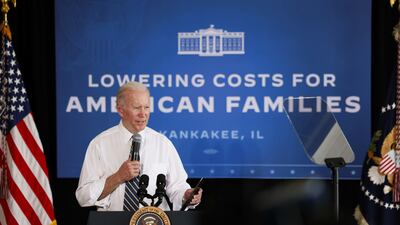
Mr Biden speaks on lowering costs for American families in Illinois. Bloomberg -

Nearly empty shelves in a supermarket in Orlando, Florida. AP


The World Bank also slashed its growth forecast for the global economy for the second time this year in June, cutting its outlook estimate for 2022 to 2.9 per cent, from a previous 3.2 per cent projection.
On Tuesday, the IMF also cut its forecast for the economic growth in the US, the world’s biggest economy, in 2022 and 2023, warning that surging inflation poses "systemic risks" to the country and the global economy amid Russia’s continued military assault in Ukraine that has exacerbated the slowdown from the Covid-19 pandemic.
Russia’s military offensive has also stoked the global commodities cycle, that has added to economic uncertainties, and exacerbated inflation that was already on the rise.
Food prices are expected to increase about 14 per cent this year, on top of a 28 per cent gain in 2021. Russia and Ukraine collectively account for about a quarter of global wheat supply. Before the war, Russia was the world’s largest wheat exporter and Ukraine the fifth, World Bank data indicated.
In April, the IMF said it expects inflation to reach 5.7 per cent in advanced economies and 8.7 per cent in emerging market and developing economies this year. Inflation was projected to fall to 2.5 per cent for advanced economies and 6.5 per cent in emerging market and developing nations for 2023.
“Inflation is higher-than-expected and has broadened beyond food and energy prices,” Ms Georgieva said.
“This has prompted major central banks to announce further monetary tightening, which is necessary but will weigh on the recovery.”
Continuing pandemic-related disruptions, especially in China, and renewed bottlenecks in global supply chains are also hampering economic activity, she added.
The IMF said decisive action and strong international co-operation, led by the G20, is needed to navigate “this sea of troubles”.
To avoid potential crises and boost growth and productivity, co-ordinated international action is required, the IMF said.
Most urgent of all is action to alleviate the cost-of-living crisis, which is pushing an additional 71 million people into extreme poverty in the world's poorest countries, according to the UN Development Programme, the IMF added.
“As concerns over food and energy supplies increase, risks of social instability are rising,” the lender said.
The first and foremost priority for countries must be to “do everything in their power to bring down high inflation”, Ms Georgieva said.
“Why? Because persistently high inflation could sink the recovery and further damage living standards, particularly for the vulnerable.”
Although tightening cycles are under way in most economies, many central banks will need to continue to decisively tighten monetary policy because delaying action now would likely create more severe challenges later.
Financial policymakers should also pursue a fiscal policy that help and not hinder central banks’ efforts to bring down inflation, the IMF said.
Countries facing elevated debt levels will also need to tighten their fiscal policy that could help reduce the burden of increasingly expensive borrowing as they complement monetary efforts to tame inflation, the fund added.
“In countries where recovery from the pandemic is more advanced, shifting away from extraordinary fiscal support will help tamp down demand and thus reduce price pressures,” according to the IMF.

