


The electric vehicle plant being built in Saudi Arabia by Lucid Group will likely be one of three assembly plants in the country, as the kingdom pushes for mega investments in new sectors, its investment minister has said.
“We just broke ground on the world's most exciting electric vehicle assembly plant,” Khalid Al Falih told a panel discussion at the World Economic Forum in Davos on Wednesday.
“150,000 vehicles will be assembled in Saudi Arabia in two years and this is one of likely three mega assembly plants."
He did not provide details on who is investing in the additional plants and whether they will build EVs or conventional combustion engine vehicles.
-
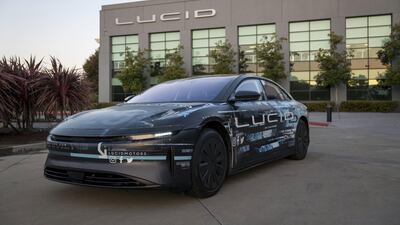
Lucid plans a phased global expansion with Saudi Arabia – the Arab world’s largest economy. Bloomberg -
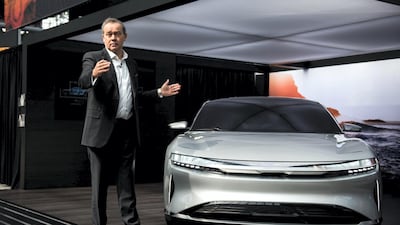
Peter Rawlinson, chief technology officer for Lucid Motors Inc. -

Lucid was founded in 2007 under the name Atieva and was initially focused on building EV batteries. -
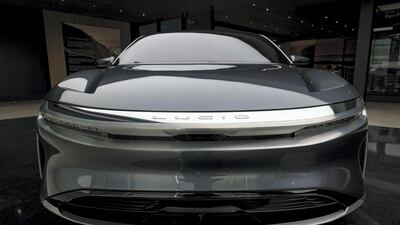
In 2016, it rebranded as Lucid Motors, moved away from being a supplier and pivoted towards making a rival luxury sedan to Tesla. -
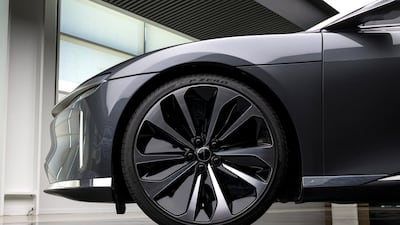
In 2018, the PIF invested more than $1 billion (Dh3.67bn) in Lucid for a majority stake in the company and to help accelerate the manufacturing of its first EV. -
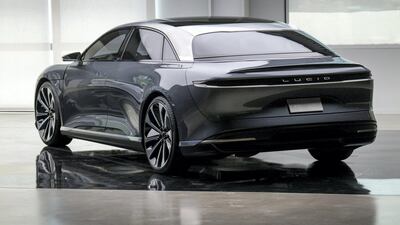
Lucid aims to produce up to 8,000 units of Air from its Arizona facility next year and then increase that to 25,000 and 34,000 in 2022 and 2023, respectively. -
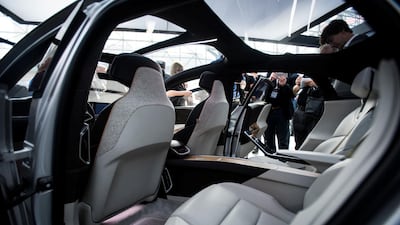
Other investors of Lucid include Tokyo-based Mitsui and California’s venture capitalist Venrock. -
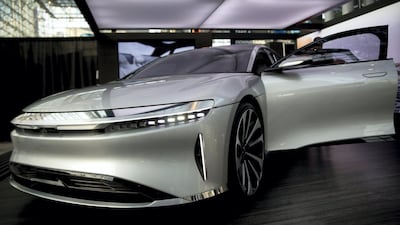
The company claims Air will be the fastest-charging EV in the market, with a charging speed of more than 32 kilometres per minute, under controlled conditions.


Earlier this month, Lucid Group, which is backed by Saudi Arabia's sovereign wealth fund, the Public Investment Fund (PIF), formally signed agreements for its new factory in the kingdom with a capacity of 155,000 units a year.
The assembly plant, the first in the Arab world’s largest economy, will push Lucid’s global production capacity to 500,000 EVs a year in the coming years, as it caters to a growing global demand for EVs, the company said at the time.
The US-listed car maker signed preliminary agreements in February with several Saudi entities, including the Ministry of Investment, the Saudi Industrial Development Fund, the Economic City at King Abdullah Economic City, and Gulf International Bank for the new plant.
These deals are estimated to provide financing and incentives worth $3.4 billion to Lucid over the next 15 years to build and operate the assembly plant in the kingdom.
Saudi Arabia, the world’s biggest oil exporter, is overhauling its economy under its overarching Vision 2030 agenda. Driving foreign investments and expanding its manufacturing base are among critical pillars of Riyadh’s strategy to cut its dependence on oil revenues.
Expanding into EV manufacturing will also support the kingdom’s sustainable development goals, which apply to all sectors of its economy. Saudi Arabia aims to achieve net-zero carbon emissions by 2060 through a circular carbon economy approach.
The PIF remains central to Riyadh’s efforts to diversify its economy and is at the heart of the kingdom’s investment strategy at home and abroad.
Under a five-year strategy announced last year, the fund aims to more than double the value of its assets under management to $1.07 trillion.
To a question on whether the kingdom still has appetite for investments in the US given its lukewarm relations with the White House, Finance Minister Mohammed Al Jadaan said on Wednesday that the PIF invests on the government’s behalf and that “they have not been shy in investing in the US”.
“We are continuing to invest in the US and elsewhere and the relationship [with the US] has been very good all over, despite whatever you hear,” he added.
PIF is also focusing on developing Saudi Arabia's local economy, and has committed to spend $40bn annually in the kingdom.
The sovereign fund is backing the $500bn futuristic city of Neom and multi-billion-dollar projects near Riyadh and on the Red Sea coast of the kingdom.
“All of the giga projects with the PIF are going [ahead] and unlocking and catalysing sectors that are open for foreign direct investment,” Mr Al Falih said.
In October, Saudi Arabia’s Crown Prince Mohammed bin Salman launched the National Investment Strategy, which seeks to net 388bn Saudi riyals ($103.47bn) in FDI annually by 2030. The kingdom aims to increase the contribution of the private sector to its gross domestic product to 65 per cent and increase the share of FDI to 5.7 per cent of its GDP.
Investment Minister, Saudi Arabia
Last year, Saudi Arabia received close to $20bn in FDI, up 257 per cent annually, with the second half of the year showing a 23.7 per cent year-on-year increase, the Ministry of Investment said at the time.
“We wanted to increase our total capital formation in absolute terms, but also as a percentage of our rapidly increasing GDP,” Mr Al Falih said.
He said the kingdom is following its growth plans and is also ahead of these in many aspects.
“Not only [is] our GDP growth [accelerating] where we're crossing the $1 trillion threshold, we’re on our way to $1.6tn to $1.8tn, which we project will position us as the 15th largest economy,” he added.

