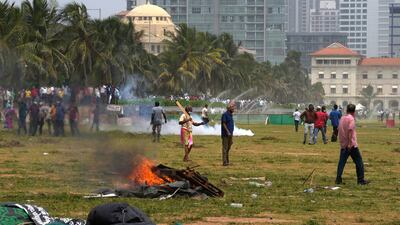
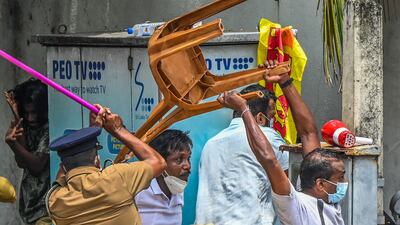
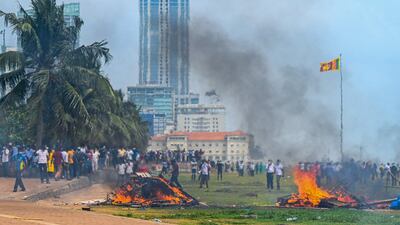
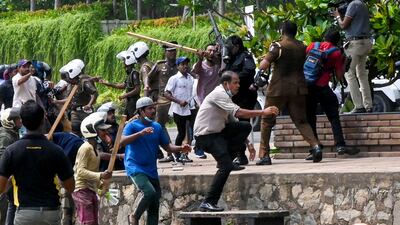
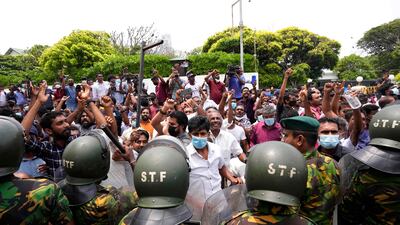
Protesters take part in an anti-government demonstration in Colombo, Sri Lanka, on May 18, 2022, demanding President Gotabaya Rajapaksa’s resignation over the country's crippling economic crisis. AFP

Sri Lanka defaults for first time in its history as inflation soars


  • English
  • Arabic

Sri Lanka has fallen into default for the first time in its history as the government struggles to halt an economic meltdown that has prompted mass protests and a political crisis.

Policymakers had flagged to creditors that the nation would not be able to make payments until the debt is restructured, and is therefore in pre-emptive default, central bank governor Nandalal Weerasinghe said at a briefing on Thursday. The coupon payments, originally due on April 18, were worth $78 million combined on notes maturing in 2023 and 2028. A 30-day grace period expired on Wednesday.

Sri Lanka has been mired in turmoil amid surging inflation — which Mr Weerasinghe sees accelerating to 40 per cent in the coming months — a plummeting currency and an economic crisis that has left the country short of the hard currency it needs to import food and fuel.

Public anger has boiled over into violent protests and led the government to announce last month it would halt payments on its $12.6 billion pile of foreign debt to preserve cash for essential goods.

That marks the nation’s first sovereign debt default since it gained independence from Britain in 1948. Its bonds are among the worst performers in the world this year and trade deep in distressed territory, with holders bracing for losses approaching 60 cents on the dollar.

Many of Sri Lanka’s bonds have so-called cross-default clauses, which drag all the outstanding dollar debt into default if there is a missed payment in a single bond. On the debt due in 2023 and 2028, the clause is triggered if any payment that exceeds $25m is not met. The country was already declared in selective default by S&P Global Ratings in late April.

Sri Lanka is in talks with the International Monetary Fund (IMF) for a bailout and needs to negotiate a debt restructuring with creditors. The country has previously said it needs between $3bn and $4bn this year to pull itself out of crisis.

“It’s not a surprise,” said Guido Chamorro, the co-head of emerging-market hard-currency debt at Pictet Asset Management, which holds Sri Lankan bonds. “It was well flagged and mostly priced with most bonds priced in the high 30s.”

Nandalal Weerasinghe, governor of the Central Bank of Sri Lanka, speaks during a monetary policy review news conference in Colombo on May 19, 2022. Bloomberg

Tighter global credit brought about by a litany of factors — the US Federal Reserve interest rate rises, soaring commodity costs and the war in Ukraine — have had a devastating effect on the low-income country, which is the biggest sovereign issuer of junk dollar bonds in Asia. And all that’s after the pandemic reduced tourism revenue by more than three quarters.

Mr Weerasinghe said on Thursday that he would like to see a finance minister appointed to sign off on any aid agreements. However, the political situation has improved with the appointment of Prime Minister Ranil Wickremesinghe. Mr Weerasinghe said that gives him comfort to continue in his job. Last week, he had threatened to quit if political stability doesn’t return soon.

“With a prime minister and cabinet in place, and parliament in session, Sri Lanka is in a better place and seems to be going in the right direction,” Mr Weerasinghe said. This is perhaps the best time to invest in Sri Lanka as "we offer an attractive rate of return", he added.

JPMorgan Chase on Wednesday turned overweight on Sri Lanka’s dollar bonds, saying recent events point towards political stability, which could pave the way for discussions with the IMF and debt-restructuring talks.

  • Violence raged across Sri Lanka late into the night on Monday, with five people dead and some 180 injured. AFP
    Violence raged across Sri Lanka late into the night on Monday, with five people dead and some 180 injured. AFP
  • Sri Lanka's pro-government supporters vandalise camps of anti government protestors outside the president's office in Colombo. AP Photo
    Sri Lanka's pro-government supporters vandalise camps of anti government protestors outside the president's office in Colombo. AP Photo
  • Sri Lankan Prime Minister Mahinda Rajapaksa quit on May 9 after a day of violence saw four people, including an MP, killed. AFP
    Sri Lankan Prime Minister Mahinda Rajapaksa quit on May 9 after a day of violence saw four people, including an MP, killed. AFP
  • Government supporters armed with sticks and clubs attack protestors. AFP
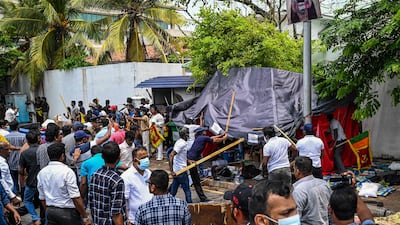
    Government supporters armed with sticks and clubs attack protestors. AFP
  • Demonstrators scuffle with police outside the president's office in Colombo. AFP
    Demonstrators scuffle with police outside the president's office in Colombo. AFP
  • Demonstrators and government supporters clash. AFP
    Demonstrators and government supporters clash. AFP
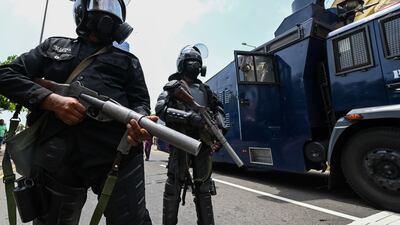
  • Police personnel stand guard outside the president's office. AFP
    Police personnel stand guard outside the president's office. AFP
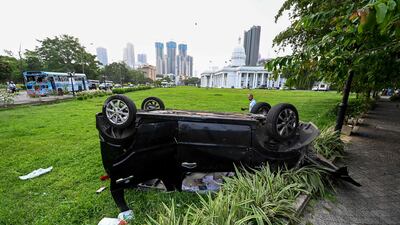
  • Destroyed vehicles litter the street after anti-government protesters rioted in Colombo. AFP
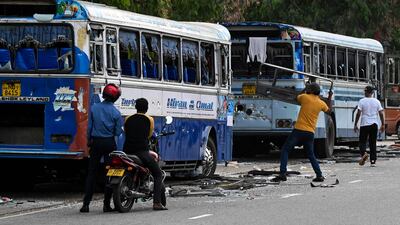
    Destroyed vehicles litter the street after anti-government protesters rioted in Colombo. AFP
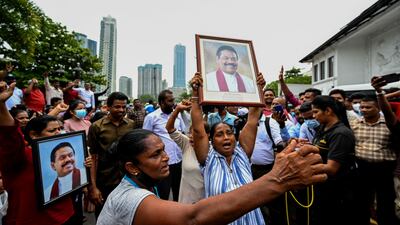
  • Pro-government supporters hold Prime Minister Mahinda Rajapaksa's portrait while protesting. AFP
    Pro-government supporters hold Prime Minister Mahinda Rajapaksa's portrait while protesting. AFP
  • A bus burns close to Sri Lanka's outgoing Prime Minister Mahinda Rajapaksa's official residence in Colombo. AFP
    A bus burns close to Sri Lanka's outgoing Prime Minister Mahinda Rajapaksa's official residence in Colombo. AFP
  • Anti-government protesters destroy a bus in Colombo. AFP
    Anti-government protesters destroy a bus in Colombo. AFP
  • Army personnel stand guard outside the president's office in Colombo. AFP
    Army personnel stand guard outside the president's office in Colombo. AFP
  • Supporters of the Sri Lankan government attempt to block a police water canon truck. AFP
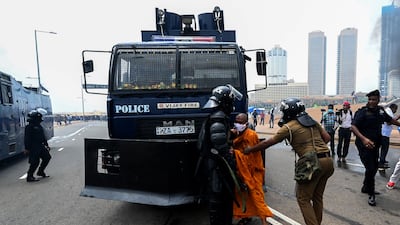
    Supporters of the Sri Lankan government attempt to block a police water canon truck. AFP
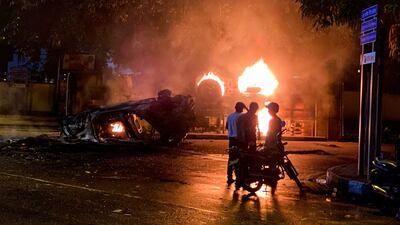
  • People gather near a burning bus in Colombo. AFP
    People gather near a burning bus in Colombo. AFP
  • Anti-government demonstrators set fire to the house owned by Cabinet Minister Sanath Nishantha. Reuters
    Anti-government demonstrators set fire to the house owned by Cabinet Minister Sanath Nishantha. Reuters
  • Sri Lankans push a bus, transporting government supporters who attacked anti-government protesters, into a lake in Colombo. AP Photo
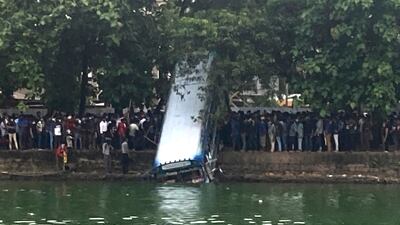
    Sri Lankans push a bus, transporting government supporters who attacked anti-government protesters, into a lake in Colombo. AP Photo
  • A policeman fires tear gas during a clash. AFP
    A policeman fires tear gas during a clash. AFP
  • Sri Lankan Prime Minister Mahinda Rajapaksa resigned on Monday over the country’s dire economic state and violence at mass protests outside his home in Colombo, his spokesman Rohan Weliwita said. AP
    Sri Lankan Prime Minister Mahinda Rajapaksa resigned on Monday over the country’s dire economic state and violence at mass protests outside his home in Colombo, his spokesman Rohan Weliwita said. AP
  • Demonstrators and government supporters clash outside the official residence of Mahinda Rajapaksa, 76, who offered his resignation to his younger brother, President Gotabaya Rajapaksa. AFP
    Demonstrators and government supporters clash outside the official residence of Mahinda Rajapaksa, 76, who offered his resignation to his younger brother, President Gotabaya Rajapaksa. AFP
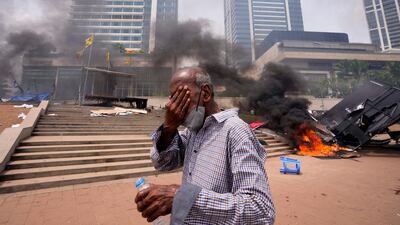
  • A man suffers after being sprayed with tear gas as cars burn on the streets of Colombo, Sri Lanka. AP
    A man suffers after being sprayed with tear gas as cars burn on the streets of Colombo, Sri Lanka. AP
  • Paramilitary police arrive as demonstrators and government supporters clash. AFP
    Paramilitary police arrive as demonstrators and government supporters clash. AFP
  • Sri Lankan government supporters cheer outside the prime minister's residence in Colombo. AP
    Sri Lankan government supporters cheer outside the prime minister's residence in Colombo. AP
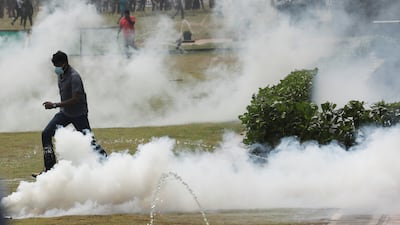
  • Supporters of the ruling party run as riot police fire tear gas during clashes in Colombo, amid the country's economic crisis. Reuters
    Supporters of the ruling party run as riot police fire tear gas during clashes in Colombo, amid the country's economic crisis. Reuters
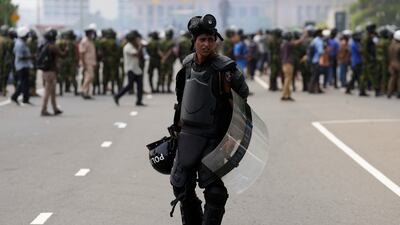
  • A policeman stands guard in riot gear. AP
    A policeman stands guard in riot gear. AP
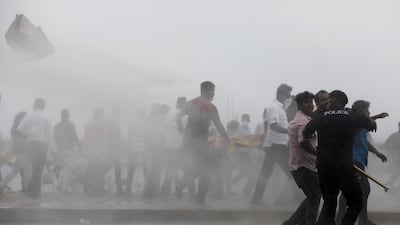
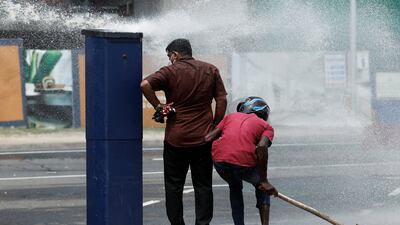
  • Water cannon are fired during a confrontation with anti-government demonstrators. Reuters
    Water cannon are fired during a confrontation with anti-government demonstrators. Reuters
  • Supporters of Sri Lanka's ruling party run in Colombo as police fire tear gas during a clash with anti-government demonstrators. Reuters
    Supporters of Sri Lanka's ruling party run in Colombo as police fire tear gas during a clash with anti-government demonstrators. Reuters
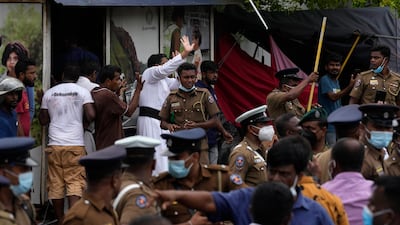
  • A Sri Lankan Catholic priest, centre in a white robe, is among anti-government protesters being attacked by supporters of the ruling party outside the prime minister's residence. AP
    A Sri Lankan Catholic priest, centre in a white robe, is among anti-government protesters being attacked by supporters of the ruling party outside the prime minister's residence. AP
  • Tears after anti-government protesters were attacked by supporters of the ruling party in Colombo. AP
    Tears after anti-government protesters were attacked by supporters of the ruling party in Colombo. AP
  • Violence flares between demonstrators and government supporters outside the president's office in Colombo. AFP
    Violence flares between demonstrators and government supporters outside the president's office in Colombo. AFP
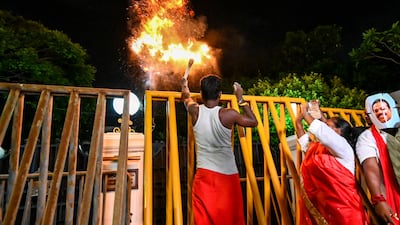
  • Activists stage a mock ritual to 'exorcise demons' outside the official residence of Sri Lanka's prime minister. AFP
    Activists stage a mock ritual to 'exorcise demons' outside the official residence of Sri Lanka's prime minister. AFP

The restructuring could take about six months, though the situation makes it difficult to predict timelines accurately, Mr Weerasinghe said. He added that recommendations for legal advisers for the restructuring will be placed before cabinet soon. The IMF could also put out a statement on Friday as the mission nears an end, Mr Weerasinghe said.

Sri Lanka’s bonds were mixed on Thursday but higher than their record lows reached last week, suggesting traders expect better recovery values. Dollar bonds due in 2030 were indicated 0.28 cents lower at 38.39 cents on the dollar and notes due in July were 0.22 cents higher at 42.78 cents, according to data compiled by Bloomberg. The Colombo All-Share Index slumped more than 3 per cent amid a global equity selloff.

“Defaults are not the end; they can signal a new beginning,” said Mr Chamorro. “Now the hard work begins.”


MATCH INFO

Uefa Champions League semi-finals, first leg
Liverpool v Roma

When: April 24, 10.45pm kick-off (UAE)
Where: Anfield, Liverpool
Live: BeIN Sports HD
Second leg: May 2, Stadio Olimpico, Rome

COMPANY%20PROFILE
%3Cp%3E%3Cstrong%3EName%3A%20%3C%2Fstrong%3ETelr%3Cbr%3E%3Cstrong%3EBased%3A%20%3C%2Fstrong%3EDubai%2C%20UAE%3Cbr%3E%3Cstrong%3ELaunch%20year%3A%3C%2Fstrong%3E%202014%3Cbr%3E%3Cstrong%3ENumber%20of%20employees%3A%20%3C%2Fstrong%3E65%3Cbr%3E%3Cstrong%3ESector%3A%20%3C%2Fstrong%3EFinTech%20and%20payments%3Cbr%3E%3Cstrong%3EFunding%3A%20%3C%2Fstrong%3Enearly%20%2430%20million%20so%20far%3C%2Fp%3E%0A
Ten tax points to be aware of in 2026

1. Domestic VAT refund amendments: request your refund within five years

If a business does not apply for the refund on time, they lose their credit.

2. E-invoicing in the UAE

Businesses should continue preparing for the implementation of e-invoicing in the UAE, with 2026 a preparation and transition period ahead of phased mandatory adoption. 

3. More tax audits

Tax authorities are increasingly using data already available across multiple filings to identify audit risks. 

4. More beneficial VAT and excise tax penalty regime

Tax disputes are expected to become more frequent and more structured, with clearer administrative objection and appeal processes. The UAE has adopted a new penalty regime for VAT and excise disputes, which now mirrors the penalty regime for corporate tax.

5. Greater emphasis on statutory audit

There is a greater need for the accuracy of financial statements. The International Financial Reporting Standards standards need to be strictly adhered to and, as a result, the quality of the audits will need to increase.

6. Further transfer pricing enforcement

Transfer pricing enforcement, which refers to the practice of establishing prices for internal transactions between related entities, is expected to broaden in scope. The UAE will shortly open the possibility to negotiate advance pricing agreements, or essentially rulings for transfer pricing purposes. 

7. Limited time periods for audits

Recent amendments also introduce a default five-year limitation period for tax audits and assessments, subject to specific statutory exceptions. While the standard audit and assessment period is five years, this may be extended to up to 15 years in cases involving fraud or tax evasion. 

8. Pillar 2 implementation 

Many multinational groups will begin to feel the practical effect of the Domestic Minimum Top-Up Tax (DMTT), the UAE's implementation of the OECD’s global minimum tax under Pillar 2. While the rules apply for financial years starting on or after January 1, 2025, it is 2026 that marks the transition to an operational phase.

9. Reduced compliance obligations for imported goods and services

Businesses that apply the reverse-charge mechanism for VAT purposes in the UAE may benefit from reduced compliance obligations. 

10. Substance and CbC reporting focus

Tax authorities are expected to continue strengthening the enforcement of economic substance and Country-by-Country (CbC) reporting frameworks. In the UAE, these regimes are increasingly being used as risk-assessment tools, providing tax authorities with a comprehensive view of multinational groups’ global footprints and enabling them to assess whether profits are aligned with real economic activity. 

Contributed by Thomas Vanhee and Hend Rashwan, Aurifer

WITHIN%20SAND
%3Cp%3EDirector%3A%20Moe%20Alatawi%3C%2Fp%3E%0A%3Cp%3EStarring%3A%20Ra%E2%80%99ed%20Alshammari%2C%20Adwa%20Fahd%2C%20Muhand%20Alsaleh%3C%2Fp%3E%0A%3Cp%3ERating%3A%203%2F5%3C%2Fp%3E%0A
Attacks on Egypt’s long rooted Copts

Egypt’s Copts belong to one of the world’s oldest Christian communities, with Mark the Evangelist credited with founding their church around 300 AD. Orthodox Christians account for the overwhelming majority of Christians in Egypt, with the rest mainly made up of Greek Orthodox, Catholics and Anglicans.

The community accounts for some 10 per cent of Egypt’s 100 million people, with the largest concentrations of Christians found in Cairo, Alexandria and the provinces of Minya and Assiut south of Cairo.

Egypt’s Christians have had a somewhat turbulent history in the Muslim majority Arab nation, with the community occasionally suffering outright persecution but generally living in peace with their Muslim compatriots. But radical Muslims who have first emerged in the 1970s have whipped up anti-Christian sentiments, something that has, in turn, led to an upsurge in attacks against their places of worship, church-linked facilities as well as their businesses and homes.

More recently, ISIS has vowed to go after the Christians, claiming responsibility for a series of attacks against churches packed with worshippers starting December 2016.

The discrimination many Christians complain about and the shift towards religious conservatism by many Egyptian Muslims over the last 50 years have forced hundreds of thousands of Christians to migrate, starting new lives in growing communities in places as far afield as Australia, Canada and the United States.

Here is a look at major attacks against Egypt's Coptic Christians in recent years:

November 2: Masked gunmen riding pickup trucks opened fire on three buses carrying pilgrims to the remote desert monastery of St. Samuel the Confessor south of Cairo, killing 7 and wounding about 20. IS claimed responsibility for the attack.

May 26, 2017: Masked militants riding in three all-terrain cars open fire on a bus carrying pilgrims on their way to the Monastery of St. Samuel the Confessor, killing 29 and wounding 22. ISIS claimed responsibility for the attack.

April 2017Twin attacks by suicide bombers hit churches in the coastal city of Alexandria and the Nile Delta city of Tanta. At least 43 people are killed and scores of worshippers injured in the Palm Sunday attack, which narrowly missed a ceremony presided over by Pope Tawadros II, spiritual leader of Egypt Orthodox Copts, in Alexandria's St. Mark's Cathedral. ISIS claimed responsibility for the attacks.

February 2017: Hundreds of Egyptian Christians flee their homes in the northern part of the Sinai Peninsula, fearing attacks by ISIS. The group's North Sinai affiliate had killed at least seven Coptic Christians in the restive peninsula in less than a month.

December 2016A bombing at a chapel adjacent to Egypt's main Coptic Christian cathedral in Cairo kills 30 people and wounds dozens during Sunday Mass in one of the deadliest attacks carried out against the religious minority in recent memory. ISIS claimed responsibility.

July 2016Pope Tawadros II says that since 2013 there were 37 sectarian attacks on Christians in Egypt, nearly one incident a month. A Muslim mob stabs to death a 27-year-old Coptic Christian man, Fam Khalaf, in the central city of Minya over a personal feud.

May 2016: A Muslim mob ransacks and torches seven Christian homes in Minya after rumours spread that a Christian man had an affair with a Muslim woman. The elderly mother of the Christian man was stripped naked and dragged through a street by the mob.

New Year's Eve 2011A bomb explodes in a Coptic Christian church in Alexandria as worshippers leave after a midnight mass, killing more than 20 people.

How to wear a kandura

Dos

  • Wear the right fabric for the right season and occasion 
  • Always ask for the dress code if you don’t know
  • Wear a white kandura, white ghutra / shemagh (headwear) and black shoes for work 
  • Wear 100 per cent cotton under the kandura as most fabrics are polyester

Don’ts 

  • Wear hamdania for work, always wear a ghutra and agal 
  • Buy a kandura only based on how it feels; ask questions about the fabric and understand what you are buying
Updated: May 20, 2022, 4:23 AM