Lebanese Prime Minister Najib Mikati believes the country will now be able to move forward after securing the backing of the IMF. Reuters

Lebanon on 'right track' as $3bn IMF deal struck, Prime Minister says


  • English
  • Arabic

The International Monetary Fund has reached an agreement to offer about $3 billion to Lebanon as part of a four-year deal based on a comprehensive economic reform programme, the IMF announced on Thursday.

“It's the first step towards really going out of this crisis and we are on the right track,” prime minister Najib Mikati told The National, when asked if the accord marked the beginning of the end of the country's economic crisis.

“We have all the necessary reform laws that they are asking for, we are going to present them soon and hopefully the parliament will look at them and God willing everything will work out,” Mr Mikati said.

The Extended Fund Arrangement (EFF) aims to “rebuild the economy, restore financial sustainability, strengthen governance and transparency, remove impediments to job-creating growth, and increase social and reconstruction spending”, the IMF said.

“This will need to be complemented by the restructuring of external public debt that will result in sufficient creditor participation to restore debt sustainability and close financing gaps,” the statement said.

The country's public debt increased to $100bn, or about 212 per cent of GDP, in 2021. That ranks Lebanon as the country with the fourth highest debt-to-GDP ratio in the world, surpassed only by Japan, Sudan and Greece, according to the World Bank.

Lebanon had applied for a $10bn IMF bailout package in May 2020. However, talks with the lender stalled due to bickering among the various political factions in the country and a lack of consensus on the size of the debt and losses on the balance sheet of the central bank.

The agreement struck on Thursday is subject to IMF management and executive board approval, after the implementation “of all prior actions and confirmation of international partners’ financial support”, the fund said.

Lebanon is going through its worst economic crisis since the country's independence in 1943. The country's economy contracted about 58 per cent between 2019 and 2021, with gross domestic product plummeting to $21.8bn in 2021 from about $52bn in 2019, according to the World Bank. That is the largest contraction on a list of 193 countries.

Lebanon's economy collapsed after it defaulted on about $31bn of Eurobonds in March 2020, with its currency sinking more than 90 per cent against the dollar on the black market and inflation rising to triple digits.

The crisis has been compounded by the Covid-19 pandemic and the August 2020 port of Beirut explosion, while the war in Ukraine is exacerbating pressures on the current account and inflation and further straining food and fuel supplies, the IMF said.

Inflation soared to an annual 215 per cent in February, marking the 20th consecutive triple-digit increase of the Central Administration of Statistics' Consumer Price Index since July 2020. The index increased 4.31 per cent from January 2022.

“Lebanon is facing an unprecedented crisis, which has led to a dramatic economic contraction and a large increase in poverty, unemployment, and emigration,” the Washington-based fund said.

“This crisis is a manifestation of deep and persistent vulnerabilities generated by many years of unsustainable macroeconomic policies fuelling large twin deficits (fiscal and external), support for an overvalued exchange rate and an oversized financial sector, combined with severe accountability and transparency problems and lack of structural reforms.”

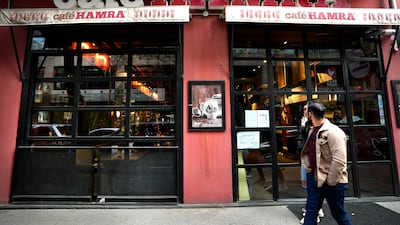
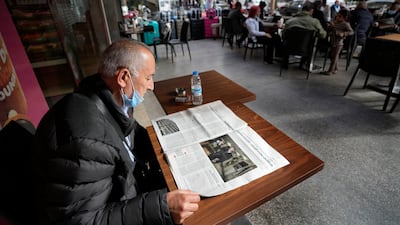
  • A coffee shop on Hamra Street in Beirut. The street has changed dramatically over the years, reflecting one of the three biggest financial crashes globally since the 1850s. All photos by AP
    A coffee shop on Hamra Street in Beirut. The street has changed dramatically over the years, reflecting one of the three biggest financial crashes globally since the 1850s. All photos by AP
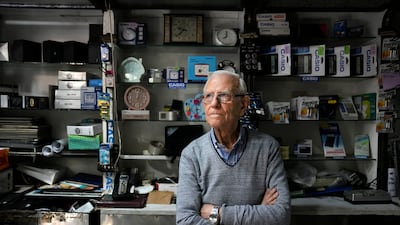
  • Michel Eid, 88, works in his music shop on Hamra street. Mr Eid has witnessed the rise and fall of Lebanon through the changing fortunes of this famed boulevard for more than 60 years.
    Michel Eid, 88, works in his music shop on Hamra street. Mr Eid has witnessed the rise and fall of Lebanon through the changing fortunes of this famed boulevard for more than 60 years.
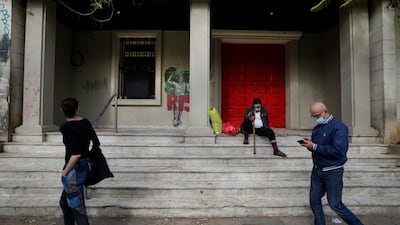
  • People pass in front of a beggar, centre, on Hamra Street. Fuelled by massive debt and the unsustainable way it was financed, the crisis has slashed Lebanon's gross domestic product by 58.1% since 2019, the World Bank said.
    People pass in front of a beggar, centre, on Hamra Street. Fuelled by massive debt and the unsustainable way it was financed, the crisis has slashed Lebanon's gross domestic product by 58.1% since 2019, the World Bank said.
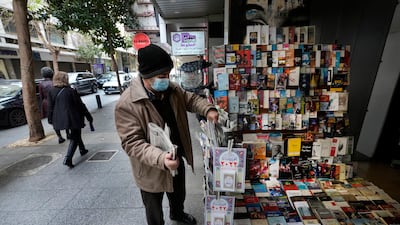
  • Naim Saleh, who sells newspapers, magazines and books. Mr Saleh said business has dropped dramatically - he used to sell 50 books a day, compared with only about two a month now.
    Naim Saleh, who sells newspapers, magazines and books. Mr Saleh said business has dropped dramatically - he used to sell 50 books a day, compared with only about two a month now.
  • Shoppers pass a masks street vendor sitting on the ground next to a shop that has closed amid the country's economic crisis.
    Shoppers pass a masks street vendor sitting on the ground next to a shop that has closed amid the country's economic crisis.
  • Hamra Street once was home to the region's top movie theatres, shops selling international brands and cafes where intellectuals from around the Arab world gathered.
    Hamra Street once was home to the region's top movie theatres, shops selling international brands and cafes where intellectuals from around the Arab world gathered.
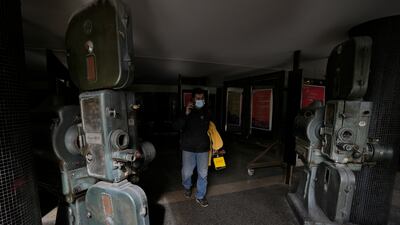
  • A man passes next to old movie projectors placed outside a theatre in Hamra Street. The projectors were used in the past at the movie theatre once known as Saroula.
    A man passes next to old movie projectors placed outside a theatre in Hamra Street. The projectors were used in the past at the movie theatre once known as Saroula.
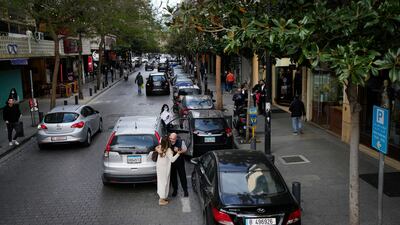
  • Today, Hamra Street reflects Lebanon's devastating multiple crises, with closed stores, beggars and piles of trash on the corners.
    Today, Hamra Street reflects Lebanon's devastating multiple crises, with closed stores, beggars and piles of trash on the corners.
  • Beggars sit in front of shops that have been closed since the economic crisis.
    Beggars sit in front of shops that have been closed since the economic crisis.
  • A sign from an old clothes shop set by Hamra Merchants Committee.
    A sign from an old clothes shop set by Hamra Merchants Committee.
  • Michel Eid in his music shop.
    Michel Eid in his music shop.
  • Elie Rbeiz, 70, a hairdresser at his shop in Hamra Street. Mr Rbeiz expanded his business 20 years ago to include men clothes. "Hamra is not the Hamra of the past," he said. His business has dropped 60% over the past two years.
    Elie Rbeiz, 70, a hairdresser at his shop in Hamra Street. Mr Rbeiz expanded his business 20 years ago to include men clothes. "Hamra is not the Hamra of the past," he said. His business has dropped 60% over the past two years.
  • In January, the World Bank blasted Lebanon's ruling class for "orchestrating" one of the world's worst national economic depressions due to their exploitative grip on resources.
    In January, the World Bank blasted Lebanon's ruling class for "orchestrating" one of the world's worst national economic depressions due to their exploitative grip on resources.

The economic reform plan includes improving public finances and reducing public debt through revenue-generating and administrative reform measures to ensure a more equal and transparent distribution of the tax burden.

Lebanon's 2022 budget, part of that plan, aims to achieve a primary deficit of 4 per cent of GDP, supported by a change in imports valuation for custom and tax purposes to be done at a unified exchange rate.

Confidence in the country's banking system and lenders who traditionally had been the backbone of the economy and helped various governments fund fiscal and current account deficits eroded as a liquidity crunch, shortage of dollars and informal capital control measures set in once the economic crisis unfolded.

The fund said the “health and viability of the financial sector will need to be restored for the country to be able to lift the existing uncertainty and provide conditions for strong economic growth".

“Total recapitalisation needs in the banking system are very large, and losses will need to be recognised upfront and allocated, while protecting small depositors. An appropriate strategy has been designed, but its implementation requires a number of legislative changes to support it.”

Lebanon had escaped the 2008 global credit crisis relatively unscathed due to a high interest rate regime, which lured more than $1bn a month in capital flows that financed the government deficits. But the outbreak of war in neighbouring Syria in 2011, years of fiscal mismanagement, and the collapse of oil prices slowed the flow of funds to Lebanese lenders which led to negative deposit growth.

The fund called for reforms to Lebanon's tax policy to strengthen its revenue intake.

“The authorities recognise the urgent need to initiate a multipronged reform programme to tackle these challenges, bring back confidence and put the economy back on a sustainable growth path, with stronger private sector activity and job creation,” the IMF said.

A man uses an ATM outside a closed bank in Beirut. AP

Prior to receiving the IMF board’s consideration, Lebanon's authorities have agreed to certain measures including cabinet approval of a bank restructuring strategy; an emergency bank resolution legislation to implement the strategy; initiating an externally assisted bank-by-bank evaluation for the country's 14 largest banks; a reformed bank secrecy law to fight corruption; a medium-term fiscal and debt restructuring strategy; and parliament approval of the 2022 budget.

"The staff-level agreement is just the first step in the process of reaching a final deal with the IMF," said Nassib Ghobril, chief economist at Byblos Bank. "It is important that Lebanese authorities abide concretely by their stated commitment to reforms, otherwise the agreement with the IMF will not go through."

The reform programme of Lebanese authorities is based on five key points:

  • Restructuring the financial sector to restore banks’ viability and their ability to efficiently allocate resources to support the recovery;
  • Implementing fiscal reforms that coupled with the proposed restructuring of external public debt will ensure debt sustainability and create space to invest in social spending, reconstruction and infrastructure;
  • Reforming state-owned enterprises, particularly in the energy sector, to provide quality services without draining public resources;
  • Strengthening governance, anti-corruption, and anti-money laundering/combating the financing of terrorism (AML/CFT) frameworks to enhance transparency and accountability, including by modernising the central bank legal framework and governance and accountability arrangements;
  • Establishing a credible and transparent monetary and exchange rate system

COMPANY%20PROFILE
%3Cp%3E%3Cstrong%3ECompany%20name%3C%2Fstrong%3E%3A%20ASI%20(formerly%20DigestAI)%3C%2Fp%3E%0A%3Cp%3E%3Cstrong%3EStarted%3A%3C%2Fstrong%3E%202017%3C%2Fp%3E%0A%3Cp%3E%3Cstrong%3EFounders%3A%3C%2Fstrong%3E%20Quddus%20Pativada%3C%2Fp%3E%0A%3Cp%3E%3Cstrong%3EBased%3A%3C%2Fstrong%3E%20Dubai%2C%20UAE%3C%2Fp%3E%0A%3Cp%3E%3Cstrong%3EIndustry%3A%3C%2Fstrong%3E%20Artificial%20intelligence%2C%20education%20technology%3C%2Fp%3E%0A%3Cp%3E%3Cstrong%3EFunding%3A%3C%2Fstrong%3E%20%243%20million-plus%3C%2Fp%3E%0A%3Cp%3E%3Cstrong%3EInvestors%3A%3C%2Fstrong%3E%20GSV%20Ventures%2C%20Character%2C%20Mark%20Cuban%3C%2Fp%3E%0A
PROFILE

Name: Enhance Fitness 

Year started: 2018 

Based: UAE 

Employees: 200 

Amount raised: $3m 

Investors: Global Ventures and angel investors 

COMPANY%20PROFILE%20
%3Cp%3E%3Cstrong%3ECompany%20name%3A%20%3C%2Fstrong%3ETerra%3Cbr%3E%3Cstrong%3EStarted%3A%3C%2Fstrong%3E%202021%3Cbr%3E%3Cstrong%3EBased%3A%3C%2Fstrong%3E%20Dubai%3Cbr%3E%3Cstrong%3EFounder%3A%3C%2Fstrong%3E%20Hussam%20Zammar%3Cbr%3E%3Cstrong%3ESector%3A%3C%2Fstrong%3E%20Mobility%3Cbr%3E%3Cstrong%3EInvestment%20stage%3A%3C%2Fstrong%3E%20Pre-seed%20funding%20of%20%241%20million%3Cbr%3E%3C%2Fp%3E%0A
AUSTRALIA SQUAD

Aaron Finch, Matt Renshaw, Brendan Doggett, Michael Neser, Usman Khawaja, Shaun Marsh, Mitchell Marsh, Tim Paine (captain), Travis Head, Marnus Labuschagne, Nathan Lyon, Jon Holland, Ashton Agar, Mitchell Starc, Peter Siddle

RESULT

Wolves 1 (Traore 67')

Tottenham 2 (Moura 8', Vertonghen 90 1')

Man of the Match: Adama Traore (Wolves)

Dhadak

Director: Shashank Khaitan

Starring: Janhvi Kapoor, Ishaan Khattar, Ashutosh Rana

Stars: 3

COMPANY%20PROFILE
%3Cp%3E%3Cstrong%3EName%3A%20%3C%2Fstrong%3ESmartCrowd%0D%3Cbr%3E%3Cstrong%3EStarted%3A%20%3C%2Fstrong%3E2018%0D%3Cbr%3E%3Cstrong%3EFounder%3A%20%3C%2Fstrong%3ESiddiq%20Farid%20and%20Musfique%20Ahmed%0D%3Cbr%3E%3Cstrong%3EBased%3A%20%3C%2Fstrong%3EDubai%0D%3Cbr%3E%3Cstrong%3ESector%3A%20%3C%2Fstrong%3EFinTech%20%2F%20PropTech%0D%3Cbr%3E%3Cstrong%3EInitial%20investment%3A%20%3C%2Fstrong%3E%24650%2C000%0D%3Cbr%3E%3Cstrong%3ECurrent%20number%20of%20staff%3A%3C%2Fstrong%3E%2035%0D%3Cbr%3E%3Cstrong%3EInvestment%20stage%3A%20%3C%2Fstrong%3ESeries%20A%0D%3Cbr%3E%3Cstrong%3EInvestors%3A%20%3C%2Fstrong%3EVarious%20institutional%20investors%20and%20notable%20angel%20investors%20(500%20MENA%2C%20Shurooq%2C%20Mada%2C%20Seedstar%2C%20Tricap)%3C%2Fp%3E%0A

Mercer, the investment consulting arm of US services company Marsh & McLennan, expects its wealth division to at least double its assets under management (AUM) in the Middle East as wealth in the region continues to grow despite economic headwinds, a company official said.

Mercer Wealth, which globally has $160 billion in AUM, plans to boost its AUM in the region to $2-$3bn in the next 2-3 years from the present $1bn, said Yasir AbuShaban, a Dubai-based principal with Mercer Wealth.

Within the next two to three years, we are looking at reaching $2 to $3 billion as a conservative estimate and we do see an opportunity to do so,” said Mr AbuShaban.

Mercer does not directly make investments, but allocates clients’ money they have discretion to, to professional asset managers. They also provide advice to clients.

“We have buying power. We can negotiate on their (client’s) behalf with asset managers to provide them lower fees than they otherwise would have to get on their own,” he added.

Mercer Wealth’s clients include sovereign wealth funds, family offices, and insurance companies among others.

From its office in Dubai, Mercer also looks after Africa, India and Turkey, where they also see opportunity for growth.

Wealth creation in Middle East and Africa (MEA) grew 8.5 per cent to $8.1 trillion last year from $7.5tn in 2015, higher than last year’s global average of 6 per cent and the second-highest growth in a region after Asia-Pacific which grew 9.9 per cent, according to consultancy Boston Consulting Group (BCG). In the region, where wealth grew just 1.9 per cent in 2015 compared with 2014, a pickup in oil prices has helped in wealth generation.

BCG is forecasting MEA wealth will rise to $12tn by 2021, growing at an annual average of 8 per cent.

Drivers of wealth generation in the region will be split evenly between new wealth creation and growth of performance of existing assets, according to BCG.

Another general trend in the region is clients’ looking for a comprehensive approach to investing, according to Mr AbuShaban.

“Institutional investors or some of the families are seeing a slowdown in the available capital they have to invest and in that sense they are looking at optimizing the way they manage their portfolios and making sure they are not investing haphazardly and different parts of their investment are working together,” said Mr AbuShaban.

Some clients also have a higher appetite for risk, given the low interest-rate environment that does not provide enough yield for some institutional investors. These clients are keen to invest in illiquid assets, such as private equity and infrastructure.

“What we have seen is a desire for higher returns in what has been a low-return environment specifically in various fixed income or bonds,” he said.

“In this environment, we have seen a de facto increase in the risk that clients are taking in things like illiquid investments, private equity investments, infrastructure and private debt, those kind of investments were higher illiquidity results in incrementally higher returns.”

The Abu Dhabi Investment Authority, one of the largest sovereign wealth funds, said in its 2016 report that has gradually increased its exposure in direct private equity and private credit transactions, mainly in Asian markets and especially in China and India. The authority’s private equity department focused on structured equities owing to “their defensive characteristics.”

PSA DUBAI WORLD SERIES FINALS LINE-UP

Men’s:
Mohamed El Shorbagy (EGY)
Ali Farag (EGY)
Simon Rosner (GER)
Tarek Momen (EGY)
Miguel Angel Rodriguez (COL)
Gregory Gaultier (FRA)
Karim Abdel Gawad (EGY)
Nick Matthew (ENG)

Women's:
Nour El Sherbini (EGY)
Raneem El Welily (EGY)
Nour El Tayeb (EGY)
Laura Massaro (ENG)
Joelle King (NZE)
Camille Serme (FRA)
Nouran Gohar (EGY)
Sarah-Jane Perry (ENG)

Updated: April 08, 2022, 11:03 AM