• Sheikh Mohamed bin Zayed, Crown Prince of Abu Dhabi and Deputy Supreme Commander of the Armed Forces, takes part in a virtual summit with India's Prime Minister Narendra Modi. Photo: Hamad Al Kaabi / Ministry of Presidential Affairs
    Sheikh Mohamed bin Zayed, Crown Prince of Abu Dhabi and Deputy Supreme Commander of the Armed Forces, takes part in a virtual summit with India's Prime Minister Narendra Modi. Photo: Hamad Al Kaabi / Ministry of Presidential Affairs
  • The virtual summit between Sheikh Mohamed bin Zayed, Crown Prince of Abu Dhabi and Deputy Supreme Commander of the Armed Forces, and India's Prime Minister Narendra Modi. Photo: Abdullah Al Neyadi / Ministry of Presidential Affairs
    The virtual summit between Sheikh Mohamed bin Zayed, Crown Prince of Abu Dhabi and Deputy Supreme Commander of the Armed Forces, and India's Prime Minister Narendra Modi. Photo: Abdullah Al Neyadi / Ministry of Presidential Affairs
  • Sheikh Mohamed bin Zayed, Crown Prince of Abu Dhabi and Deputy Supreme Commander of the Armed Forces, and Sheikh Abdullah bin Zayed, Minister of Foreign Affairs and International Co-operation, take part in the virtual summit. Photo: Abdullah Al Neyadi / Ministry of Presidential Affairs
    Sheikh Mohamed bin Zayed, Crown Prince of Abu Dhabi and Deputy Supreme Commander of the Armed Forces, and Sheikh Abdullah bin Zayed, Minister of Foreign Affairs and International Co-operation, take part in the virtual summit. Photo: Abdullah Al Neyadi / Ministry of Presidential Affairs
  • Sheikh Mohamed bin Zayed, Crown Prince of Abu Dhabi and Deputy Supreme Commander of the Armed Forces, at the summit in which the UAE and India signed a Comprehensive Economic Partnership Agreement. Photo: Hamad Al Kaabi / Ministry of Presidential Affairs
    Sheikh Mohamed bin Zayed, Crown Prince of Abu Dhabi and Deputy Supreme Commander of the Armed Forces, at the summit in which the UAE and India signed a Comprehensive Economic Partnership Agreement. Photo: Hamad Al Kaabi / Ministry of Presidential Affairs
  • Sheikh Mohamed bin Zayed, Crown Prince of Abu Dhabi and Deputy Supreme Commander of the Armed Forces, and Sheikh Abdullah bin Zayed, Minister of Foreign Affairs and International Co-operation, at the summit. The agreement is expected to boost non-oil trade between the UAE and India from $60 billion at present to $100 billion within five years. Photo: Hamad Al Kaabi / Ministry of Presidential Affairs
    Sheikh Mohamed bin Zayed, Crown Prince of Abu Dhabi and Deputy Supreme Commander of the Armed Forces, and Sheikh Abdullah bin Zayed, Minister of Foreign Affairs and International Co-operation, at the summit. The agreement is expected to boost non-oil trade between the UAE and India from $60 billion at present to $100 billion within five years. Photo: Hamad Al Kaabi / Ministry of Presidential Affairs
  • Sheikh Mohamed bin Zayed, Crown Prince of Abu Dhabi and Deputy Supreme Commander of the Armed Forces, and Sheikh Abdullah bin Zayed, Minister of Foreign Affairs and International Co-operation, at the virtual summit with India's Prime Minister Narendra Modi. Photo: Abdullah Al Neyadi / Ministry of Presidential Affairs
    Sheikh Mohamed bin Zayed, Crown Prince of Abu Dhabi and Deputy Supreme Commander of the Armed Forces, and Sheikh Abdullah bin Zayed, Minister of Foreign Affairs and International Co-operation, at the virtual summit with India's Prime Minister Narendra Modi. Photo: Abdullah Al Neyadi / Ministry of Presidential Affairs

UAE and India sign comprehensive economic partnership to boost trade and investment ties


  • English
  • Arabic

The UAE and India, Asia’s third-largest economy, signed a Comprehensive Economic Partnership Agreement that is expected to boost non-oil trade between the two countries to $100 billion in five years, from $60bn currently.

The agreement marks a new phase of strategic co-operation and will open additional avenues of investment and trade for companies in India and the UAE.

It will add 1.7 per cent or $8.9bn to the UAE's gross domestic product and boost exports by 1.5 per cent or $7.6bn by 2030, said Abdulla bin Touq, UAE Minister of Economy, in an online joint press conference on Friday in New Delhi, attended by top government officials from both countries.

The 881-page agreement lifts 80 per cent of tariffs on UAE and India goods, while all tariffs will be removed within 10 years, said Dr Thani Al Zeyoudi, the UAE Minister of State for Foreign Trade.

“The fact that we were able to agree the terms of a deal of this size, scope and importance within five months, demonstrates the power of our shared vision,” Mr bin Touq said.

“I am confident that the UAE-India CEPA agreement will be regarded as a towering achievement and a new era, not only for our two nations, but for global trade.”

The pact is an extension of the long-standing economic and trade relationship between the two countries. India is already the UAE’s second-largest trading partner, accounting for 9 per cent of the Emirates’ total foreign trade and 13 per cent of non-oil exports.

Trade between India and the UAE grew by more than 70 per cent in the first six months of 2021 to $21bn.

India is expected to become the world's fastest-growing major economy in 2022, expanding by 9 per cent despite continued headwinds fanned by the Covid-19 pandemic, according to the International Monetary Fund. Its economy grew at the same pace last year.

India could become the world's third-largest economy by 2026 and have an economic output of $10 trillion by 2030 if it grows at the same pace, Bloomberg Intelligence and World Bank estimates show.

Under the CEPA, key UAE commodities that will benefit from the tariff elimination include aluminium, copper and petrochemicals.

The key Indian sectors that will benefit are textiles, agriculture, furniture, pharmaceuticals and engineering, said India’s Minister for Commerce and Industry Piyush Goyal.

The fact that we were able to agree the terms of a deal of this size, scope and importance within five months demonstrates the power of our shared vision.
Abdullah bin Touq Al Marri,
UAE Minister of Economy

The deal will promote trade, investment and innovation in diverse sectors, including economy, energy, climate action, emerging technologies, skills and education, food security, health care and defence and security, the Indian prime minister's office said in a statement.

The agreement was signed by Mr Goyal and Mr bin Touq in the presence of Sheikh Mohamed bin Zayed, Crown Prince of Abu Dhabi and Deputy Supreme Commander of the Armed Forces, as well as India's Prime Minister Narendra Modi on Friday in New Delhi in an online ceremony.

.
.

India and the UAE also signed two initial pacts related to food security and financial services.

Negotiations between the two countries covered 18 chapters, resulting in the elimination of tariffs and enabling further investment in sectors including hospitality, logistics, construction and professional services, Mr bin Touq said.

It will also promote collaboration in key future industries such as AgriTech, renewable energy and advanced technology, while providing a platform for small- and medium-sized businesses to expand to new markets, he said.

“As we emerge from the global pandemic, this CEPA will uphold the movement to a free, fair, inclusive and non-discriminatory, transparent, predictable and stable trade and investment environment,” he said.

The deal with the UAE follows several rounds of talks that were first initiated in September, when Dr Al Zeyoudi led a delegation to India.

The UAE official held discussions with India’s Finance Minister Nirmala Sitharaman, Mr Goyal, Minister of Civil Aviation Jyotiraditya Scindia and Minister of Electronics and Information Technology Ashwini Vaishnaw, as well as with senior government officials during the tour.

The mutually beneficial partnership will help to create new jobs, promote foreign direct investment, empower entrepreneurs, attract talent and accelerate the knowledge-driven economies of the two countries, Dr Al Zeyoudi said at the time.

The agreement will “deepen economic ties” between the two countries that have shared a “long and rich history” of social, cultural and commercial ties spanning several centuries, global consultancy KPMG said in its report.

“The future of the India-UAE relationship is bright as both countries look to strengthen ties in the coming years,” it said.

“Both governments have been proactive in developing initiatives to boost foreign investment and their key sectors.”

For Indian companies, the attraction of the UAE includes its geographic proximity to India, its strategic location providing access to key markets in the GCC and Africa, and the ease of doing business.

For UAE companies, India's large market, the wealth of opportunities across sectors and cost advantages are attractive.

“As both nations look to strengthen ties further in the coming years, there are several opportunities across various sectors to boost bilateral trade and investment,” KPMG said, identifying 12 sectors that show potential for growth.

These include gems and jewellery, pharmaceuticals and medical services, food production and security, technology start-ups and artificial intelligence, education, financial services, advanced technology, aviation, defence, infrastructure development, oil and gas and renewables, it said.

While sectors such as gems and oil and gas will continue to be important, emerging sectors in both countries will be key in driving future trade and investment opportunities, KPMG said.

.
.

There is also significant opportunity in focusing on emerging economic centres such as second-tier and third-tier cities in India to strengthen ties.

“The planned CEPA is an important milestone in the historic partnership between the two countries. Its effective implementation will be a major boost to trade and investment relations, providing prioritised access to markets and capital,” KPMG said.

The agreement will provide a launch pad for more jobs and higher investment in industries from textiles and steel to food processing, experts said.

Arun Chawla, director general of the Federation of Indian Chambers of Commerce and Industry, said the textile, steel and food-processing industries will benefit most from the agreement.

“With the UAE looking for food security and plans to set up India-UAE food corridor, removal of the current 5 per cent tariff on food and dairy products will be a win-win for both the countries,” he told The National.

“The food and agri-processing industry in India will see tremendous growth as we see a potential duty-free access to the UAE market of over 10 million consumers and [it] is expected to act as a springboard for the entire Mena region.”

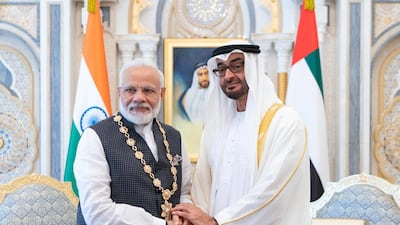
  • Sheikh Mohamed bin Zayed, Crown Prince of Abu Dhabi and Deputy Supreme Commander of the Armed Forces, with Indian Prime Minister Narendra Modi. Photo: Ministry of Presidential Affairs
    Sheikh Mohamed bin Zayed, Crown Prince of Abu Dhabi and Deputy Supreme Commander of the Armed Forces, with Indian Prime Minister Narendra Modi. Photo: Ministry of Presidential Affairs
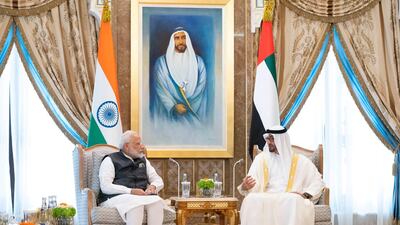
  • Sheikh Mohamed and Mr Modi during talks at Qasr Al Watan in Abu Dhabi. Photo: Ministry of Presidential Affairs
    Sheikh Mohamed and Mr Modi during talks at Qasr Al Watan in Abu Dhabi. Photo: Ministry of Presidential Affairs
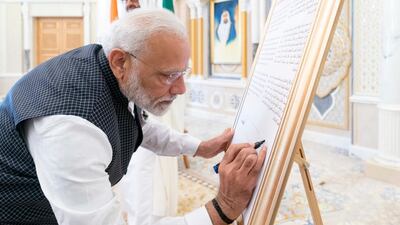
  • Mr Modi signs a board announcing the introduction of a postage stamp celebrating 150 years since the birth of Mahatma Gandhi, during a reception at Qasr Al Watan. Photo: Ministry of Presidential Affairs
    Mr Modi signs a board announcing the introduction of a postage stamp celebrating 150 years since the birth of Mahatma Gandhi, during a reception at Qasr Al Watan. Photo: Ministry of Presidential Affairs
  • Sheikh Mohamed signs the same board announcing the introduction of the stamp. Photo: Ministry of Presidential Affairs
    Sheikh Mohamed signs the same board announcing the introduction of the stamp. Photo: Ministry of Presidential Affairs
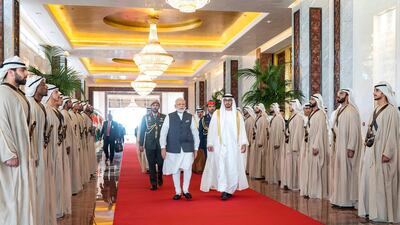
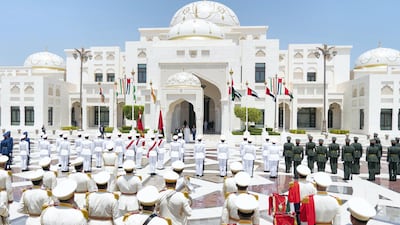
  • Sheikh Mohamed and Mr Modi inspect a guard of honour in the UAE capital. Wam
    Sheikh Mohamed and Mr Modi inspect a guard of honour in the UAE capital. Wam
  • Security forces stand at attention as the national anthem is sung at Qasr Al Watan. Photo: Ministry of Presidential Affairs
    Security forces stand at attention as the national anthem is sung at Qasr Al Watan. Photo: Ministry of Presidential Affairs
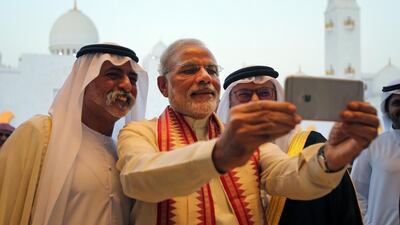
  • Mr Modi takes a selfie with Sheikh Nahyan bin Mubarak, Minister of Tolerance and Coexistence, left, as they tour the Sheikh Zayed Grand Mosque in Abu Dhabi. AP
    Mr Modi takes a selfie with Sheikh Nahyan bin Mubarak, Minister of Tolerance and Coexistence, left, as they tour the Sheikh Zayed Grand Mosque in Abu Dhabi. AP
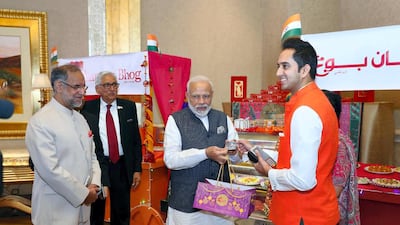
  • Mr Modi pays for sweets with the new RuPay card during a visit to Emirates Palace.
    Mr Modi pays for sweets with the new RuPay card during a visit to Emirates Palace.
  • Indians queue to hear Mr Modi speak at the Dubai International Cricket Stadium. Pawan Singh / The National
    Indians queue to hear Mr Modi speak at the Dubai International Cricket Stadium. Pawan Singh / The National
  • The Dubai International Cricket Stadium fills up before the Indian prime minister's arrival. Pawan Singh / The National
    The Dubai International Cricket Stadium fills up before the Indian prime minister's arrival. Pawan Singh / The National
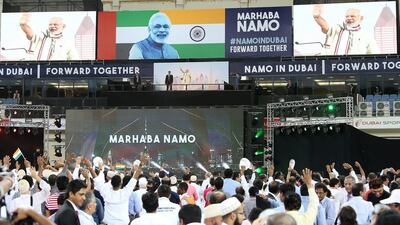
  • Mr Modi speaking at the Dubai International Cricket Stadium. Pawan Singh / The National
    Mr Modi speaking at the Dubai International Cricket Stadium. Pawan Singh / The National
  • The Indian prime minister waves goodbye to the audience after his speech. Pawan Singh / The National
    The Indian prime minister waves goodbye to the audience after his speech. Pawan Singh / The National
  • Consul General Dr Aman Puri (centre) and guests take part in India’s 73rd Republic Day celebrations at the country's pavilion at Expo 2020 Dubai. Pawan Singh / The National
    Consul General Dr Aman Puri (centre) and guests take part in India’s 73rd Republic Day celebrations at the country's pavilion at Expo 2020 Dubai. Pawan Singh / The National
  • Artists perform cultural dances during the Republic Day celebrations at the Expo site in Dubai. Pawan Singh / The National
    Artists perform cultural dances during the Republic Day celebrations at the Expo site in Dubai. Pawan Singh / The National
  • Guests take pictures during the Republic Day celebrations at the Expo site. Pawan Singh / The National
    Guests take pictures during the Republic Day celebrations at the Expo site. Pawan Singh / The National

The Emirates, as is the case with other GCC countries, imports about 85 per cent of its food products.

In 2020, UAE entities committed $7bn to create a food corridor between the UAE and India to provide a stable market for farmers in the Indian states of Punjab, Madhya Pradesh, Uttar Pradesh and Gujarat.

The agreement will also trigger collaborations between businesses in technology, health care and education.

“Despite the challenges posed by the pandemic, the two countries worked together relentlessly to ensure a long-term growth in the coming years. With this [agreement], there will be an immediate boost in people-to-people contact,” Mr Chawla said.

There are gains expected with job creation as the two countries strengthen co-operation.

“The CEPA is expected to benefit labour-intensive sectors such as aluminium, copper, the chemicals and petrochemicals industry, agriculture, textile and jewellery,” he said.

“This will result in spillover economic benefits, including increased investments, job creation and employment opportunities, which in turn will boost the economy.”

Jewellery businesses are also expecting a rise in exports to the UAE.

The UAE accounts for 80 per cent of India’s plain gold jewellery exports and 20 per cent of studded jewellery exports.

.
.

Colin Shah, chairman of India's Gem and Jewellery Export Promotion Council, described the country as the gateway to the entire Middle East.

The agreement “will provide impetus and much-needed push to exports of gem and jewellery products to the Emirates”, Mr Shah said.

In December, the export credit agencies of the UAE and India also signed an agreement to improve trade ties and provide market access for small- and medium-sized enterprises.

Etihad Credit Insurance and India's Export Credit Guarantee Corporation will co-operate in exploring mutual opportunities for insurance, reinsurance and coinsurance services linked to the export of goods in a third country, as well as support insured exporters with investments, ECI said on December 29.

India, with a population of more than 1.3 billion, is already an attractive market for the UAE’s private and public sector companies.

In June 2020, Abu Dhabi’s strategic sovereign fund Mubadala Investment Company invested $1.2bn in India’s telecoms provider Jio Platforms.

Indian conglomerate Reliance last year announced an investment of $2bn in Abu Dhabi’s Ta'ziz Industrial Chemical Zone.

The UAE, the Arab world’s second-biggest economy, has made a strong recovery from the coronavirus-induced economic slowdown and has maintained strong trade momentum despite global travel uncertainty.

Its exports are projected to expand at an average annual rate of more than 6 per cent to Dh1.1tn ($299bn) by 2030, as the UAE continues to diversify its economy away from oil, Standard Chartered said in a report this month.

Metals and minerals as well as gold and machinery will dominate the UAE's exports over the next decade, with India and China serving as the country's principal export markets, the report said.

The country is further strengthening relations with key trading partners. It is currently negotiating a CEPA agreement with Indonesia, the biggest South-East Asian economy.

Indonesia expects to finalise the agreement in the first quarter of this year, its Trade Minister Muhammad Lutfi told The National in November.

“We are going to sign the CEPA in the first quarter of next year [2022] and hopefully after that … we are going to double or triple [our trade] by 2025,” he said at the time.

The UAE is also holding negotiations for a CEPA agreement with South Korea, which is expected to be finalised by the end of 2022. The agreement aims to enhance the economic partnership between the two countries to a minimum of $20bn in the next three to five years.


Blackpink World Tour [Born Pink] In Cinemas

Starring: Rose, Jisoo, Jennie, Lisa

Directors: Min Geun, Oh Yoon-Dong

Rating: 3/5

Sun jukebox

Rufus Thomas, Bear Cat (The Answer to Hound Dog) (1953)

This rip-off of Leiber/Stoller’s early rock stomper brought a lawsuit against Phillips and necessitated Presley’s premature sale to RCA.

Elvis Presley, Mystery Train (1955)

The B-side of Presley’s final single for Sun bops with a drummer-less groove.

Johnny Cash and the Tennessee Two, Folsom Prison Blues (1955)

Originally recorded for Sun, Cash’s signature tune was performed for inmates of the titular prison 13 years later.

Carl Perkins, Blue Suede Shoes (1956)

Within a month of Sun’s February release Elvis had his version out on RCA.

Roy Orbison, Ooby Dooby (1956)

An essential piece of irreverent juvenilia from Orbison.

Jerry Lee Lewis, Great Balls of Fire (1957)

Lee’s trademark anthem is one of the era’s best-remembered – and best-selling – songs.

Greatest Royal Rumble results

John Cena pinned Triple H in a singles match

Cedric Alexander retained the WWE Cruiserweight title against Kalisto

Matt Hardy and Bray Wyatt win the Raw Tag Team titles against Cesaro and Sheamus

Jeff Hardy retained the United States title against Jinder Mahal

Bludgeon Brothers retain the SmackDown Tag Team titles against the Usos

Seth Rollins retains the Intercontinental title against The Miz, Finn Balor and Samoa Joe

AJ Styles remains WWE World Heavyweight champion after he and Shinsuke Nakamura are both counted out

The Undertaker beats Rusev in a casket match

Brock Lesnar retains the WWE Universal title against Roman Reigns in a steel cage match

Braun Strowman won the 50-man Royal Rumble by eliminating Big Cass last

Mercer, the investment consulting arm of US services company Marsh & McLennan, expects its wealth division to at least double its assets under management (AUM) in the Middle East as wealth in the region continues to grow despite economic headwinds, a company official said.

Mercer Wealth, which globally has $160 billion in AUM, plans to boost its AUM in the region to $2-$3bn in the next 2-3 years from the present $1bn, said Yasir AbuShaban, a Dubai-based principal with Mercer Wealth.

Within the next two to three years, we are looking at reaching $2 to $3 billion as a conservative estimate and we do see an opportunity to do so,” said Mr AbuShaban.

Mercer does not directly make investments, but allocates clients’ money they have discretion to, to professional asset managers. They also provide advice to clients.

“We have buying power. We can negotiate on their (client’s) behalf with asset managers to provide them lower fees than they otherwise would have to get on their own,” he added.

Mercer Wealth’s clients include sovereign wealth funds, family offices, and insurance companies among others.

From its office in Dubai, Mercer also looks after Africa, India and Turkey, where they also see opportunity for growth.

Wealth creation in Middle East and Africa (MEA) grew 8.5 per cent to $8.1 trillion last year from $7.5tn in 2015, higher than last year’s global average of 6 per cent and the second-highest growth in a region after Asia-Pacific which grew 9.9 per cent, according to consultancy Boston Consulting Group (BCG). In the region, where wealth grew just 1.9 per cent in 2015 compared with 2014, a pickup in oil prices has helped in wealth generation.

BCG is forecasting MEA wealth will rise to $12tn by 2021, growing at an annual average of 8 per cent.

Drivers of wealth generation in the region will be split evenly between new wealth creation and growth of performance of existing assets, according to BCG.

Another general trend in the region is clients’ looking for a comprehensive approach to investing, according to Mr AbuShaban.

“Institutional investors or some of the families are seeing a slowdown in the available capital they have to invest and in that sense they are looking at optimizing the way they manage their portfolios and making sure they are not investing haphazardly and different parts of their investment are working together,” said Mr AbuShaban.

Some clients also have a higher appetite for risk, given the low interest-rate environment that does not provide enough yield for some institutional investors. These clients are keen to invest in illiquid assets, such as private equity and infrastructure.

“What we have seen is a desire for higher returns in what has been a low-return environment specifically in various fixed income or bonds,” he said.

“In this environment, we have seen a de facto increase in the risk that clients are taking in things like illiquid investments, private equity investments, infrastructure and private debt, those kind of investments were higher illiquidity results in incrementally higher returns.”

The Abu Dhabi Investment Authority, one of the largest sovereign wealth funds, said in its 2016 report that has gradually increased its exposure in direct private equity and private credit transactions, mainly in Asian markets and especially in China and India. The authority’s private equity department focused on structured equities owing to “their defensive characteristics.”

Classification of skills

A worker is categorised as skilled by the MOHRE based on nine levels given in the International Standard Classification of Occupations (ISCO) issued by the International Labour Organisation. 

A skilled worker would be someone at a professional level (levels 1 – 5) which includes managers, professionals, technicians and associate professionals, clerical support workers, and service and sales workers.

The worker must also have an attested educational certificate higher than secondary or an equivalent certification, and earn a monthly salary of at least Dh4,000. 

The biog

Date of birth: 27 May, 1995

Place of birth: Dubai, UAE

Status: Single

School: Al Ittihad private school in Al Mamzar

University: University of Sharjah

Degree: Renewable and Sustainable Energy

Hobby: I enjoy travelling a lot, not just for fun, but I like to cross things off my bucket list and the map and do something there like a 'green project'.

Another way to earn air miles

In addition to the Emirates and Etihad programmes, there is the Air Miles Middle East card, which offers members the ability to choose any airline, has no black-out dates and no restrictions on seat availability. Air Miles is linked up to HSBC credit cards and can also be earned through retail partners such as Spinneys, Sharaf DG and The Toy Store.

An Emirates Dubai-London round-trip ticket costs 180,000 miles on the Air Miles website. But customers earn these ‘miles’ at a much faster rate than airline miles. Adidas offers two air miles per Dh1 spent. Air Miles has partnerships with websites as well, so booking.com and agoda.com offer three miles per Dh1 spent.

“If you use your HSBC credit card when shopping at our partners, you are able to earn Air Miles twice which will mean you can get that flight reward faster and for less spend,” says Paul Lacey, the managing director for Europe, Middle East and India for Aimia, which owns and operates Air Miles Middle East.

Ten tax points to be aware of in 2026

1. Domestic VAT refund amendments: request your refund within five years

If a business does not apply for the refund on time, they lose their credit.

2. E-invoicing in the UAE

Businesses should continue preparing for the implementation of e-invoicing in the UAE, with 2026 a preparation and transition period ahead of phased mandatory adoption. 

3. More tax audits

Tax authorities are increasingly using data already available across multiple filings to identify audit risks. 

4. More beneficial VAT and excise tax penalty regime

Tax disputes are expected to become more frequent and more structured, with clearer administrative objection and appeal processes. The UAE has adopted a new penalty regime for VAT and excise disputes, which now mirrors the penalty regime for corporate tax.

5. Greater emphasis on statutory audit

There is a greater need for the accuracy of financial statements. The International Financial Reporting Standards standards need to be strictly adhered to and, as a result, the quality of the audits will need to increase.

6. Further transfer pricing enforcement

Transfer pricing enforcement, which refers to the practice of establishing prices for internal transactions between related entities, is expected to broaden in scope. The UAE will shortly open the possibility to negotiate advance pricing agreements, or essentially rulings for transfer pricing purposes. 

7. Limited time periods for audits

Recent amendments also introduce a default five-year limitation period for tax audits and assessments, subject to specific statutory exceptions. While the standard audit and assessment period is five years, this may be extended to up to 15 years in cases involving fraud or tax evasion. 

8. Pillar 2 implementation 

Many multinational groups will begin to feel the practical effect of the Domestic Minimum Top-Up Tax (DMTT), the UAE's implementation of the OECD’s global minimum tax under Pillar 2. While the rules apply for financial years starting on or after January 1, 2025, it is 2026 that marks the transition to an operational phase.

9. Reduced compliance obligations for imported goods and services

Businesses that apply the reverse-charge mechanism for VAT purposes in the UAE may benefit from reduced compliance obligations. 

10. Substance and CbC reporting focus

Tax authorities are expected to continue strengthening the enforcement of economic substance and Country-by-Country (CbC) reporting frameworks. In the UAE, these regimes are increasingly being used as risk-assessment tools, providing tax authorities with a comprehensive view of multinational groups’ global footprints and enabling them to assess whether profits are aligned with real economic activity. 

Contributed by Thomas Vanhee and Hend Rashwan, Aurifer

MATCH INFO

Manchester City 3 (Silva 8' &15, Foden 33')

Birmginahm City 0

Man of the match Bernado Silva (Manchester City)

How to apply for a drone permit
  • Individuals must register on UAE Drone app or website using their UAE Pass
  • Add all their personal details, including name, nationality, passport number, Emiratis ID, email and phone number
  • Upload the training certificate from a centre accredited by the GCAA
  • Submit their request
What are the regulations?
  • Fly it within visual line of sight
  • Never over populated areas
  • Ensure maximum flying height of 400 feet (122 metres) above ground level is not crossed
  • Users must avoid flying over restricted areas listed on the UAE Drone app
  • Only fly the drone during the day, and never at night
  • Should have a live feed of the drone flight
  • Drones must weigh 5 kg or less
Updated: February 21, 2022, 4:27 AM