


Anyone under the impression that Britain's supply chain crisis is coming to an end only needs to look at the latest economic data to realise how wrong they are.
Britain’s economy barely grew in October, with an uplift of just 0.1 per cent, as the supply chain crisis continued to put production lines on the go-slow.
The picture did not get any rosier in November when the strongest inflation pressures in at least 23 years crimped the recovery of British companies with the IHS Markit/CIPS Composite Purchasing Managers' Index (PMI) – a combination of the services and manufacturing PMI – easing to 57.6 in November from 57.8 in October.
“The supply chain crisis is far from over,” Stuart Cole, chief macroeconomist at brokerage Equiti Capital, told The National.
“Judging from survey data, we are still a long way off supply chain issues being overcome. So the outlook over the short to medium term at least looks to be a continuation of what we are seeing now.”
This year the economy bounced back from the pandemic, following an output contraction of 9.9 per cent last year. However, the supply chain crisis complicated the recovery, emptying shelves in supermarkets, and causing mayhem on constructions sites, in factories and at the petrol pumps.

While output growth across manufacturing and services came in slightly faster than expected in November, according to the PMI reading, it was heavily skewed towards the service sector as factories continued to struggle with supply shortages and falling exports.
"Rising costs for fuel and wage demands led to the highest inflationary pressures since January 1998 as 63 per cent of supply chain managers paid more for their materials,” Duncan Brock, group director at the Chartered Institute of Procurement & Supply, said of the November report.
"Shortages of staff and production stoppages due to a lack of supplies added to frustrations in the manufacturing sector as some machines fell silent."
The outlook for the fourth quarter looks even less rosy as Omicron threatens to hit the services sector hard thanks to many new restrictions for hospitality venues and shops to prevent the spread of the virus.
Under the Plan B measures unveiled by Prime Minister Boris Johnson, people have been advised to work from home while masks must be worn in indoor settings including cinemas, theatres and churches.
The 'just-in-time' root cause of the supply chain crisis
Many thought the first sign of the unfolding supply chain crisis came in March when the giant container ship Ever Given bound for Rotterdam from Malaysia, got stranded in the Suez Canal for six days, backing up shipping traffic at an estimated cost of $1 billion.
The problem quickly escalated with ships forced to queue at seaports around the globe, with some container vessels turned away as there was no one to unload them.
-
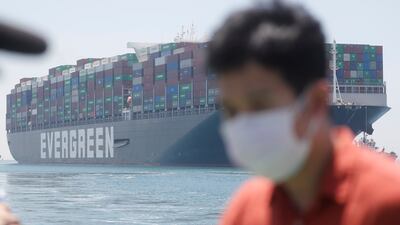
The 'Ever Given', one of the world's largest container ships, sails in the Suez Canal after authorities agreed to a settlement with the vessel's owner and insurers. -

Men fish near the 'Ever Given', which blocked the Suez Canal for six days in March. -

The vessel was not allowed to leave Egyptian waters until an agreement was reached between its owners and the Suez Canal Authority. -
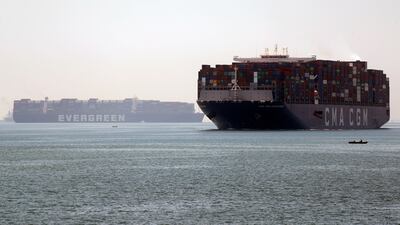
The 'Ever Given' sails in the Suez Canal. -

The blockage caused by the 'Ever Given' caused major disruption to international shipping. -

The 400-metre vessel became grounded while sailing through the Suez. -
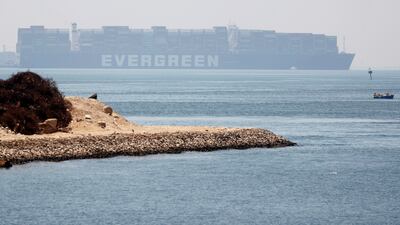
The incident caused a logjam of hundreds of vessels waiting to pass through the vital waterway in Egypt. -
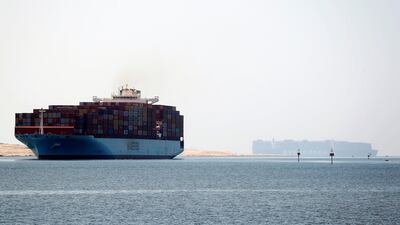
The 'Ever Given' was held in the Great Bitter Lake, off the canal, after it was freed. -

Journalists travel to see the 'Ever Given' leave the Suez Canal.


The root cause of all this stretches back decades, however, when the just-in-time model, adopted by goods and services producers across the UK, along with the rest of the world, first came into play.
First proposed by Toyota engineer Taachi Ohno in the 1950s, the concept was seen as a way of eliminating “waste” in the production and movement of goods.
Instead of wasting time, labour and money by storing key components in warehouses or next to assembly lines, Ohno’s idea required suppliers to only deliver what was needed – reducing the need for businesses to spend on maintaining inventories.
Fast forward to the modern day and every supplier is expected to deliver products promptly to the next buyer in the supply chain, with just-in-time delivery leading to the rise of the low-wage jobs where workers were only brought in when needed
While a tight supply chain keeps costs down, throw a pandemic into the mix and the whole concept collapses.
"Efficiency has basically been organised around having inventories which are not on balance sheets, but actually available, almost at a flick of a switch, on demand available across the entire supply chain," Naresh Aggarwal, associate policy and technical director at the Association of Corporate Treasurers, told The National.
“The challenge has been that we assumed we could continue to operate on a just-in-time basis ... so, it's been a problem waiting to happen in that we have become incredibly reliant on the success of supply chains."
With companies also forced to comply with tighter compliance measures, it concentrated where they sourced from in turn giving them fewer relationships to manage and economies of scale.
But the risk of that strategy arose during the pandemic, with companies dependent on one or two supplies left high and dry.
“If something happens to that one supplier, you don't really have any recourse elsewhere. Over the past five or 10 years this has accelerated and we've got to a point where we have got quite long supply chains all focused on cost reduction and a much narrower group of core suppliers," Mr Aggarwal said.
System collapsed on surging demand from consumers after lockdown
Surging demand from consumers as economies creaked back into life from lockdowns compounded the issue further, with container ports suddenly facing backlogs as rising activity globally put pressure on cargo storage and production levels struggled to keep up.
“There was very much a ripple effect, as Covid infections and subsequent lockdown measures fanned out from China to spread around the world," said Mr Cole.
With containers in the wrong place and some Chinese ports dormant or operating at reduced capacity, freight rates soared by up to 10 times in some cases from only two years ago.
In turn, manufacturers requiring internationally traded components to finish the production and distribution of their goods and services were forced to wait for parts, with car production in Britain, for instance, shrinking 41.5 per cent in September – the worst-performing September since 1982 – because of a lack of semi-conductors.

By the end of August, Britain's factories, supermarkets and restaurants were grappling with the fallout with shop shelves empty, restaurants struggling to meet orders and production lines on the go-slow.
At one point US burger chain McDonald's ran out of milkshakes and bottled drinks, while fast-food chains Nando’s and KFC complained of running out of chicken, with Nando’s forced to temporarily shut 50 of its outlets.
The National Health Service was forced to temporarily stop blood testing for certain conditions because of a shortage of collection tubes, while Iceland said it was struggling to keep everyday items, such as bread and soft drinks, on the shelves.
“The supply chain crisis is essentially a second order effect of Covid and will act to ensure the economic costs of the crisis are amplified and remain around for longer,” said Mr Cole.
“The direct results will be lower global growth, higher inflation, tighter monetary policy and looser fiscal positions than would likely otherwise have been the case.”
Shortage of lorry drivers and the effect on petrol pumps
While global container congestion was one issue, Britain had another problem: a severe shortage of haulage drivers to offload freight, caused by Britain's exit from the EU, due to a flight of foreign workers in the post-Brexit era, as well as during the pandemic lockdowns.
However, the shortfall also unleashed panic in the UK when a leaked document showing BP had told ministers of looming supply chain problems led to fuel deliveries being rationed and motorists rushing to the pumps.
Scenes of motorists queuing for hours outside petrol stations or fighting on the forecourt beamed across the world as empty tanks stopped some people from getting to work or taking their children to school.
While the situation eased as the army was brought in to deliver fuel and emergency hiring measures were put in place to solve the shortfall, the number of job vacancies in the UK hit a record high of 1.3 million in October, with shortages in the retail sector, accommodation, food services, professional activities and manufacturing.

The labour shortages only added to existing supply chain bottlenecks as companies did not have enough staff to get the job done – a problem still very much in existence today with wages on the rise as businesses desperately try to fill positions.
“A shortage of labour is preventing companies from raising output levels even if other raw material/capital inputs are sufficient for them to do so,” said Mr Cole.
Add in soaring gas prices in the UK and Europe caused by two of Britain’s main carbon dioxide factories shutting down in September because extortionate costs were leading to enormous losses and the situation seemed to spiral.
The devastating effect on the economy
The effects of all this on the economy have been brutal, with the rapid pace in the recovery recorded when restrictions first eased slowing over the summer and into the third and fourth quarters.
The main drag on October’s GDP reading came from manufacturing and construction which are still facing supply chain bottlenecks and labour shortages – leaving the world’s 5th largest economy 0.5 per cent smaller than pre-pandemic levels.
While the Black Friday binge seen at the end of November saw spending on cards hit the highest level since before the pandemic, consumers settling in at home under the new Omicron work-from-home measures may return to pre-pandemic habits of ordering treats online.

“Fresh demand could push prices even higher, especially as getting hold of popular products is still such a headache with ongoing supply chain issues,” said Susannah Streeter, senior investment and markets analyst, Hargreaves Lansdown.
“That could provide the extra rocket fuel for goods inflation at a time when the economy is struggling to recover.”
The risk is that the peak of the supply chain crisis has yet to come, Mr Cole said, if you take inflation as a measure of the impact supply chain issues are having.
Britain's inflation rate hit a decade high of 4.2 per cent in October with the Bank of England expecting the figure to surpass 5 per cent by the middle of next year
“The argument must be that supply chain issues are still very much in play and continuing to impose an economic cost,” said Mr Cole.
-

British Prime Minister Boris Johnson gives a press conference at 10 Downing Street. He announced that the government will implement its “Plan B” due to the rapid transmission of the Omicron variant. Getty Images -

Empty seats on an early morning commuter train on the District Line, in west London, the morning after Mr Johnson announced that work-from-home guidance will return on Monday. PA -
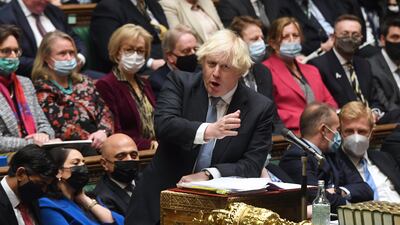
Boris Johnson during the Prime Minister's Questions at the House of Commons. Johnson faced questions amid allegations that Downing Street staff held a Christmas party during the Covid-19 lockdown 2020. EPA -

A patient receives the Pfizer vaccine at Swaminarayan School vaccination centre, in London. Britain says it will offer all adults a booster dose of vaccine within two months. AP Photo -

People queue up for Covid-19 booster jabs outside a vaccination centre in London. EPA -
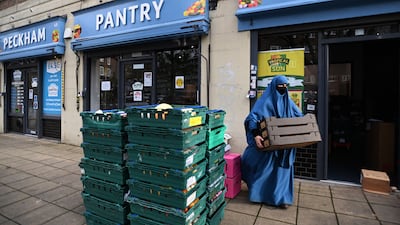
Staff with a new food delivery outside the Peckham Pantry in London. Food banks are braced for a big rise in demand in the run up to Christmas. EPA -

People wearing face masks pass electronic signs telling people they must wear masks on public transport, at Bond Street underground station in London. AP -

Allegra Stratton speaks outside her home in north London. Ms Stratton, a senior aide to Mr Johnson, resigned hours after an investigation began into allegations of a Covid-breaking Christmas party at Downing Street last year. AP -

Masked travellers get off a bus in London. According to his official spokesperson in Downing Street, Mr Johnson has told his cabinet that the Omicron variant of coronavirus appears to be more transmissible. EPA -

Margaret Keenan and Nurse May Parsons at University Hospital Coventry & Warwickshire, a year after Ms Keenan was the first person in the UK to receive the Pfizer-BioNTech vaccine. PA -
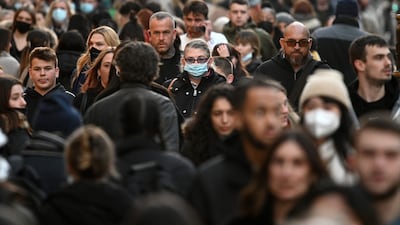
Shoppers, some wearing face-masks, walk along Oxford Street in central London, as compulsory mask wearing in shops is reintroduced in England. AFP


With the strength of the inflationary pressure now eroding real incomes and wealth and "facilitating a concomitant reduction in discretionary consumption", Mr Cole said the central bank will have little choice but to increase interest rates to stem rising prices.
Although the Omicron variant poses another threat, Mr Aggarwal said organisations will have to get used to the "short-term irritant of what the latest mutation of concern is".
"Some of these things will settle down and it may be that we get used to a world of fewer choices. That may well be a consequence of moving to a more ESG (Environmental, Social, and Governance) environment where people are more thoughtful about what they need and how it gets shipped," he said.
"Human behaviour will change, especially in younger generations, who will recognise that having everything available on tap all the time, there's a cost to that."

