
Leading central banks made a big call this week, deciding that coronavirus is no longer calling the shots in their economies, and inflation is now the bigger threat.
For almost two years, the main challenge for monetary authorities was to anticipate where the next pandemic blow might fall – and cushion its impact on economic growth and employment.
Not any more. In the past couple of days, central banks in the US and Europe have pivoted – at varying speeds – towards tighter policy. They now see reining in prices as a higher priority than protecting output and employment from further pandemic fall-out.
The Bank of England on Thursday became the first central bank in a Group of Seven economy to raise interest rates since Covid-19 arrived. The Federal Reserve said on Wednesday it will bring forward the end of its bond-buying programme and signalled three rate increases next year. The European Central Bank is also winding down emergency measures.
“It does not seem that the Fed or other central banks are feeling it necessary to ignore the very strong signals and elevated inflation readings they’ve seen just because of Covid,” said Mark Cabana, head of US interest rates strategy at Bank of America. “In fact, we’re seeing actions to the contrary.”
Behind the shift lies an assessment that, while Covid-19 is not going away, western countries are figuring out how to live with it – and the impact on economies of each virus mutation as a result will be smaller than the previous one.
“Many people have been vaccinated, and booster campaigns have accelerated,” ECB president Christine Lagarde said on Thursday. “Society has become better at coping with the pandemic waves and resulting constraints. This has lessened the pandemic impact on the economy.”
What is more, as central bankers have learnt more about pandemic inflation, they have arrived at a different view of how new virus outbreaks affect the economy.
Early in the crisis, the focus was on lockdowns as a damper to consumer demand – which easy monetary policy could help prop up. Now, officials also worry about the way health restrictions hold back the supply and movement of goods – driving up prices, and strengthening the case for higher interest rates.
“Previous economic frameworks were about what happens to demand growth,” said Sanjay Raja, an economist at Deutsche Bank in London. “Now it’s about the hit to demand versus the hit to supply. That is changing the calculus.”
Not all are showing speed. On Friday, the Bank of Japan announce it would withdraw its pandemic aid slowly. It extended loan assistance for struggling small businesses by another six months.
-

Medical staff take care of a Covid-19 patient in the intensive care unit at the University Medical Centre Magdeburg in Magdeburg, eastern Germany. AFP -

Pedestrians on a pedestrian crossing in the Shibuya district of Tokyo, Japan. AP Photo -
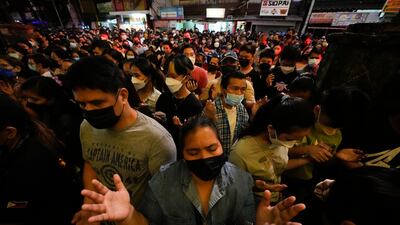
Worshippers at the first of nine daily dawn masses before Christmas day at the St Joseph parish church in suburban Las Pinas city, Philippines. AP Photo -
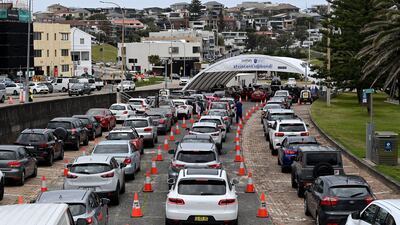
The queue for a Covid-19 test at St Vincent's Hospital drive-through testing clinic at Bondi Beach in Sydney, Australia. EPA -
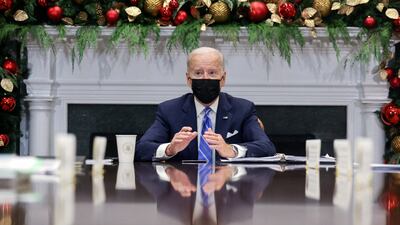
US President Joe Biden meets members of the White House Covid-19 Response Team to discuss latest developments related to the Omicron variant in the Roosevelt Room in the White House in Washington, DC. Reuters -

A mobile testing site near the NYU campus in New York. AP Photo -

Outdoor tables at a restaurant on Old Compton Street in Soho, London. PA -
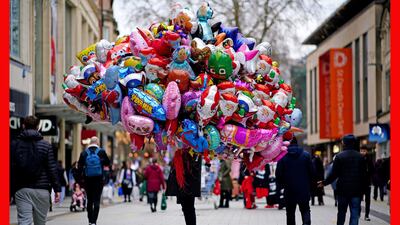
A balloon vendor and Christmas shoppers in the centre of Cardiff, Wales. PA -

A healthcare worker prepares a dose of Moderna Covid-19 vaccine in Nairobi, Kenya. AFP -

Medical staff prepare an isolation ward for Covid-19 patients at a government hospital in Chennai, India. AFP -

Residents of the Soweto Home for the Aged social distancing during breakfast in Johannesburg. AP Photo -

Skiers ride a lift line on Mount Jahorina, Bosnia and Herzegovina. AP Photo


For those who are adjusting, it is clear from the havoc the Omicron variant has been causing that there are lots of risks from changing gear.
Especially in Europe, governments are re-imposing some of the restrictions – from work-at-home guidance to travel curbs – that they had lifted earlier in the year, as cases spread rapidly and hospitals fill up again. Criticised for being too comfortable about inflation in recent months, there is a risk that officials are playing down the ongoing pandemic too much now.
Still, at press conferences this week, central bankers made it clear that they see Covid risks as diminishing; while their tolerance of price pressures has run out.
On Wednesday, Federal Reserve chairman Jerome Powell rejected a suggestion that the Fed should refrain from winding up its so-called taper by March because of the latest virus threat. “Omicron doesn’t really have much to do with that,” he said.
Mr Powell acknowledged that there are plenty of unknowns surrounding the new variant. He pointed out that the last one to spread around the world hurt the supply side of economies as well as crimping demand.
“Delta had an effect of slowing down hiring,” Mr Powell said, but also “hurt the process of the global supply chains getting worked out”.
head of US interest rates strategy at Bank of America
Those disruptions, coupled with strong consumer demand shored up by government spending to protect households in the pandemic, are what is driving inflation to multi-year highs in western economies.
Central bankers until recently said that the price spike would not last long – a stance from which they are now distancing themselves.
They are worried that supply-chain blockages and labour-market shifts triggered by Covid-19 may be around for a while – and if inflation gets entrenched, households and businesses may come to anticipate more of the same, and that expectation could prove self-fulfilling.
Effectively, the central banks are now betting that it is the new virus waves – or at least their economic impact – that will turn out to be transitory.

