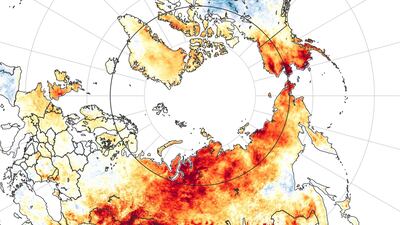
A NASA map showing land surface temperature anomalies from 19 March to 20 June 2020). Red colors depict areas that were hotter than average for the same period from 2003-2018. Siberia, famous for cold wintertime temperatures, saw its town of Verkhoyansk report a daytime temperature of 38 degrees Celsius on June 20. EPA
A NASA map showing land surface temperature anomalies from 19 March to 20 June 2020). Red colors depict areas that were hotter than average for the same period from 2003-2018. Siberia, famous for cold

How Opec can guide its members through the climate crisis


Robin Mills
  • English
  • Arabic

In Dubai on Friday, the temperature reached 40 Celsius, nothing surprising for this time of year. Yet Verkhoyansk in Siberia, north of the Arctic Circle, hit 38 degrees, an Arctic record. This shocking occurrence, in one of the coldest places in the world during winter at -50 degrees, warns the petroleum industry that rapid, transformational and disruptive change is imminent.

An increasing number of oil companies, including Shell, BP, Total, Eni and Repsol, have announced goals to be net zero-carbon by around mid-century. It might seem a radical departure for Opec to emulate them – but in some ways, it would be returning to the roots of the petroleum exporters’ organisation.

Italian historian Giuliano Garavini, in his history of Opec which I reviewed here in January, argued that Opec had antecedents as a conservation organisation. The Texas Railroad Commission's petroleum regulations, an inspiration for Opec, were born out of the wish to curtail physical waste of oil in the early 1930s glut.

Juan Pablo Pérez Alfonzo, former Venezuelan oil minister and one of the early guiding spirits of Opec, and the deposed Shah of Iran’s finance minister, Jamshid Amouzegar, were both conservationists.

The organisation went through several incarnations following its foundation in 1960. At first, it secured its members a fair share of their oil revenues by coordinating on taxation and forming a common front against the international oil firms who then dominated the industry. Then in the 1970s, it was the agent of increasing prices and nationalisation.

Only in the 1980s did it take on its familiar modern role, of propping up falling prices by setting per-member limits on production. Most recently, from 2016 onwards, it has widened this scope by cooperated closely within the Opec+ framework including Russia, Oman and other petroleum-exporting states.

Individual national oil companies (NOCs) of Opec+ countries have, of course, been preparing themselves for a lower-carbon future and the rise of electric vehicles.

Adnoc and Aramco have large-scale plans for carbon capture and storage. Aramco is developing mobile carbon capture systems and substitutes for metallic materials made from oil. Petroleum Development Oman is rebranding as Energy Development Oman and investing in renewable energy projects. Expansion into petrochemicals instead of transport fuels is de rigeur for many NOCs.

Some other state oil giants within Opec+ are struggling just to run their businesses in the face of the collapse in prices, the disruptions of coronavirus, and sometimes local conflicts and political turmoil. They do not have the opportunity or ability to take the slightly longer view.

So, what would Opec do, if recast as an organisation to guide its members through the climate crisis? One of its current core intentions would remain: coordinating production to achieve relatively stable and attractive prices and dealing with unexpected upsets in the world market.

Beyond this are three key duties it could take on. The first is to develop a long-term, climate-compatible view of the demand for oil, and help guide individual members in updating their plans for their oil industry and national economy in that light.

The second is to coordinate an Opec response on global climate policy. The organisation has often been seen as a barrier to climate action, even if that was more to do with the position of some individual members. Instead, it needs to maximise the value of its remaining hydrocarbons while charting a path to net zero. That includes policies to tax carbon rationally and efficiently, offset emissions by drawing down carbon dioxide from the atmosphere, develop non-emitting uses of oil, and adopt domestic regulations to avoid carbon border tariffs such as those proposed by the EU.

The third is to progress an ambitious technology development programme. The Opec Fund for International Development has total assets of $7.3 billion (Dh26.8bn), and has financed various climate-related initiatives. For the sake of its members, the organisation should be partnering with international oil companies and governments to advance research and development in key but underfunded areas.

These include ways to remove carbon dioxide from the atmosphere, including biosequestration, mineralisation and the creation of ceramics, fuels and plastics. Cooperation with Japan, Australia and Germany on generating, transporting and using carbon-neutral hydrogen is promising. Geoengineering may be necessary to cool the Earth directly.

Would it better for Opec, or the wider Opec+ grouping, to take on these tasks? Opec+ is not yet a formalised organisation and may never be. It is also more heterogenous, including a wider range of geographies than Opec’s primarily Middle East-Africa membership. Some non-Opec members are large gas exporters, some have quite diversified economies, and most have smaller oil reserves, declining production and less strategic flexibility.

Most importantly, Opec+ includes one large and influential state. Russia has lagged on taking climate change seriously. Its big government companies, Rosneft and Gazprom, have not shown urgency to reshape their business models.

Now, in the face of the heat and continuing wildfires in Siberia, and the massive oil spill earlier this month, blamed on melting permafrost, there are signs President Vladimir Putin may be paying more attention to global warming. Nevertheless, it would be hard to reconcile Moscow’s environmental imperatives with those of the main Opec states.

If Opec can manage this coordination, it would mark the next phase in its sixty-year existence. This return to its origins in the responsible use of nature’s bounty would also assure its future, and that of its members.

Robin M. Mills is CEO of Qamar Energy, and author of The Myth of the Oil Crisis

The bio

Favourite book: The Alchemist by Paulo Coelho

Favourite travel destination: Maldives and south of France

Favourite pastime: Family and friends, meditation, discovering new cuisines

Favourite Movie: Joker (2019). I didn’t like it while I was watching it but then afterwards I loved it. I loved the psychology behind it.

Favourite Author: My father for sure

Favourite Artist: Damien Hurst

The biog:

Languages: Arabic, Farsi, Hindi, basic Russian 

Favourite food: Pizza 

Best food on the road: rice

Favourite colour: silver 

Favourite bike: Gold Wing, Honda

Favourite biking destination: Canada 

Groom and Two Brides

Director: Elie Semaan

Starring: Abdullah Boushehri, Laila Abdallah, Lulwa Almulla

Rating: 3/5

The alternatives

• Founded in 2014, Telr is a payment aggregator and gateway with an office in Silicon Oasis. It’s e-commerce entry plan costs Dh349 monthly (plus VAT). QR codes direct customers to an online payment page and merchants can generate payments through messaging apps.

• Business Bay’s Pallapay claims 40,000-plus active merchants who can invoice customers and receive payment by card. Fees range from 1.99 per cent plus Dh1 per transaction depending on payment method and location, such as online or via UAE mobile.

• Tap started in May 2013 in Kuwait, allowing Middle East businesses to bill, accept, receive and make payments online “easier, faster and smoother” via goSell and goCollect. It supports more than 10,000 merchants. Monthly fees range from US$65-100, plus card charges of 2.75-3.75 per cent and Dh1.2 per sale.

2checkout’s “all-in-one payment gateway and merchant account” accepts payments in 200-plus markets for 2.4-3.9 per cent, plus a Dh1.2-Dh1.8 currency conversion charge. The US provider processes online shop and mobile transactions and has 17,000-plus active digital commerce users.

• PayPal is probably the best-known online goods payment method - usually used for eBay purchases -  but can be used to receive funds, providing everyone’s signed up. Costs from 2.9 per cent plus Dh1.2 per transaction.

Labour dispute

The insured employee may still file an ILOE claim even if a labour dispute is ongoing post termination, but the insurer may suspend or reject payment, until the courts resolve the dispute, especially if the reason for termination is contested. The outcome of the labour court proceedings can directly affect eligibility.


- Abdullah Ishnaneh, Partner, BSA Law 

THE BIO

Occupation: Specialised chief medical laboratory technologist

Age: 78

Favourite destination: Always Al Ain “Dar Al Zain”

Hobbies: his work  - “ the thing which I am most passionate for and which occupied all my time in the morning and evening from 1963 to 2019”

Other hobbies: football

Favorite football club: Al Ain Sports Club


EXPATS
%3Cp%3E%3Cstrong%3EDirector%3A%3C%2Fstrong%3E%20Lulu%20Wang%26nbsp%3B%3C%2Fp%3E%0A%3Cp%3E%3Cstrong%3EStars%3A%3C%2Fstrong%3E%20Nicole%20Kidman%2C%20Sarayu%20Blue%2C%20Ji-young%20Yoo%2C%20Brian%20Tee%2C%20Jack%20Huston%3C%2Fp%3E%0A%3Cp%3E%3Cstrong%3ERating%3A%3C%2Fstrong%3E%204%2F5%3C%2Fp%3E%0A
History's medical milestones

1799 - First small pox vaccine administered

1846 - First public demonstration of anaesthesia in surgery

1861 - Louis Pasteur published his germ theory which proved that bacteria caused diseases

1895 - Discovery of x-rays

1923 - Heart valve surgery performed successfully for first time

1928 - Alexander Fleming discovers penicillin

1953 - Structure of DNA discovered

1952 - First organ transplant - a kidney - takes place 

1954 - Clinical trials of birth control pill

1979 - MRI, or magnetic resonance imaging, scanned used to diagnose illness and injury.

1998 - The first adult live-donor liver transplant is carried out

Women%E2%80%99s%20T20%20World%20Cup%20Qualifier
%3Cp%3E%3Cstrong%3EUAE%20fixtures%3C%2Fstrong%3E%3C%2Fp%3E%0A%3Cp%3E25%20April%20%E2%80%93%20Ireland%20v%20UAE*%3Cbr%3E27%20April%20%E2%80%93%20UAE%20v%20Zimbabwe**%3Cbr%3E29%20April%20%E2%80%93%20Netherlands%20v%20UAE*%3Cbr%3E3%20May%20%E2%80%93%20UAE%20v%20Vanuatu*%3Cbr%3E5%20May%20%E2%80%93%20Semi-finals%3Cbr%3E7%20May%20%E2%80%93%20Final%3Cbr%3E%3Cstrong%3EUAE%20squad%3A%20%3C%2Fstrong%3EEsha%20Oza%20(captain)%2C%20Al%20Maseera%20Jahangir%2C%20Avanee%20Patel%2C%20Heena%20Hotchandani%2C%20Indhuja%20Nandakumar%2C%20Kavisha%20Kumari%2C%20Khushi%20Sharma%2C%20Lavanya%20Keny%2C%20Mehak%20Thakur%2C%20Rinitha%20Rajith%2C%20Samaira%20Dharnidharka%2C%20Siya%20Gokhale%2C%20Suraksha%20Kotte%2C%20Theertha%20Satish%2C%20Vaishnave%20Mahesh.%3C%2Fp%3E%0A%3Cp%3E*Zayed%20Cricket%20Stadium%3C%2Fp%3E%0A%3Cp%3E**Tolerance%20Oval%3C%2Fp%3E%0A
Timeline

2012-2015

The company offers payments/bribes to win key contracts in the Middle East

May 2017

The UK SFO officially opens investigation into Petrofac’s use of agents, corruption, and potential bribery to secure contracts

September 2021

Petrofac pleads guilty to seven counts of failing to prevent bribery under the UK Bribery Act

October 2021

Court fines Petrofac £77 million for bribery. Former executive receives a two-year suspended sentence 

December 2024

Petrofac enters into comprehensive restructuring to strengthen the financial position of the group

May 2025

The High Court of England and Wales approves the company’s restructuring plan

July 2025

The Court of Appeal issues a judgment challenging parts of the restructuring plan

August 2025

Petrofac issues a business update to execute the restructuring and confirms it will appeal the Court of Appeal decision

October 2025

Petrofac loses a major TenneT offshore wind contract worth €13 billion. Holding company files for administration in the UK. Petrofac delisted from the London Stock Exchange

November 2025

180 Petrofac employees laid off in the UAE

Springsteen: Deliver Me from Nowhere

Director: Scott Cooper

Starring: Jeremy Allen White, Odessa Young, Jeremy Strong

Rating: 4/5

Who's who in Yemen conflict

Houthis: Iran-backed rebels who occupy Sanaa and run unrecognised government

Yemeni government: Exiled government in Aden led by eight-member Presidential Leadership Council

Southern Transitional Council: Faction in Yemeni government that seeks autonomy for the south

Habrish 'rebels': Tribal-backed forces feuding with STC over control of oil in government territory

What vitamins do we know are beneficial for living in the UAE

Vitamin D: Highly relevant in the UAE due to limited sun exposure; supports bone health, immunity and mood.Vitamin B12: Important for nerve health and energy production, especially for vegetarians, vegans and individuals with absorption issues.Iron: Useful only when deficiency or anaemia is confirmed; helps reduce fatigue and support immunity.Omega-3 (EPA/DHA): Supports heart health and reduces inflammation, especially for those who consume little fish.

What drives subscription retailing?

Once the domain of newspaper home deliveries, subscription model retailing has combined with e-commerce to permeate myriad products and services.

The concept has grown tremendously around the world and is forecast to thrive further, according to UnivDatos Market Insights’ report on recent and predicted trends in the sector.

The global subscription e-commerce market was valued at $13.2 billion (Dh48.5bn) in 2018. It is forecast to touch $478.2bn in 2025, and include the entertainment, fitness, food, cosmetics, baby care and fashion sectors.

The report says subscription-based services currently constitute “a small trend within e-commerce”. The US hosts almost 70 per cent of recurring plan firms, including leaders Dollar Shave Club, Hello Fresh and Netflix. Walmart and Sephora are among longer established retailers entering the space.

UnivDatos cites younger and affluent urbanites as prime subscription targets, with women currently the largest share of end-users.

That’s expected to remain unchanged until 2025, when women will represent a $246.6bn market share, owing to increasing numbers of start-ups targeting women.

Personal care and beauty occupy the largest chunk of the worldwide subscription e-commerce market, with changing lifestyles, work schedules, customisation and convenience among the chief future drivers.

The specs
Engine: 2.5-litre, turbocharged 5-cylinder

Transmission: seven-speed auto

Power: 400hp

Torque: 500Nm

Price: Dh300,000 (estimate)

On sale: 2022 

The specs

Engine: 2x201bhp AC Permanent-magnetic electric

Transmission: n/a

Power: 402bhp

Torque: 659Nm

Price estimate: Dh200,000

On sale: Q3 2022 

The%20Roundup
%3Cp%3EDirector%3A%20Lee%20Sang-yong%3Cbr%3EStars%3A%20Ma%20Dong-seok%2C%20Sukku%20Son%2C%20Choi%20Gwi-hwa%3Cbr%3ERating%3A%204%2F5%3C%2Fp%3E%0A
Company%20Profile
%3Cp%3E%3Cstrong%3EName%3A%3C%2Fstrong%3E%20Raha%3Cbr%3E%3Cstrong%3EStarted%3A%3C%2Fstrong%3E%202022%3Cbr%3E%3Cstrong%3EBased%3A%3C%2Fstrong%3E%20Kuwait%2FSaudi%3Cbr%3E%3Cstrong%3EIndustry%3A%3C%2Fstrong%3E%20Tech%20Logistics%3Cbr%3E%3Cstrong%3EFunding%3A%3C%2Fstrong%3E%20%2414%20million%3Cbr%3E%3Cstrong%3EInvestors%3A%3C%2Fstrong%3E%20Soor%20Capital%2C%20eWTP%20Arabia%20Capital%2C%20Aujan%20Enterprises%2C%20Nox%20Management%2C%20Cedar%20Mundi%20Ventures%3Cbr%3E%3Cstrong%3ENumber%20of%20employees%3A%3C%2Fstrong%3E%20166%3C%2Fp%3E%0A
What can victims do?

Always use only regulated platforms

Stop all transactions and communication on suspicion

Save all evidence (screenshots, chat logs, transaction IDs)

Report to local authorities

Warn others to prevent further harm

Courtesy: Crystal Intelligence
