


Live updates: Follow the latest news on Israel-Gaza
From the chariot to the longbow, gunpowder, the tank, aeroplane and nuclear bombs, military leaders have long sought invincible weapons.
A new arm has entered service, giving dangerous confidence to weaker forces, and used effectively by Hamas in its attack on Israel.
As Israel shuts down a key offshore gasfield, a proliferation of drones and guided cruise missiles threatens not just soldiers, but critical infrastructure providing energy supplies for modern life.
The rise of relatively humble, cheap but numerous Turkish-built drones was prominent in Azerbaijan’s speedy defeat of Armenia in September-November 2020.
Watch: Israel pounds Gaza after evacuation deadline expires
But from an energy viewpoint, such weapons proved their capability earlier.
Experience from clashes such as the Iran-Iraq war, when both sides pounded away at oilfields, refineries and terminals, suggested that relatively small energy targets were hard to damage with inaccurate unguided missiles, or by planes that were vulnerable to interception.
But in September 2019, drones and cruise missiles, claimed by Houthi forces in Yemen, but more likely coming from Iran or Iran-linked groups in Iraq, hit the Abqaiq oil-processing facility and Khurais oilfield in Saudi Arabia, evading radar and the Patriot missile defence system.
The strikes temporarily knocked out 5.7 million barrels per day of oil production.
They appeared to be carefully calibrated to avoid major permanent damage, and Saudi Arabia was able to restore full capacity within a few weeks.
The main effect was political, demonstrating Iran’s ability to cause severe disruption to energy facilities key not only for Saudi Arabia, but for global oil consumers.
Drones have again been prominent in the Russia-Ukraine war, and not just on the front lines.
Russia has repeatedly struck at Ukrainian electricity supplies, especially last winter, aiming to disrupt the economy and break morale.
Ukraine has hit back through a series of shadowy attacks and somewhat unexplained explosions at Russian refineries, fuel depots and power plants.
These drones are not just aerial. Ukraine has innovated with marine drones, used in a series of attacks on Russia’s Black Sea fleet, the Kerch Bridge to Crimea and, in August, oil tankers.
That leads to perhaps the most mysterious recent energy sabotage.
Last September, three of the four lines of the Nord Stream I and II gas pipelines running from Russia to Germany under the Baltic Sea were destroyed by explosions.
Every plausible and implausible candidate has been blamed, including Russia, Ukraine or pro-Ukrainian groups, Nato, the US and the UK, but no proof has emerged.
On Tuesday, another Baltic gas pipeline between Finland and Estonia was broken by an apparent explosion, which Finland blames on “outside activity”.
Neither this nor the Nord Stream sabotage had to be carried out by drone – explosives laid by divers, mini-submarines or remotely operated vehicles from ships are most likely.
But it does show the vulnerability of the increasingly dense network of subsea pipelines, electricity and fibre-optic cables, growing as grids are integrated and offshore wind farms advance.
Following Hamas’s surprise attack, Israel shut down the important Tamar gasfield, whose production platform can be seen from Gaza on a clear day.
Israel-Gaza war latest - in pictures
-
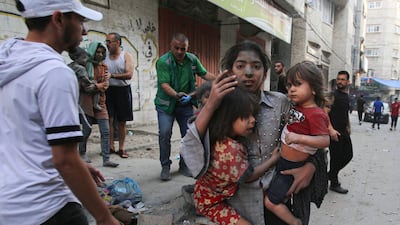
A Palestinian girl holds two children as she stands on a street in Gaza city as Israel continues to launch air strikes. AFP -
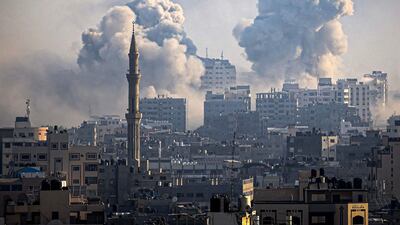
Smoke plumes billow during Israeli air strikes on Gaza city. AFP -
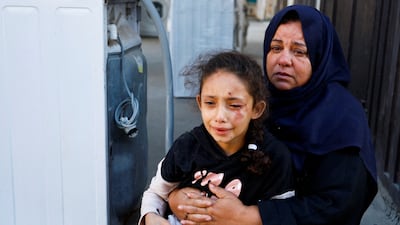
A Palestinian girl following an Israeli air strike in Khan Younis. Reuters -
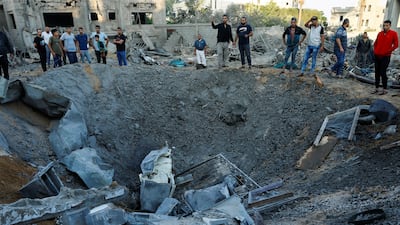
Palestinians survey the rubble of a house destroyed in Israeli strikes in Khan Younis, in the southern Gaza Strip. Reuters -
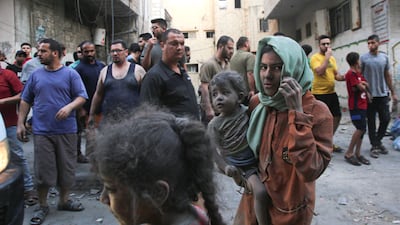
A Palestinian woman, covered in dust, carries a child in Gaza city. AFP -
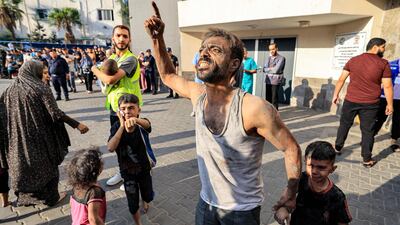
A Palestinian man with a child outside al-Shifa hospital in Gaza city. AFP -
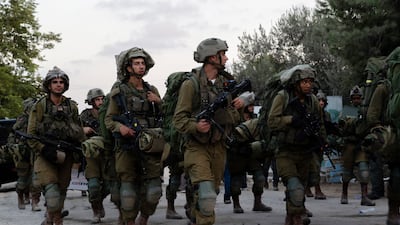
Israeli soldiers walk through Kibbutz Be'eri. Days earlier Hamas militants killed more than a hundred civilians near the border with Gaza. Getty Images -
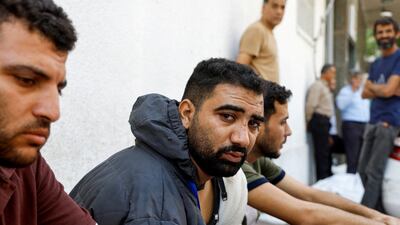
A wounded Palestinian man Ala Al-Kafarneh, who survived Israeli strikes, attends a hospital in Gaza city. Mr Al-Kafarneh lost his pregnant wife and several members of his family in air strikes after they fled Beit Hanoun. Reuters -

Supermarket shelves containing dry goods are left depleted in Tel Aviv. Getty Images -
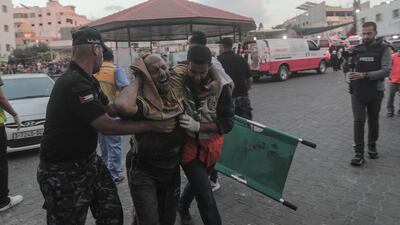
An injured Palestinian man arrives at Al-Shefa hospital in Gaza city. EPA -
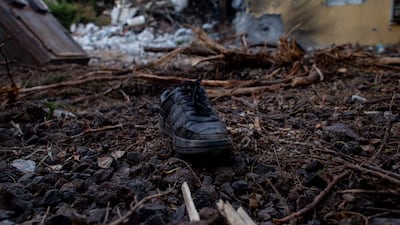
A boot lies on the ground outside a damaged house in Be'eri, Israel. EPA -
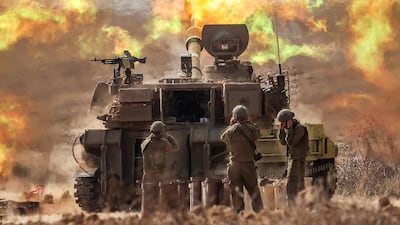
An Israeli army self-propelled howitzer near the border with Gaza in southern Israel. AFP -
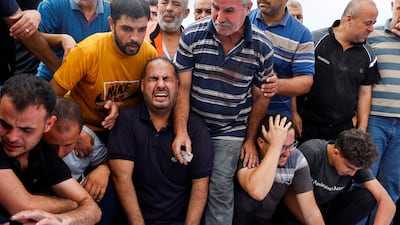
Palestinian mourners during the funerals of Al-Agha family members killed in Israeli strikes in Khan Younis in the southern Gaza Strip. Reuters -

Family and friends of May Naim, 24, who was killed by Palestinians militants at a party near the Israeli border with the Gaza Strip, during her funeral in Gan Haim, Israel. Getty Images -

Palestinian children in Khan Younis fill bottles with water from public taps during the conflict with Israel. Reuters -
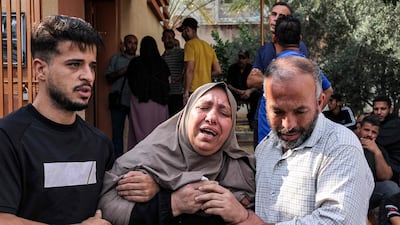
Men outside a morgue in Khan Yunis console a woman mourning loved ones killed in an Israeli air strike. AFP -

A Palestinian girl injured in Israeli strikes is taken to hospital in Gaza City. Reuters -

An Israeli woman is evacuated by paramedics following a rocket attack launched from the Gaza Strip into Israel, in Sderot. Reuters -
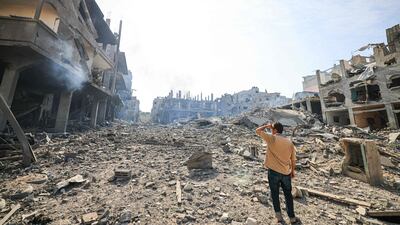
A man looks at the destruction in the ravaged Jabalia refugee camp, following overnight Israeli air strikes. AFP -
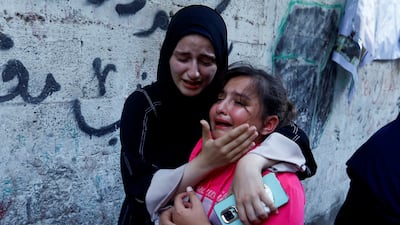
The daughter of Zakaria Abu Maamar, a member of Hamas's political office, at her father's funeral, after he was killed in an air strike in Khan Younis. Reuters -
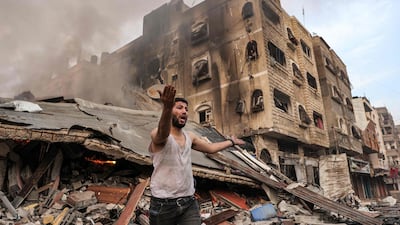
A collapsed building after an Israeli bombardment in Gaza City. AFP -
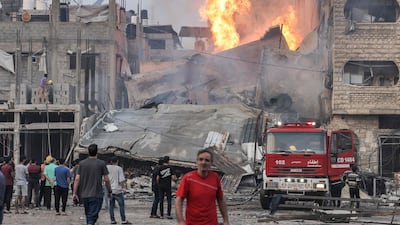
Firefighters attend a burning building after an Israeli bombardment in Gaza City. AFP -

Women and children in Gaza City. AFP -
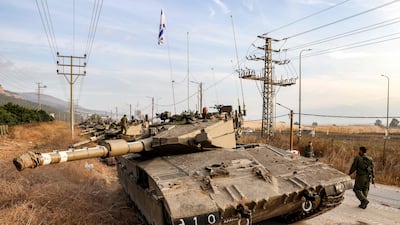
An Israeli army soldier passes a Merkava battle tank in northern Israel near the border with Lebanon. AFP -
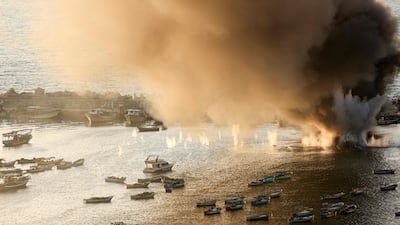
An Israeli strike on the port of Gaza City. AFP -

Demonstrators outside the West Los Angeles Federal Building in California during a rally in support of Israel. AFP -
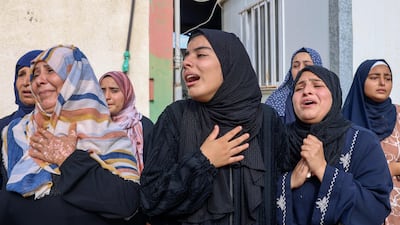
Mourners at the funeral of Palestinians killed in overnight Israeli shelling in Khan Younis in Gaza. AFP -

Israeli journalists take cover during a rocket attack from Gaza in the southern Israeli kibbutz of Kfar Aza near the border. AFP -

Palestinians rescue a young girl from the rubble of a destroyed residential building following an Israeli air strike. AP -

Mourners at the graveside of Eden Guez, who was killed as she attended a festival that was attacked by Hamas gunmen from Gaza. Reuters -
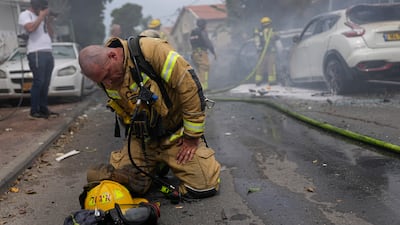
An Israeli fireman recovers after extinguishing cars set on fire by a rocket fired from Gaza. AP -
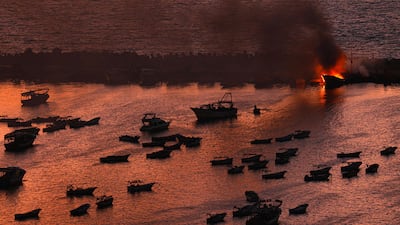
Smoke billows from a boat after a strike by Israel on the port of Gaza City. AFP -

Destroyed residential buildings in Gaza City. AP -

Rockets from Gaza launched towards Israel. Reuters -

A Palestinian woman sits among the rubble in the destroyed Al-Ramal neighborhood following an Israeli air strike in Gaza City. EPA -
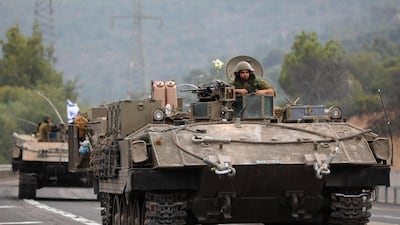
Israeli soldiers in armoured vehicles near the northern town of Kiryat Shmona close to the border with Lebanon. AFP -

Buildings destroyed by Israeli strikes in Gaza city. Reuters -

Nicole Izsak, right, confronts a Palestinian supporter near the Israeli consulate in New York, claiming her cousin is being held hostage in Gaza. AFP -
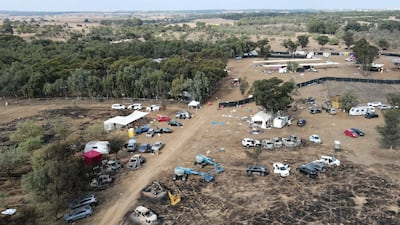
The abandoned site of the Supernova music festival, besieged by Hamas militants in southern Israel. AFP -
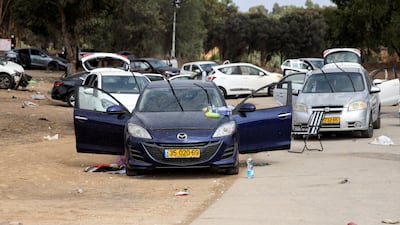
An attack on the site by Hamas gunmen from Gaza left at least 260 people dead. Reuters -

A man carries a blood-stained flak jacket belonging to a Palestinian journalist, who was killed with two colleagues when an Israeli missile hit a hospital building while they were outside reporting, in Gaza city. Reuters -
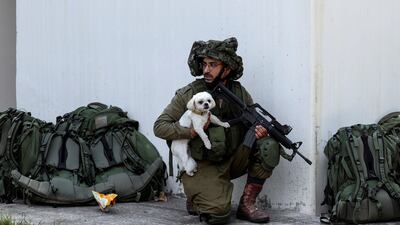
An Israeli soldier holds a rescued dog as he takes position near a bomb shelter in Kibbutz Kfar Aza, southern Israel. Reuters -

Protesters chant and wave the Palestinian flag at a rally in Melbourne, Australia. Getty Images -
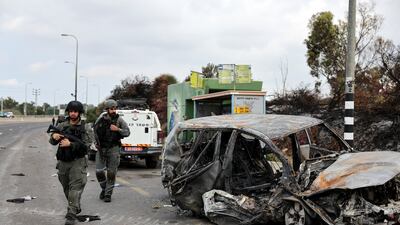
Israeli border police walk past a burnt-out car as rockets are launched from the Gaza Strip towards Israel, in Ashkelon, southern Israel. Reuters -

Palestinians amid the rubble following Israeli air strikes that razed a neighbourhood in Gaza city. AP -
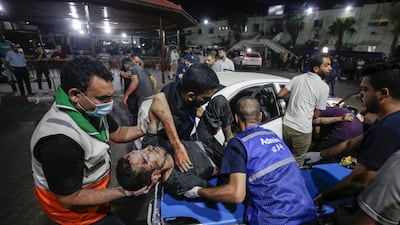
Palestinians carry a wounded man at Al Shifa Hospital in Gaza city. EPA -
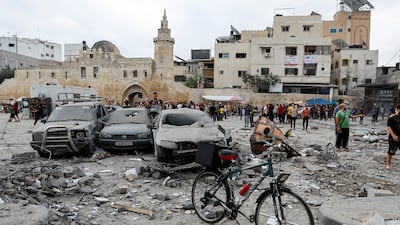
Palestinians inspect damage in the aftermath of Israeli strikes in Khan Younis, southern Gaza Strip. Reuters


This was apparently precautionary. The facilities for Israel’s two other producing fields, Leviathan and Karish, are located much further north, near the Lebanese offshore border.
Tamar was also briefly closed during the unrest of May 2021, albeit that was much less serious.
The Israel Defence Forces claimed to have thwarted a submarine drone attack from Gaza on Tamar, and that rockets had also been unsuccessfully fired at the platform.
In July 2022, the IDF said it had downed three reconnaissance drones launched by Hezbollah towards the Karish floating production vessel.
On Saturday, unofficial reports suggested the much-watched Qana well, being drilled by France’s TotalEnergies in Lebanon just over the boundary line, had failed to find gas.
That remains to be confirmed but, if true, it would dampen the incentive for Hezbollah to avoid targeting Israeli energy infrastructure for fear of retaliation.
Tamar provides nearly half of Israel’s gas production, and contributes to its exports to Jordan and Egypt.
In turn, Egypt had been in the process of resuming liquefied natural gas exports, helping to supply Europe.
For now, there is no reason to expect the closure to be prolonged, but if it were, it would tighten global gas supplies as the Northern Hemisphere winter approaches.
European gas prices have risen by more than half since last Saturday, mostly because of the ominous Baltic pipeline rupture.
Drones have several advantages. They can be cheap and simple, well within the capability of weaker or poorer states as well as non-state groups.
Therefore they can be deniable, making it hard for the target to know who to retaliate against and how.
They can overwhelm expensive conventional defences with a combination of numbers and undetectability. And they avoid exposing their users directly to harm.
Their main weakness is dependence on GPS systems and communications from human operators, which can be blocked by electronic measures.
That may disappear as fully autonomous drones, micro-drones and swarms are deployed. Drone attacks are also more effective when teamed with guided missiles and bombs, cyberwarfare, and traditional ground forces and misdirection.
New weapons win battles and even campaigns, but rarely provide a durable strategic advantage.
Opponents adopt them, or find ways to counter them. Nevertheless, they can lead countries or armed groups to start conflicts against apparently much stronger opponents. They also change the nature and targets of warfare.
Both the Middle East and Europe abound in exposed energy infrastructure. Defences can be beefed up, and critical systems can be hardened.
Ukraine’s experience in keeping much of its heat, water and electricity flowing even through prolonged attacks is testament to the value of robustness, duplication and improvisation.
Still, there are no easy answers to this new threat: the energy industry and defence forces need to learn quickly and be prepared for the unexpected, and even the previously unthinkable.
Robin M. Mills is chief executive of Qamar Energy, and author of The Myth of the Oil Crisis

