


Russia’s invasion of Ukraine has overturned the global paradigm of gas security and flexibility that emerged in the 1970s and was refurbished in the 2000s.
In terms of gas security, Europe has become Japan, while China has become Europe – a shift with momentous geoeconomic and security implications. On Tuesday, gas consumers and producers met in Tokyo to redraw their maps.
The International Energy Agency was founded in November 1974, immediately after the first great oil shock, to ensure the security of petroleum supplies for the industrialised countries at the time.
Its role has broadened to include all forms of energy and also climate. In advance of the Tokyo meeting, its new review of global gas market security outlines how radically things have changed since February 2022.
The world gas paradigm that took shape between the 1970s and the 2000s had four major consuming poles. North America – the US and Canada – was a vast producer and user of gas, that imported a little for balance.
Japan, Taiwan and South Korea had minimal hydrocarbon resources of their own, were entirely dependent on imports, and rightly paranoid about the security of supply, pioneering the global liquefied natural gas, or LNG, business, with long-term contracts and deep partnerships with producers.
Europe produced large amounts domestically after finding reserves in the Netherlands in 1959, imported a growing amount from its immediate neighbourhood in North Africa and, from 1968, the Soviet Union then Russia, and used LNG imports to balance demand and Russian supplies.
Europe liberalised its markets in the 2000s and became the global balancing point for the LNG market. When prices were low, it could take more, through a set of usually underutilised import terminals, and cut back on Russian supplies via pipeline, or boost storage. When prices rose, it could do the opposite.
Russia, meanwhile, was chained to the European market by expensive, inflexible pipelines. Since the late 1990s, Qatar and Australia developed large LNG export industries, mostly focused on East Asia, but with a significant share of Qatari volumes going to Europe.
Finally, China relied almost entirely on coal, produced most of its gas, and bought a little LNG for premium coastal markets.
Now, the role of every one of those core locations has changed. Russia has shaken in months, an industry and a reputation that took decades and hundreds of billions of dollars of investment to create. It aims to pivot from west to east, but its first pipeline to China only started operations in December 2019 and carries a small fraction of its previous sales.
Shale resources have enabled the US to become a major LNG exporter, with much more growth to come. The latest project, Rio Grande LNG, which includes Abu Dhabi’s Mubadala among its backers, reached its investment decision last Monday.
US projects are flexible at least on the downside – when global LNG prices fall too low, they can shut off exports and sell to the domestic market, as during the Covid-related demand slump in 2020.
LNG demand in the original core trio of Japan, South Korea and Taiwan is now set to drop, hit by maturing economies, efficiency measures, the restart of nuclear reactors, and more renewable energy. Japan aims to become a leader in offshore wind power.
Europe’s production has collapsed because of the shutdown following earth tremors of the Netherlands’ Groningen field, the original trigger for the gasification of its economy in the 1960s.
Norway remains a strong supplier. But only a dribble of Russian gas still reaches the continent via pipelines through Ukraine and Turkey, and the Ukrainian route could be closed entirely this winter.
Europe has fared much better than expected in the face of an unthinkable shut-off. Efficiency gains, renewable energy, industrial closures, scouring the world for new LNG supplies and opening additional import terminals have brought prices back to tolerable levels, though still elevated over pre-war norms.
But Europe has become Japan – its happy role as a balancer is gone with the evaporation of Russian supplies. It now needs rather costly LNG as baseload provisions. Its own storage capacity is already near-full to the brim this summer, yet not enough to offset a potential cold winter.
-
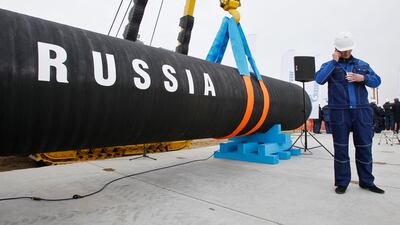
A Russian construction worker speaks on a mobile phone during a ceremony marking the construction of the Nord Stream pipeline in Portovaya Bay, 170 kilometres north-west of St Petersburg in Russia. AP Photo -
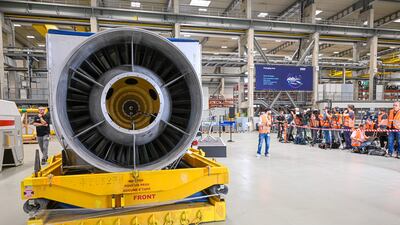
A turbine of the Nord Stream 1 pipeline at the Siemens Energy plant in western Germany. AFP -
The logo of Russia's energy giant Gazprom is pictured at one of its petrol stations in Sofia, Bulgaria. AFP -
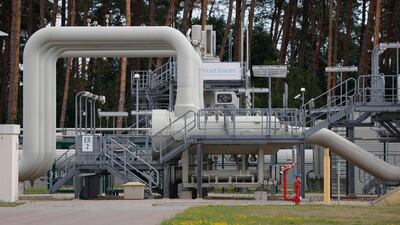
Facilities to receive and distribute natural gas are pictured on the grounds of gas transport and pipeline network operator Cascade in Lubmin, north-eastern Germany, close to the border with Poland. AFP -
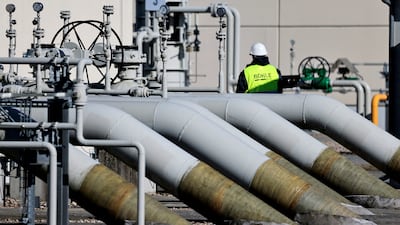
Pipes at the landfall facilities of the 'Nord Stream 1' gas pipeline in Lubmin. Reuters -
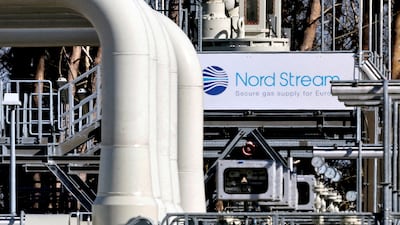
The Nord Stream 1 gas pipeline in Lubmin, Germany. Reuters


Renewables, alternatives such as biogas and hydrogen, and a shift to electrically-driven heat pumps for homes, will help. But in the interim, Europe needs to learn from the energy bureaucrats and trading houses of Japan, taught stern lessons by the 1970s.
The Japanese government has proposed a global strategic gas reserve for such contingencies. IEA members are already obliged to hold 90 days of oil imports in stock. Europe needs more gas storage – and could reach an agreement with Ukraine to use some of its large spare capacity.
It could do with new pipeline imports, but its political timidity and aversion to new fossil fuel projects have prevented it from engaging robustly with North Africa, the East Mediterranean and Iraq. Despite its longer-term decarbonisation goals, it needs somehow to agree on long-term contracts to underpin LNG investments and purchases, to compete effectively with China.
Conversely, China has become Europe. It has gasified much of its industry and home heating to reduce air pollution from coal. A major gas producer itself, it is now also the world’s biggest importer of gas by pipeline – from Russia and Central Asia – and of LNG, overtaking Japan.
In recent months, its state companies have signed 27-year deals to purchase Qatari LNG and invest in its plants, while restarting work on a major new pipeline from Turkmenistan and dangling the prospect of another big pipeline before Moscow’s eyes.
It is in an enviable position to pick and choose suppliers. It can buy long-term LNG from Qatar, then resell flexible short-term LNG from the US when its home demand slips or market conditions elsewhere look favourable.
The new fulcrum of the global gas world must balance the imperatives of low prices, competitive tension between sellers, and security to mishaps or geopolitical turbulence. Beijing should learn – and benefit – from the missteps of Brussels and Berlin.
Robin M. Mills is the chief executive of Qamar Energy and author of The Myth of the Oil Crisis

