


History could have been very different had John Goodenough accepted the Shah of Iran’s 1974 offer of $7 million to found a solar research institute.
Instead, he moved to Oxford University and invented the practical lithium battery. Goodenough, who died last week aged 100, became the oldest Nobel Prize winner in 2019.
He had two co-winners. M. Stanley Whittingham, a British-born American Exxon scientist, was the first to try using lithium for batteries. Then, as recounted in Bottled Lightning, Seth Fletcher’s book on battery history, Goodenough replaced flammable lithium metal in the cathode, the battery’s negatively-charged electrode, with cobalt oxide. Finally, Japanese researcher Akira Yoshino introduced graphite for the anode, the positive electrode.

The result had a higher voltage than traditional batteries, twice the storage capacity, and could be recharged hundreds of times. It was also lighter, due to lithium being the lightest metal. Unlike their competitors that powered popular gadgets such as the 1979 Sony Walkman or the early brick-sized mobile phones of the 1980s, Li-ion batteries do not contain toxic mercury and were not harmful to children when swallowed.
Introduced by Sony in 1991, the Li-ion battery cost nearly $8,000 per kilowatt-hour (a typical smartphone today contains about 12 to 16 watt-hours). Now, that is down to $151 per kilowatt-hour. The technology has improved but, mostly, manufacturing has been transformed in scale and sophistication.

While the basic configuration of most lithium-ion batteries remains the same today, it has enabled three revolutions.
The first was in mobile phones.
The second revolution is picking up speed: motoring. Goodenough entered battery research in 1973 precisely because he wanted to solve the US's over-reliance on imported oil. A modern Tesla car with 100 kilowatt hours of storage would have cost $800,000 in 1991 for the battery alone. Now, the falling cost and rising capacity of his Li-ion innovation makes possible, for the first time in a century, a ground transport system that does not rely mostly on petroleum.
In the third revolution, that of renewable energy, Li-ion plays more of a supporting role, but various types of batteries will become increasingly important. Wind and solar power need to smooth out their fluctuations, and to store electricity for night, calm conditions and surges in demand. The US, China and Australia have contended as hosts of the world’s biggest Li-ion grid storage, with projects in the UK and Saudi Arabia that would greatly exceed the current record-holder in California.
Such revolutions come with many further consequences, even for the relative strength of nations. After Japan took an early lead, two Chinese companies – Contemporary Amperex Technology Limited (CATL) and BYD – now hold nearly half of the world market for Li-ion battery manufacturing.
Seven companies – three from China, three from South Korea and one from Japan – hold nearly nine-tenths of the global production capacity.
Fearing being left behind in the global technology race, the US and EU have unveiled massive subsidies to build their own factories.
The soft, light, silvery-white metal that set off the whole revolution has itself become a geopolitical prize. Australia, Chile and China are its leading producers. The salt flats of South America tantalise their nations with the promise of wealth and influence. Chile’s President Gabriel Boric announced in April that he would nationalise lithium, following the lead of Mexican President Andres Manuel Lopez Obrador, who did the same in February. Bolivia nationalised its huge resources in 2008, but has struggled ever since to build up any significant extraction.
Latin America wants to benefit from lithium in a way it feels it did not from previous resource booms, building up local processing and manufacturing of batteries and electric cars. But it may miss the bus again, as attention grows on lithium mining elsewhere, and the recovery of the metal from saline water extracted with oil or from geothermal wells.
Then, there is the race to improve on the basic Li-ion battery, or replace it entirely. About half of the cost of a Li-ion battery is accounted for by the cathode, which contains some combination of lithium, cobalt, nickel and manganese.
The other metals have themselves become the focus of concerns over costs and price volatility, the reliability of supply from countries such as the Democratic Republic of Congo and Indonesia, processing in China, and environmental and social damage during extraction.
-
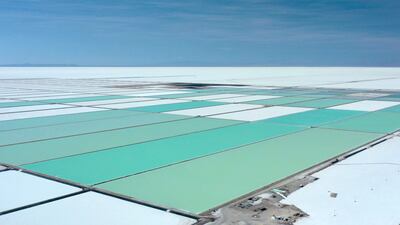
Evaporation pools at the new state-owned lithium extraction complex in the southern zone of Uyuni Salt Flat, Bolivia. AFP -
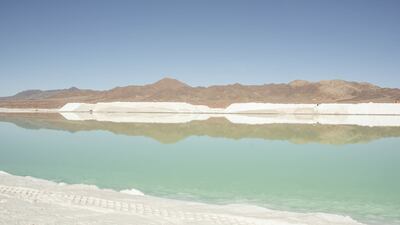
A brine pool at the Albemarle Corp lithium mine in Calama, northern Chile. Albemarle is the world's biggest producer of lithium. Bloomberg -
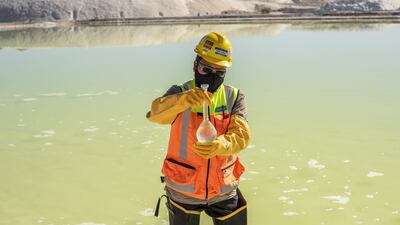
A mine worker takes water samples from a brine pool at the Albemarle lithium mine in Calama. Bloomberg -
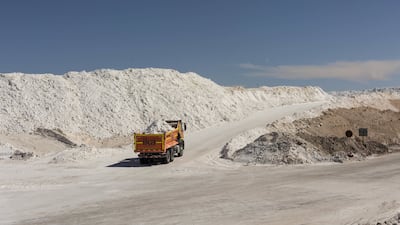
A lorry carries a load of potassium chloride at the Albemarle lithium mine in Calama. Bloomberg -
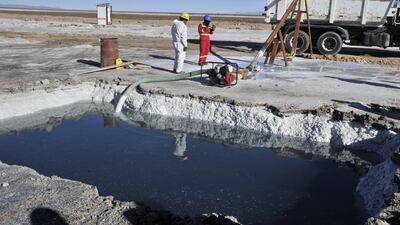
Workers at the Llipi pilot plant at Uyuni Salt Flat, south of Bolivia's capital La Paz. The country has more than 40 per cent of global lithium reserves. AFP -

Brine pools at SQM lithium mine on the Atacama Salt Flat in the Atacama Desert of northern Chile. Reuters -
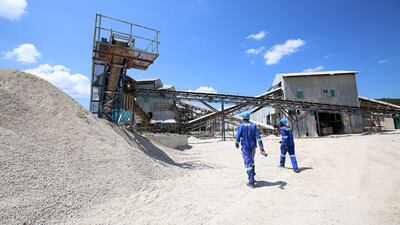
Bikita Minerals' mining plant in Bikita, 340 kilometres south of Zimbabwe's capital Harare. It is the only mine in Africa that produces world-class lithium pegmatite. Zimbabwe is the sixth-largest producer of lithium. EPA -
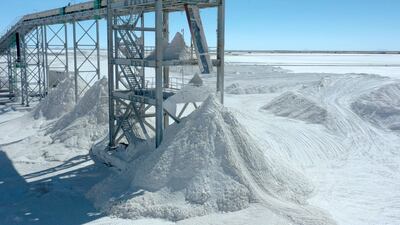
Piles of salt, a byproduct of lithium extraction, at the new state-owned lithium extraction complex at Uyuni Salt Flat, Bolivia. AFP -

Mountains provide a stunning backdrop to a lithium mine brine pool at the Atacama Salt Flat in Chile. Reuters


Various tweaks aim to reduce or eliminate the need for these metals. Goodenough was also an early researcher of lithium iron phosphate batteries in 1997. These do not contain cobalt, are cheaper and safer, and are gaining popularity for mid-range vehicles, but have a lower energy density and voltage.
Another emerging technology, silicon-based anodes without cobalt, promises much higher capacities. Lithium-sulphur batteries are already used in drones and, being cheaper and lighter, could power short-range electric aeroplanes.
In recent years, Goodenough worked on a solid electrolyte, the conductive material between the anode and cathode, that would replace the flammable liquid electrolyte in current Li-ion batteries. Solid-state batteries may not only be safer, but have twice the energy density.
Then, there are batteries that don’t use lithium at all. Sodium-ion batteries contain a much more common metal – sodium being the main constituent of sea salt – with similar chemical properties to lithium. Though heavier than Li-ion, they could be safer and cheaper, and good for stationary applications such as power grids. Flow batteries, which work on a very different principle, are another option for long-term electricity storage.
“I didn’t know they were going to be worth billions,” Goodenough said in 2019, shortly before his Nobel award. Like lasers, “a solution seeking a problem”, or solar photovoltaic cells, originally made for satellites, Li-ion batteries have turned out to have uses far beyond their original scope, and are transforming whole industries and economies.
This took innovation: Goodenough complained that no company in Europe or the US would license his invention at the time “because it was unorthodox”. It took patience: 15 years of research from concept to commercial product, and another 15 years from Sony’s battery to the Tesla Roadster, the first marketed Li-ion car. Alternatives will also need years to reach commercial performance and scale.
But their consequences will spark further revolutions beyond their inventors’ imaginations.
Robin M. Mills is chief executive of Qamar Energy, and author of The Myth of the Oil Crisis

