


“What do you think about the El Nino phenomenon?
“Umm … it’s a blip. I think basically Latin music is on its way out.”
Bridget Jones does not get the TV job she’s interviewing for in the 2001 film. But El Nino is back now, bringing extreme weather and trouble for energy systems around the globe.
From 2020 to 2022, the world was in La Nina conditions. Warm surface waters in the tropical Pacific moved west, allowing cold water to well up from deeper levels along the western coast of South America. This brings generally cooler weather, though with global warming, last year was still the fifth hottest on record.
On Thursday, the US Climate Prediction Centre officially concluded that the El Nino-Southern Oscillation (ENSO) has flipped into its opposite, warmer phase. The eastern Pacific is now unusually hot, and the prevailing east-to-west trade winds are blowing the other way. The 1997 to 1998 El Nino was especially intense, as was that of 2016, while 2019’s repeat was weak.
Forecasters are suggesting this El Nino may be stronger than average – meaning 2024 is set to be a hot year.
Climate change may make El Nino more frequent and intense, but the link is not certain. What is clear is that the generally hotter conditions during El Nino, on top of global warming, mean new temperature extremes are likely.
Average global temperatures are already 1.1°C above pre-industrial levels, and El Nino could add 0.2°C to that, bringing us very close to breaching the 1.5°C limit that 2015’s Paris Agreement aims for.
The World Meteorological Association sees a two-in-three chance that this target will be exceeded in at least one of the next five years – a temporary setback but an ominous one.
Both phases of ENSO change weather patterns globally, via teleconnections with remote regions.
During El Nino, the Sahel, southern Africa, Australia and South-East Asia, India and northern South America are likely to be drier and hotter. Europe, the southern US and eastern China may be wetter. But beyond the tropical Pacific, El Nino is not the only major atmospheric and oceanic phenomenon. There are oscillations within the Indian Ocean, the Atlantic and the Arctic Ocean that may reinforce or offset it.
The chaotic weather of the last two years has strained energy systems.
Drought in Latin America, drying up hydroelectric dams, and low wind in Europe set the stage for the high gas prices of late 2021. The blistering pre-monsoon heatwave of 2022 in India and Pakistan caused the worst electricity shortages for six years, as air-conditioning use soared while coal stocks ran short.
Europe’s hot summer then saw river levels fall, forcing French nuclear plants to shut down as they lacked cooling water, and making it hard to move coal by barge, further stressing the continent’s electricity.
But the European winter was fairly warm though dry, cutting the demand for gas for heating and helping the continent cope with the cut-off of most Russian gas supplies.
The higher temperatures of El Nino will give a preview of our permanently hotter world a decade or two in the future.
South-East Asia baked in a heatwave this May and June that saw Thailand and Vietnam break their all-time temperature records, hitting 45.4°C and 44.2°C, respectively.
Shanghai has recorded its hottest May in more than 150 years. Outdoor workers risk dehydration and heat stroke, while most people in poorer countries such as Cambodia, Laos and Myanmar don’t have access to air conditioning.
The skies of New York, Toronto and Calgary recently turned orange under choking smoke from three massive sets of Canadian wildfires.
Climate disasters do not respect borders. Droughts and hot weather expose forests to such blazes, which also struck California, Greece, Algeria and Australia in recent years. The pollution left a legacy of respiratory disease among children.
If we do not build it wisely, the future energy system will be more vulnerable than today’s to extreme weather. Wind, solar, nuclear and biofuel cultivation are all likely to be major parts of a low-carbon future, and are affected by outdoor conditions. Areas affected by the North American wildfires have seen solar output drop by half.
Green hydrogen, made with renewable electricity, would be affected in turn. Hydropower is crucial for balancing variable renewables, but is increasingly unreliable. The dream of many environmentalists, a system where cars, heating, cooling, desalination and industries are fully electrified, can be disrupted by any grid failure.
El Nino probably means a quieter Atlantic hurricane season. But these powerful storms are more intense in a warming world, and can shut down offshore wind farms as well as oil and gas platforms.
Many facilities for energy production, export and use are located along coastlines, where they can be damaged by storm surges made more dangerous by rising sea levels. High rainfall and melting snow flood mines, including those for critical future minerals such as copper.
Electricity transmission lines can be threatened by wildfires – or have to be turned off to avoid sparking them.
-
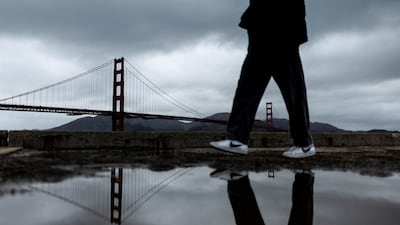
Dark clouds over the Golden Gate Bridge as storms approach San Francisco. Reuters -
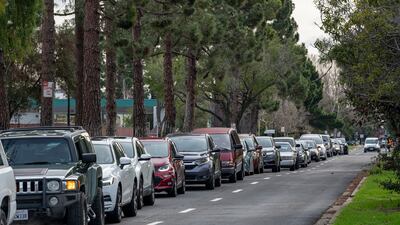
Residents queue up for sandbags at a City of Oakland site before the storm. Bloomberg -
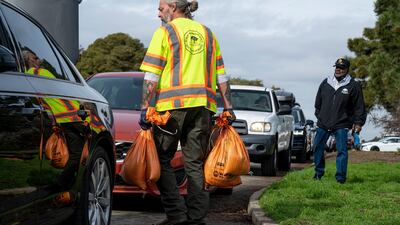
The next in a series of rain events is bearing down on the most populous US state. Bloomberg -
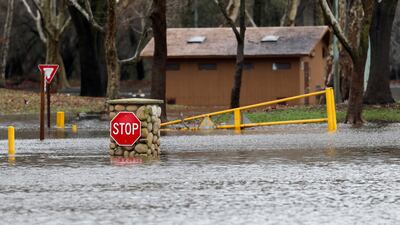
Stormwater floods Discovery Park, where the Sacramento and American Rivers meet, in Sacramento, California. Reuters -
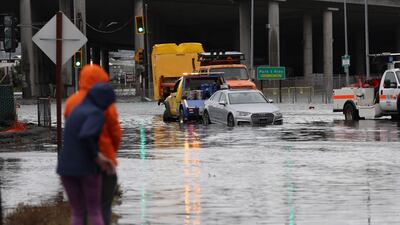
A tow truck pulls a car from a flooded junction in Mill Valley, California, on Wednesday. Getty -
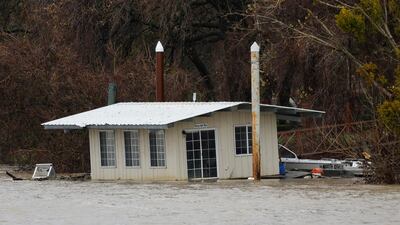
A partially submerged boathouse on the Sacramento River on Tuesday. Reuters -
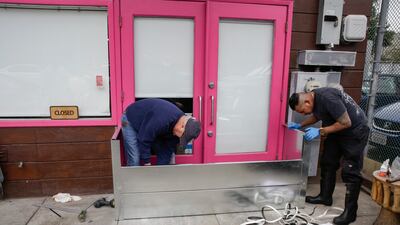
Men install a floodgate in front of Pink Onion, a pizza shop in the Mission District in San Francisco. San Francisco Chronicle / AP -
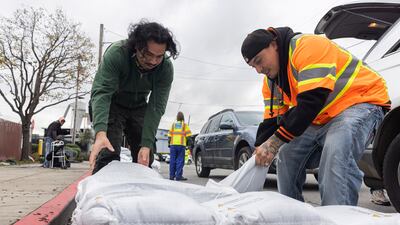
Fernando Bizarro, left, collects sandbags from an emergency centre to prepare for the coming storm. San Francisco Chronicle / AP -
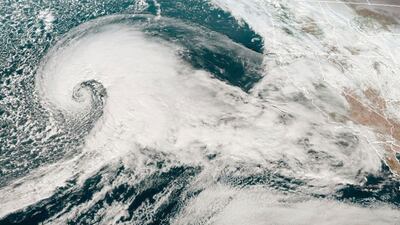
A satellite image of a storm system approaching the US West Coast. National Oceanic and Atmospheric Administration / AP -
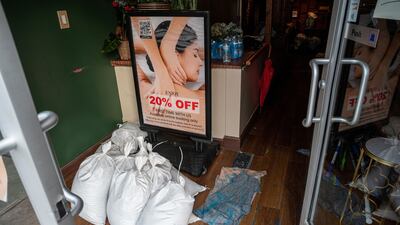
Sandbags at the entrance to a business in the Mission District of San Francisco. Bloomberg -
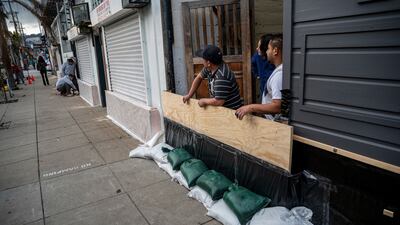
Workers build a flood protection barrier at the entrance of a business in the Mission District of San Francisco. Bloomberg -
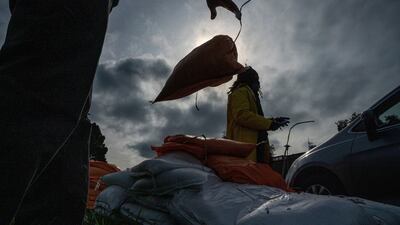
California tries to clean up from floods and mudslides that killed at least one person over the weekend. Bloomberg -
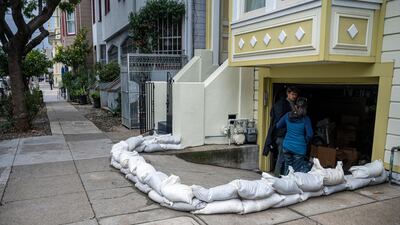
Residents pile protective sand bags around the entrance to their garage in the Mission District of San Francisco. Bloomberg -
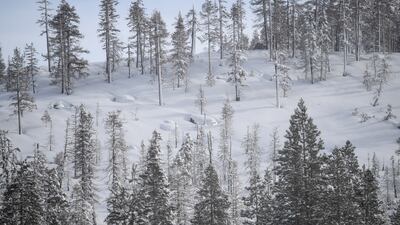
The California snowpack is at a record high but the state's largest reservoirs are still down. EPA -

A mountain near the site of the first snow survey of the 2023 season, at Phillips Station in the Sierra Nevada Mountains. EPA -
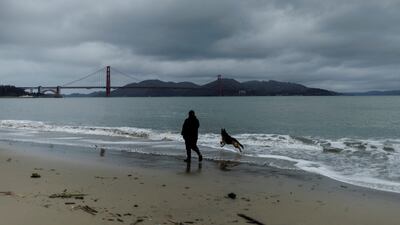
San Francisco residents are preparing for large-scale flooding. Reuters -

Upholstery was damaged in a recent flood at a business in the Mission District of San Francisco. Bloomberg -
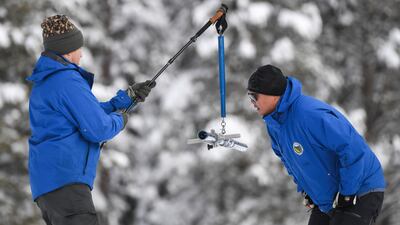
Engineer Anthony Burdock, left, and forecasting chief Sean de Guzman on the measurement phase of the snow survey at Phillips Station. California Department of Water Resources / AP -

Dark clouds over the San Francisco skyline. Reuters -
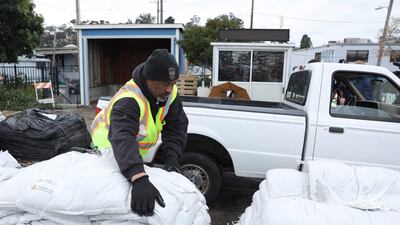
A San Francisco Department of Public Works worker loads sandbags into a lorry. Getty / AFP -
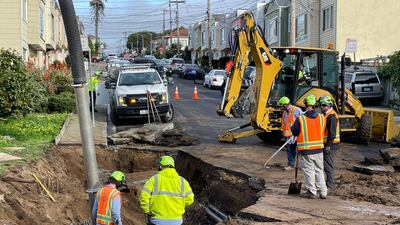
Crews at a sinkhole from recent storms in Daly City, California, as residents brace for more extreme weather. AP -
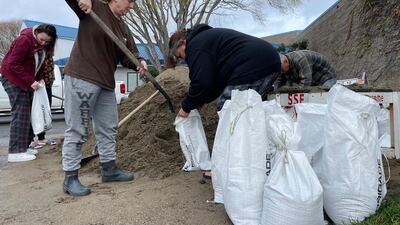
Flooding from a New Year's Eve deluge killed one person, prompted more than 1,000 inmates to be moved from a county jail and washed away a section of a levee system that protects farmland. AP


California’s utility PG&E filed for bankruptcy in 2019 after racking up $30 billion of liabilities for blazes caused by its cables. Long heatwaves drive up electricity consumption, including in regions that have historically not used much air conditioning either because of lower incomes or milder summers.
If indeed this El Nino is particularly strong, the world needs to be prepared.
The system is particularly perilously balanced today, because of years of underinvestment, the shock of the Russia-Ukraine war and the loss of most Russian gas, and the patchy and inchoate nature of the energy transition. Europe may think it is out of the woods, but a baking hot, dry summer followed by an Arctic winter there or in China could burn up surplus gas stocks.
And in the longer term, the energy complex needs to be robust and diverse, both between sources and geographies. We need energy connections between regions to spread risk, but also local self sufficiency to avoid chains of failure.
El Ninos will come and go, but an ever-hotter world is with us for decades.
Robin M. Mills is chief executive of Qamar Energy and author of 'The Myth of the Oil Crisis'

