A billboard reads 'one year free natural gas in homes for the kitchen and hot water', with the portrait of Turkish President Recep Tayyip Erdogan reading 'My promise to you' in south-eastern Turkey. AFP
A billboard reads 'one year free natural gas in homes for the kitchen and hot water', with the portrait of Turkish President Recep Tayyip Erdogan reading 'My promise to you' in south-eastern Turkey. A

Why Turkey election outcome is crucial for world energy


Robin Mills
  • English
  • Arabic

In 718 AD, the Byzantine Empire used Greek fire, a petroleum-based weapon, to destroy an Arab fleet besieging Constantinople. That is perhaps the last time that what is today Turkey has played a leading role in global energy politics. But Sunday’s elections, which are set to go to a run-off, could change all that.

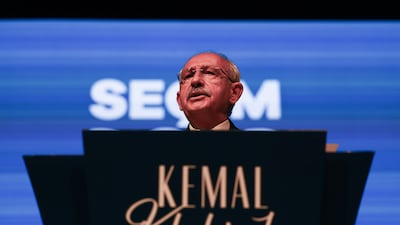
Turks went to the polls to decide between long-time leader Recep Tayyip Erdogan of the Justice and Development Party (AKP), and his main challenger, Kemal Kilicdaroglu of the six-party Nation Alliance centred on the Republican People’s Party (CHP). However, by Monday morning, since neither of the candidates had cleared the 50 per cent threshold needed, there will be a second round of elections on May 28.

The vote hinges on several crucial issues: blame on the AKP for high inflation and poor economic conditions, and the devastating impact of February’s earthquakes, hostility to Syrian refugees, concerns over Mr Erdogan’s alleged authoritarianism and corruption, women’s rights, and complaints of Russian interference.

  • People walk under posters showing Mustafa Kemal Ataturk, founder of modern Turkey, in Ankara. The country is holding its first presidential run-off election after neither candidate earned more than 50 per cent of the vote in the May 14 election. Getty
    People walk under posters showing Mustafa Kemal Ataturk, founder of modern Turkey, in Ankara. The country is holding its first presidential run-off election after neither candidate earned more than 50 per cent of the vote in the May 14 election. Getty
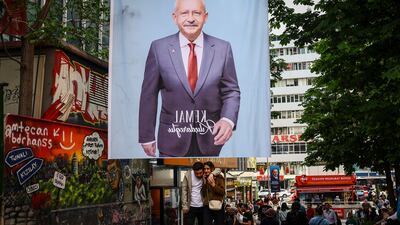
  • A couple walk under a poster of Turkish presidential candidate Kemal Kilicdaroglu, leader of the opposition Republican People's Party, the day after the general election, in Ankara. EPA
    A couple walk under a poster of Turkish presidential candidate Kemal Kilicdaroglu, leader of the opposition Republican People's Party, the day after the general election, in Ankara. EPA
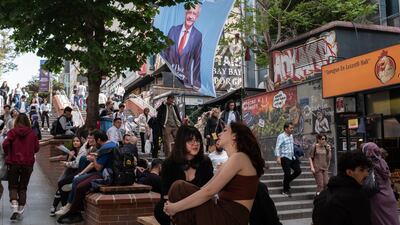
  • People sit on a bench by posters showing Mr Kilicdaroglu in Ankara. Getty
    People sit on a bench by posters showing Mr Kilicdaroglu in Ankara. Getty
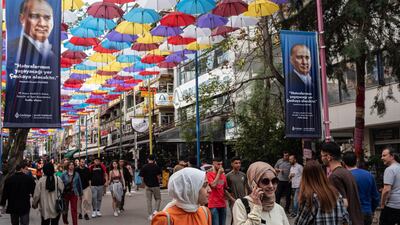
  • The bustling Taksim area of Istanbul. Turkey will hold its first presidential run-off election after neither candidate earned more than 50 per cent of the vote this week. Getty
    The bustling Taksim area of Istanbul. Turkey will hold its first presidential run-off election after neither candidate earned more than 50 per cent of the vote this week. Getty
  • People eat ice cream in Istanbul as the country prepares for an election run-off later this month. Getty
    People eat ice cream in Istanbul as the country prepares for an election run-off later this month. Getty
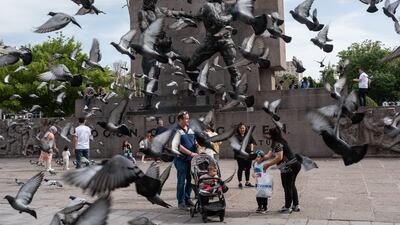
  • People stand in front of the Guven Monument in Ankara. Getty
    People stand in front of the Guven Monument in Ankara. Getty
  • The second round of voting will be held on May 28. Getty
    The second round of voting will be held on May 28. Getty
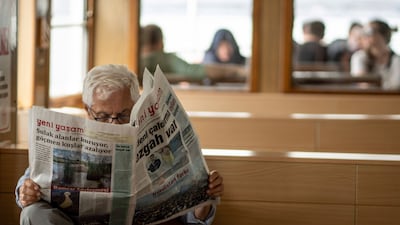
  • A passenger reads a newspaper on a ferry across the Bosphorus in Istanbul. Bloomberg
    A passenger reads a newspaper on a ferry across the Bosphorus in Istanbul. Bloomberg
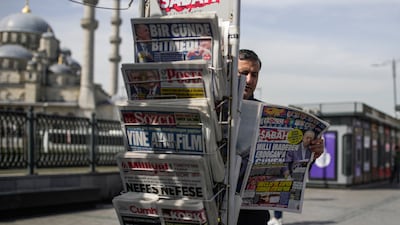
  • Politics dominates the headlines in Istanbul on the day after the presidential elections. AP
    Politics dominates the headlines in Istanbul on the day after the presidential elections. AP
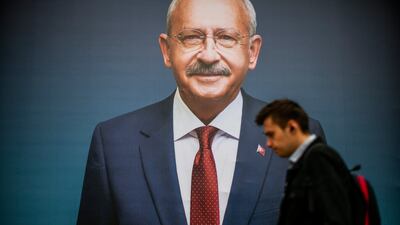
  • A billboard featuring presidential candidate Mr Kilicdaroglu in Istanbul. AP
    A billboard featuring presidential candidate Mr Kilicdaroglu in Istanbul. AP
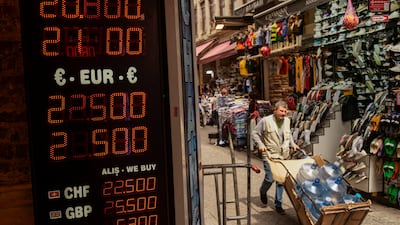
  • A run-off for the presidency was expected to lead to volatility for the Turkish lira. AP
    A run-off for the presidency was expected to lead to volatility for the Turkish lira. AP
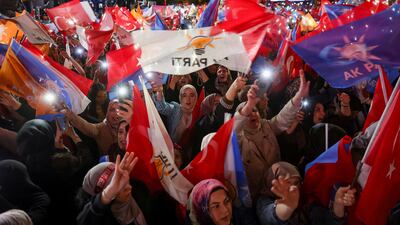
  • Supporters of President Recep Tayyip Erdogan gather at the AK Party's headquarters in Istanbul on election night. Getty
    Supporters of President Recep Tayyip Erdogan gather at the AK Party's headquarters in Istanbul on election night. Getty
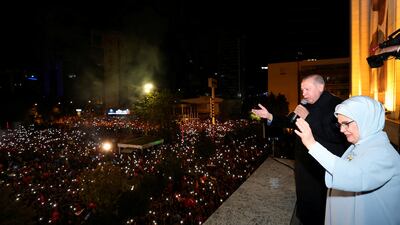
  • Mr Erdogan, accompanied by his wife Emine, addresses supporters in Ankara. Photo: Turkish Presidential Press Office
    Mr Erdogan, accompanied by his wife Emine, addresses supporters in Ankara. Photo: Turkish Presidential Press Office
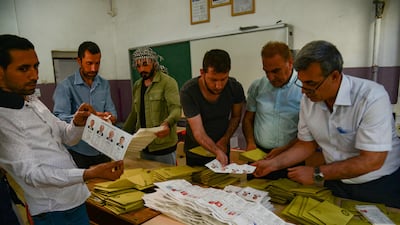
  • Election officials count ballots in Diyarbakir after polls closed in Turkey's presidential and parliamentary elections. AFP
    Election officials count ballots in Diyarbakir after polls closed in Turkey's presidential and parliamentary elections. AFP
  • Turkish presidential candidate Kemal Kilicdaroglu, leader of the opposition Republican People's Party, speaks to the media in Ankara. EPA
    Turkish presidential candidate Kemal Kilicdaroglu, leader of the opposition Republican People's Party, speaks to the media in Ankara. EPA
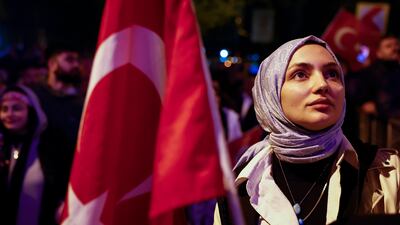
  • Mr Erdogan's supporters wave flags outside the AK Party's headquarters in Ankara. Reuters
    Mr Erdogan's supporters wave flags outside the AK Party's headquarters in Ankara. Reuters
  • Mr Erdogan casts his vote in Istanbul on Sunday. Getty
    Mr Erdogan casts his vote in Istanbul on Sunday. Getty
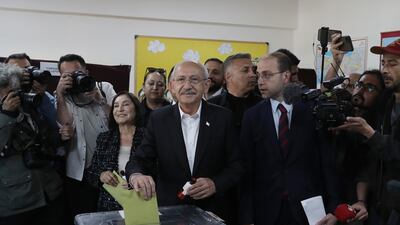
  • Mr Kilicdaroglu votes in Ankara. Getty
    Mr Kilicdaroglu votes in Ankara. Getty
  • People wait for Mr Erdogan outside a polling station in Istanbul. Reuters
    People wait for Mr Erdogan outside a polling station in Istanbul. Reuters
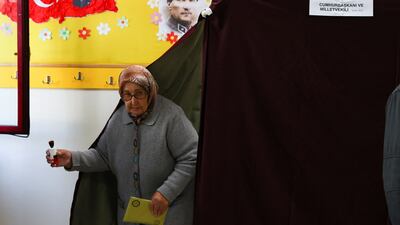
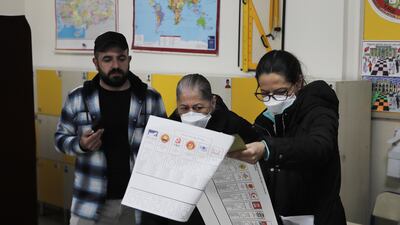
  • A man holds a ballot at a polling station in Hatay. Reuters
    A man holds a ballot at a polling station in Hatay. Reuters
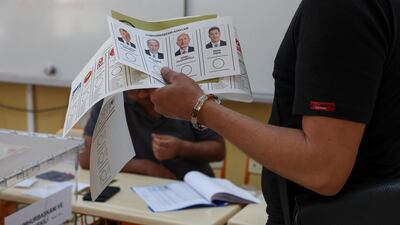
  • A ballot paper featuring candidates for Turkey's presidential and parliamentary elections. Reuters
    A ballot paper featuring candidates for Turkey's presidential and parliamentary elections. Reuters
  • Voting began in Turkey's presidential election on Sunday morning. Reuters
    Voting began in Turkey's presidential election on Sunday morning. Reuters
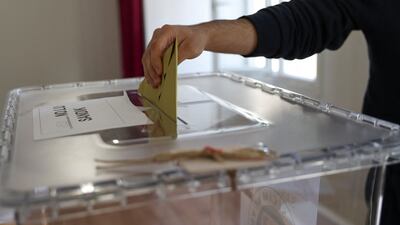
  • A voter casts a ballot at a polling station in Hatay. Reuters
    A voter casts a ballot at a polling station in Hatay. Reuters
  • Hatay is one of the Turkish regions that were worst-affected by February's earthquake. Reuters
    Hatay is one of the Turkish regions that were worst-affected by February's earthquake. Reuters
  • Voters take a closer look at the candidates on the ballot, in Ankara. Getty
    Voters take a closer look at the candidates on the ballot, in Ankara. Getty
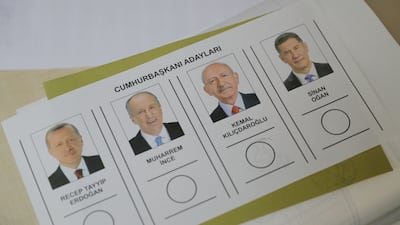
  • A ballot paper with Mr Erdogan, Muharrem Ince, Mr Kilicdaroglu and Sinan Ogan. Getty
    A ballot paper with Mr Erdogan, Muharrem Ince, Mr Kilicdaroglu and Sinan Ogan. Getty
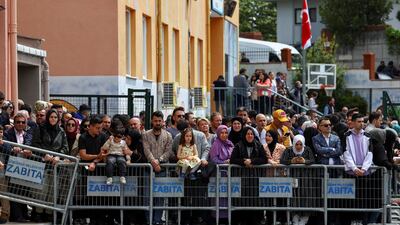
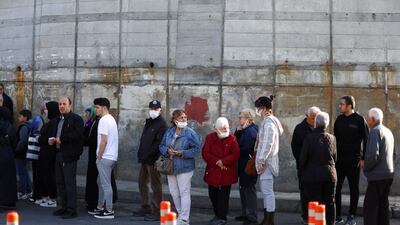
  • Voters queue outside a polling station in Istanbul. Reuters
    Voters queue outside a polling station in Istanbul. Reuters
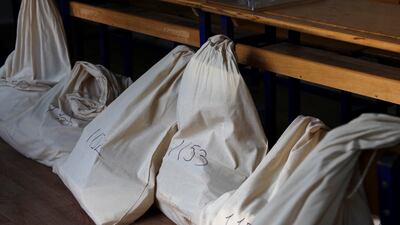
  • Bags containing blank ballots are stored at a temporary polling station in the courtyard of a quake-damaged school in Hatay. Reuters
    Bags containing blank ballots are stored at a temporary polling station in the courtyard of a quake-damaged school in Hatay. Reuters
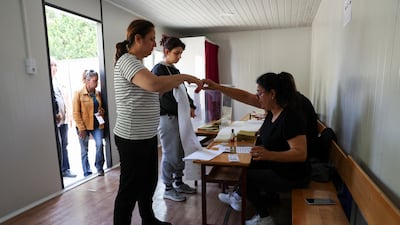
  • An election worker prepares a temporary polling station in Hatay. Reuters
    An election worker prepares a temporary polling station in Hatay. Reuters

Energy is not directly one of these. Yet the outcome is suddenly crucial for world energy in a way that previous Turkish votes were not. That change comes from three major developments of recent years. First, Ankara’s relations with Moscow and the impact of the war in Ukraine. Second, its complex involvement with Iraq. And third, the emergence of the East Mediterranean as an important gas-producing area.

Interactions with Russia are multifaceted and often contradictory. Mr Erdogan has clashed with President Vladimir Putin, particularly over Syria, but he has also worked with the Russian leader on that country, as well as in mediating issues from the Ukraine war, such as grain exports. Mr Kilicdaroglu would probably follow a more traditional pro-Western course.

Turkish energy policy has long been oriented to reduce its import bill, which soared to $80 billion last year, worsening the perennial trade deficit and weakening the lira. Russia is a key part of both problem and solution. State-owned Rosatom is building what will be Turkey’s first nuclear power plant, at Akkuyu on the southern coast, which will provide 10 per cent of the country’s electricity.

Turkey is heavily dependent on imports of Russian gas itself, and is now virtually the only operating route for gas from Russia to reach Europe by pipeline. The new TurkStream pipeline, which connects to Bulgaria, Serbia and Hungary, is flowing at essentially pre-war rates.

Turkey has long sought to become a gas hub, profiting as an intermediary by moving gas from Azerbaijan and Iran as well as Russia to European markets. On Wednesday, Moscow agreed to defer a $600 million gas bill until next year, creating a poison pill for a new administration.

Turkey has also made its own large gas discoveries in the Black Sea, finally providing some measure of self-sufficiency. Gas is expected to begin flowing from the Sakarya field imminently, helping to bring down consumers’ bills. Earlier this month, Turkish Petroleum said it had also unearthed a billion barrels of oil in the south-east, the largest find in national history, though this may be pre-election propaganda.

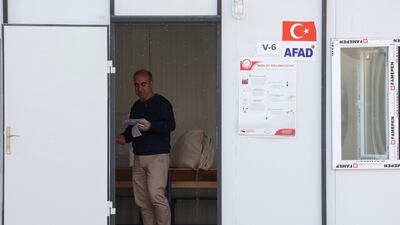
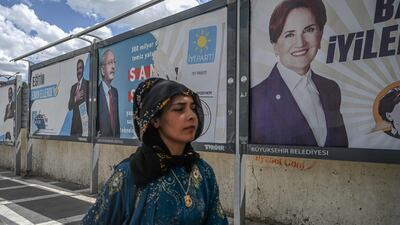
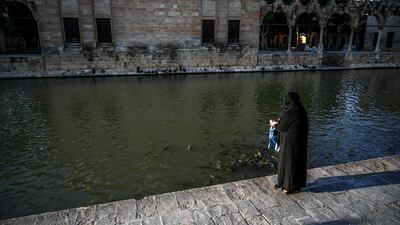
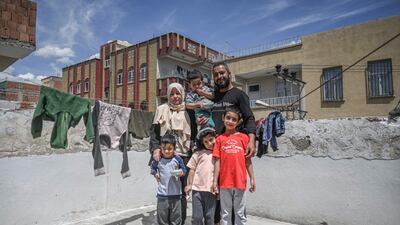
  • Since the Syrian war broke out in 2011, Turkey has become the new home of at least 3.7 million people who fled the regime of President Bashar Al Assad, Russian bombardments and ISIS. All photos: AFP
    Since the Syrian war broke out in 2011, Turkey has become the new home of at least 3.7 million people who fled the regime of President Bashar Al Assad, Russian bombardments and ISIS. All photos: AFP
  • Most have temporary protection status, leaving them vulnerable to forced return
    Most have temporary protection status, leaving them vulnerable to forced return
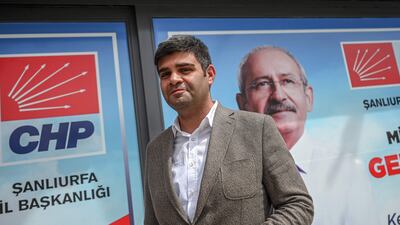
  • The secular CHP party of Kemal Kilicdaroglu, who is running neck-and-neck against Mr Erdogan, pledges to repatriate Syrian refugees 'within two years'
    The secular CHP party of Kemal Kilicdaroglu, who is running neck-and-neck against Mr Erdogan, pledges to repatriate Syrian refugees 'within two years'
  • 'May Erdogan win,' says Neroz Hussein (pictured), a mother from Kurdish-majority Kobane in Syria's north-west. 'Recep Tayyip Erdogan will help us stay'
    'May Erdogan win,' says Neroz Hussein (pictured), a mother from Kurdish-majority Kobane in Syria's north-west. 'Recep Tayyip Erdogan will help us stay'
  • "Even if they don't send us back all at once, they will put pressure on us, demand papers, increase our rents and bills," she says.
    "Even if they don't send us back all at once, they will put pressure on us, demand papers, increase our rents and bills," she says.
  • About 240,000 Syrians have obtained Turkish citizenship and the accompanying right to vote in the approaching polls, in which a new parliament will also be elected
    About 240,000 Syrians have obtained Turkish citizenship and the accompanying right to vote in the approaching polls, in which a new parliament will also be elected
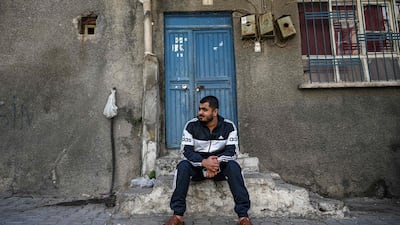
  • They can gain citizenship by investing or, like Hussein Utbah (pictured), by becoming students in sought-after fields such as electrical engineering
    They can gain citizenship by investing or, like Hussein Utbah (pictured), by becoming students in sought-after fields such as electrical engineering
  • 'My friends and I all have the same view: not only because we are Syrians, but because of what we see he has done for the country,' he said of Mr Erdogan
    'My friends and I all have the same view: not only because we are Syrians, but because of what we see he has done for the country,' he said of Mr Erdogan
  • Hussein also scoffed at the CHP's pledge to ensure Syrians' 'voluntary and dignified' return. 'We can't go back and trust Bashar al-Assad,' said Hussein, whose family fled Raqqa when it became the self-proclaimed ISIS capital in 2015
    Hussein also scoffed at the CHP's pledge to ensure Syrians' 'voluntary and dignified' return. 'We can't go back and trust Bashar al-Assad,' said Hussein, whose family fled Raqqa when it became the self-proclaimed ISIS capital in 2015
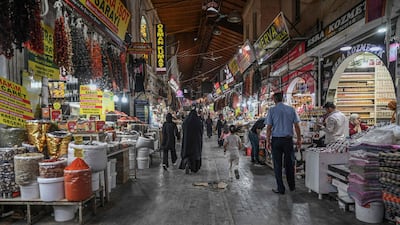
  • Syrians also provide a source of cheap labour on Turkish farms, construction sites and textile mills, causing some analysts to believe mass repatriation is unrealistic
    Syrians also provide a source of cheap labour on Turkish farms, construction sites and textile mills, causing some analysts to believe mass repatriation is unrealistic
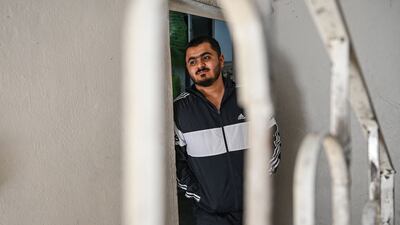
  • Mohamed Utbah (pictured) wondered why anyone would want to send him back. 'We're not doing anything wrong here, we're useful to Turkey'
    Mohamed Utbah (pictured) wondered why anyone would want to send him back. 'We're not doing anything wrong here, we're useful to Turkey'

After India and China, Turkey has emerged as the main alternative market for Russian crude oil, which is now mostly banned from Europe, and it benefits from discounts. It is also attractive to Russia as its proximity means much lower freight costs than to Asian buyers, and it is the critical transit route for oil through the Black Sea and south Caucasus from Russia itself, Kazakhstan and Azerbaijan.

The victory in late 2020 by Turkish-backed Azerbaijan over Russian-allied Armenia, prophetic in some ways of the Ukraine war, reconfigured power and transport links in the strategic area. Mr Kilicdaroglu has said that he would abide by Western decisions on sanctions.

Turkey also plays a complex part in Iraq’s energy politics. In March, an arbitral tribunal in Paris ruled against Ankara in a case brought by the federal government in Baghdad, complaining of a breach of the treaty governing operations of the Iraq-Turkey oil pipeline. Turkey had allowed the semi-autonomous Kurdistan region to use the pipeline for its exports.

Though the financial damages awarded were relatively modest, Turkey has closed down the pipeline since then, awaiting resolution of a second case and blaming “technical” grounds for not restarting, even though Baghdad and Kurdistan have reached an agreement on how to handle the exports. Turkey is apparently waiting until after its election — keeping some 450,000 barrels per day off world markets, and putting severe pressure on Kurdistan, with which it had developed strong economic and political ties.

Turkey would also be the key route for any gas exports from the Kurdistan region to Europe. And, via its dams on the headwaters of the Tigris and Euphrates, it controls Iraq’s lifeline.

Finally, there have been large gas finds over the last decade in the offshore areas of Israel, Cyprus and Egypt, and potentially Lebanon. Turkey has chased off drilling and survey vessels from areas it claims as its own or on behalf of the Turkish Republic of Northern Cyprus, which only Ankara recognises. It has not apparently found gas itself here. But its difficult relations with Nicosia and Athens hamper plans for a pipeline to Greece and on to Italy, or even a route direct to Turkey itself.

So there are several areas in which Turkey could be a key energy partner of Europe and help build its resilience against Russia. These are not necessarily prevented by the re-election of Mr Erdogan, but he will certainly extract a political price for any realisation.

A new government would take a fresh approach, but still would find its room for manoeuvre constrained by domestic realities and Moscow’s economic leverage. A period of political uncertainty or interregnum could bring chaos. The eyes of energy policymakers from Brussels to Baghdad and Baku will be trained on the Bosporus this week.

Robin M. Mills is chief executive of Qamar Energy and author of The Myth of the Oil Crisis

What is type-1 diabetes

Type 1 diabetes is a genetic and unavoidable condition, rather than the lifestyle-related type 2 diabetes.

It occurs mostly in people under 40 and a result of the pancreas failing to produce enough insulin to regulate blood sugars.

Too much or too little blood sugar can result in an attack where sufferers lose consciousness in serious cases.

Being overweight or obese increases the chances of developing the more common type 2 diabetes.

COMPANY PROFILE

Name: Rain Management

Year started: 2017

Based: Bahrain

Employees: 100-120

Amount raised: $2.5m from BitMex Ventures and Blockwater. Another $6m raised from MEVP, Coinbase, Vision Ventures, CMT, Jimco and DIFC Fintech Fund

From Conquest to Deportation

Jeronim Perovic, Hurst

Mia Man’s tips for fermentation

- Start with a simple recipe such as yogurt or sauerkraut

- Keep your hands and kitchen tools clean. Sanitize knives, cutting boards, tongs and storage jars with boiling water before you start.

- Mold is bad: the colour pink is a sign of mold. If yogurt turns pink as it ferments, you need to discard it and start again. For kraut, if you remove the top leaves and see any sign of mold, you should discard the batch.

- Always use clean, closed, airtight lids and containers such as mason jars when fermenting yogurt and kraut. Keep the lid closed to prevent insects and contaminants from getting in.


Ten tax points to be aware of in 2026

1. Domestic VAT refund amendments: request your refund within five years

If a business does not apply for the refund on time, they lose their credit.

2. E-invoicing in the UAE

Businesses should continue preparing for the implementation of e-invoicing in the UAE, with 2026 a preparation and transition period ahead of phased mandatory adoption. 

3. More tax audits

Tax authorities are increasingly using data already available across multiple filings to identify audit risks. 

4. More beneficial VAT and excise tax penalty regime

Tax disputes are expected to become more frequent and more structured, with clearer administrative objection and appeal processes. The UAE has adopted a new penalty regime for VAT and excise disputes, which now mirrors the penalty regime for corporate tax.

5. Greater emphasis on statutory audit

There is a greater need for the accuracy of financial statements. The International Financial Reporting Standards standards need to be strictly adhered to and, as a result, the quality of the audits will need to increase.

6. Further transfer pricing enforcement

Transfer pricing enforcement, which refers to the practice of establishing prices for internal transactions between related entities, is expected to broaden in scope. The UAE will shortly open the possibility to negotiate advance pricing agreements, or essentially rulings for transfer pricing purposes. 

7. Limited time periods for audits

Recent amendments also introduce a default five-year limitation period for tax audits and assessments, subject to specific statutory exceptions. While the standard audit and assessment period is five years, this may be extended to up to 15 years in cases involving fraud or tax evasion. 

8. Pillar 2 implementation 

Many multinational groups will begin to feel the practical effect of the Domestic Minimum Top-Up Tax (DMTT), the UAE's implementation of the OECD’s global minimum tax under Pillar 2. While the rules apply for financial years starting on or after January 1, 2025, it is 2026 that marks the transition to an operational phase.

9. Reduced compliance obligations for imported goods and services

Businesses that apply the reverse-charge mechanism for VAT purposes in the UAE may benefit from reduced compliance obligations. 

10. Substance and CbC reporting focus

Tax authorities are expected to continue strengthening the enforcement of economic substance and Country-by-Country (CbC) reporting frameworks. In the UAE, these regimes are increasingly being used as risk-assessment tools, providing tax authorities with a comprehensive view of multinational groups’ global footprints and enabling them to assess whether profits are aligned with real economic activity. 

Contributed by Thomas Vanhee and Hend Rashwan, Aurifer

The winners

Fiction

  • ‘Amreekiya’  by Lena Mahmoud
  •  ‘As Good As True’ by Cheryl Reid

The Evelyn Shakir Non-Fiction Award

  • ‘Syrian and Lebanese Patricios in Sao Paulo’ by Oswaldo Truzzi;  translated by Ramon J Stern
  • ‘The Sound of Listening’ by Philip Metres

The George Ellenbogen Poetry Award

  • ‘Footnotes in the Order  of Disappearance’ by Fady Joudah

Children/Young Adult

  •  ‘I’ve Loved You Since Forever’ by Hoda Kotb 
Lexus LX700h specs

Engine: 3.4-litre twin-turbo V6 plus supplementary electric motor

Power: 464hp at 5,200rpm

Torque: 790Nm from 2,000-3,600rpm

Transmission: 10-speed auto

Fuel consumption: 11.7L/100km

On sale: Now

Price: From Dh590,000

The specs: Volvo XC40

Price: base / as tested: Dh185,000

Engine: 2.0-litre, turbocharged in-line four-cylinder

Gearbox: Eight-speed automatic

Power: 250hp @ 5,500rpm

Torque: 350Nm @ 1,500rpm

Fuel economy, combined: 10.4L / 100km

Your rights as an employee

The government has taken an increasingly tough line against companies that fail to pay employees on time. Three years ago, the Cabinet passed a decree allowing the government to halt the granting of work permits to companies with wage backlogs.

The new measures passed by the Cabinet in 2016 were an update to the Wage Protection System, which is in place to track whether a company pays its employees on time or not.

If wages are 10 days late, the new measures kick in and the company is alerted it is in breach of labour rules. If wages remain unpaid for a total of 16 days, the authorities can cancel work permits, effectively shutting off operations. Fines of up to Dh5,000 per unpaid employee follow after 60 days.

Despite those measures, late payments remain an issue, particularly in the construction sector. Smaller contractors, such as electrical, plumbing and fit-out businesses, often blame the bigger companies that hire them for wages being late.

The authorities have urged employees to report their companies at the labour ministry or Tawafuq service centres — there are 15 in Abu Dhabi.

Updated: May 15, 2023, 9:58 AM