


“It was forced on them. They don’t have the ability to keep up the production volumes because they don’t have access to necessary technology.” So said the EU’s energy commissioner Kadri Simson in response to Russia’s announcement that it would cut oil production in March by 500,000 barrels per day (bpd). But is this the real reason?
National oil industries can collapse for various non-technical reasons: war, sanctions, political breakdown. History offers at least four solid examples that might compare to Russia’s current situation, excluding physical destruction such as that in Kuwait in 1990-91.
Iran’s production reached its all-time high of slightly more than 6 million bpd in 1974. The revolution of 1978-79, strikes by oil workers and the invasion by Saddam Hussein’s Iraq in 1980 brought it crashing down to 1.3 million bpd in 1981.
Post-war recovery was hampered by American sanctions and unattractive conditions for foreign investment, then by US presidents Obama and Trump’s moves to cut off most of the country’s oil exports. Nevertheless, despite ageing fields and infrastructure, and waves of civil unrest, production still hovers around 3.6 million bpd.
Iraq was also badly affected by wars. Production in the post-nationalisation glory years of the 1970s peaked at almost 3.7 million bpd in 1979. During the Iran-Iraq War, exports via the Gulf were cut by Iranian military action and Iran’s ally Syria closed the pipeline through its territory. Output dwindled, partly recovered when a pipeline via Turkey was opened, then crashed to fewer than 300,000 bpd because of UN sanctions following the 1990 invasion of Kuwait.
The oil-for-food programme in the 1990s allowed for some recovery but the industry was starved of funds and equipment, then battered by looting and political chaos following the 2003 US-led invasion. Only after 2009 and the advent of major foreign investment could the situation improve, as Iraq passed its previous high in 2015 and reached a record of nearly 4.8 million bpd in 2019 before Covid struck. Today’s Iraqi oil industry is almost entirely a post-2009 creation.
Venezuela is the most extraordinary case: without war or, until 2019, strict sanctions, it sabotaged itself. In the late 1990s, it challenged Saudi Arabia and its Opec colleagues with plans for rapid production growth, contributing to a price collapse. President Hugo Chavez, elected in December 1998, reinstated full co-operation with Opec. He fired 17,000 oil workers after a general strike of 2002-03 aimed at unseating him, ruining Petroleos de Venezuela, once an admired national company.
Expropriation of foreign projects, lack of investment, emigration, corruption, theft and sabotage decimated Venezuela’s petroleum industry under Mr Chavez and his hand-picked successor Nicolas Maduro. US sanctions in early 2019, following another disputed presidential election, were the final straw. Record production in 1998 of more than 3.4 million bpd slumped to just 640,000 bpd in 2020.
Despite sanctions waivers to allow US companies to resume some operations, and greater openness to foreign involvement after an apparent change of heart in the Maduro administration, it seems unlikely that Venezuela’s rusting industry, based on heavy, high-carbon oil, will ever truly recover.
Russia itself is the final example. As Thane Gustafson’s prescient book Crisis Amid Plenty recounts, the Soviet oil industry of the late 1980s, when Russian output peaked at 11.4 million bpd, was already struggling with inefficiency, outdated technology and depleted fields.
During the post-Soviet time of troubles in the 1990s, the integrated business was broken up and most passed into the hands of “oligarchs”, who fought messy corporate battles to grab more. Prices were low, investment and tax payments minimal.
When oil prices recovered — to the great good fortune of Vladimir Putin, who had become President in 2000 — the cleverest of the oligarchs had reinvented themselves as market-friendly entrepreneurs. Dismal output of merely 6 million bpd in the nadir of 1996 turned around as modern technology was applied to the heartland of West Siberia.
Then Mr Putin tamed or exiled those who threatened him politically, and reunited most of the oil and gas business under the state giants Rosneft and Gazprom, run by loyalists. Growth continued, but much more slowly, passing the Soviet-era record in 2018 and topping out at 11.7 million bpd in 2019.
-
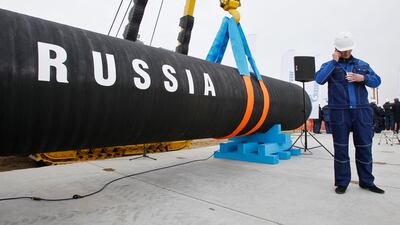
A Russian construction worker speaks on a mobile phone during a ceremony marking the construction of the Nord Stream pipeline in Portovaya Bay, 170 kilometres north-west of St Petersburg in Russia. AP Photo -
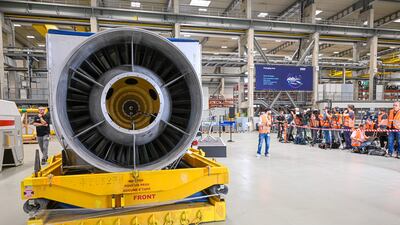
A turbine of the Nord Stream 1 pipeline at the Siemens Energy plant in western Germany. AFP -
The logo of Russia's energy giant Gazprom is pictured at one of its petrol stations in Sofia, Bulgaria. AFP -
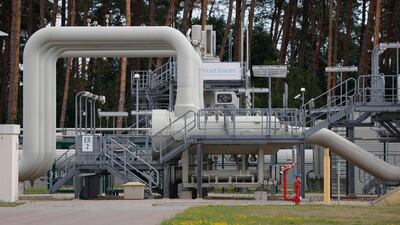
Facilities to receive and distribute natural gas are pictured on the grounds of gas transport and pipeline network operator Cascade in Lubmin, north-eastern Germany, close to the border with Poland. AFP -
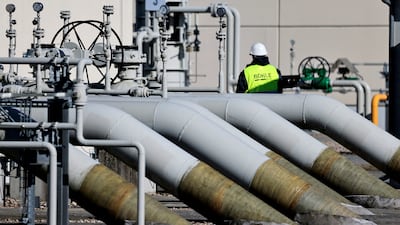
Pipes at the landfall facilities of the 'Nord Stream 1' gas pipeline in Lubmin. Reuters -
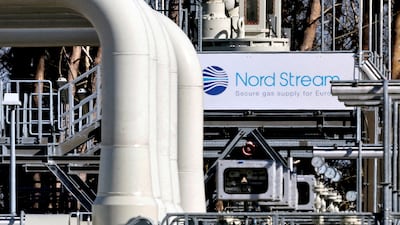
The Nord Stream 1 gas pipeline in Lubmin, Germany. Reuters


These past cases tell us that temporary production drops, even physical destruction, can be reversed; the long-lasting degradation of a nation’s petroleum industry comes from the loss of institutional capability, expertise and access to markets.
How does this apply to today’s Russia? Its future expansion is reliant on unconventional resources and a new generation of fields in the Arctic offshore and remote East Siberia, requiring vast investment in basic infrastructure. That will not be forthcoming as long as the war in Ukraine continues, European sanctions close off Russia’s best market and international expertise is restricted. In July, Swiss-based trader Trafigura exited its investment in Vostok Oil, an $85 billion, 2 million bpd East Siberian project which was to have driven the next phase of Russian output growth.
Nevertheless, Russian drilling was at a decade’s high last year. Capable companies and people remain active; the country has been producing below capacity since April 2020 because of compliance with the Opec agreement. There is no sign of an imminent decline in output and Ms Simson’s characterisation of the situation is misleading.
If Russia does indeed cut production, it is because it can sell neither the crude nor the associated refined products, in the face of the EU’s ban and difficulty accessing enough tankers for the long voyages to India and China.
The Kremlin will attempt to extract more cash from the industry to fund its war — as it has already done by raising the price benchmark used for taxation and receiving a large special dividend from Gazprom. That and sanctions will eat away at the productive base over time.
A slow decline in Russian output is favourable for its Opec partners, who can gain market share. It also aligns with European and American intent, to limit Russian government revenue, avoid a price spike and, in the longer term, to transition to a lower-carbon, less oil-intensive economy.
As Mr Gustafson’s sequel Klimat argued in 2021, Russia’s petroleum business already faced swelling challenges in the 2030s and beyond. It will not collapse like 1990s Iraq or 2000s Venezuela, or even its own earlier incarnation. But the confrontation with the West has dramatically accelerated its reckoning with a difficult destiny.
Robin M. Mills is chief executive of Qamar Energy, and author of The Myth of the Oil Crisis

