Global greenhouse gas emissions will have to drop 45 per cent by 2030. AP

Why it is time for the world to take geoengineering seriously


Robin Mills
  • English
  • Arabic

It’s often a mystery where the supervillains in James Bond films got their start to build up the enormous secret bases and hordes of minions they deploy to conquer the world.

Perhaps they did what Luke Iseman did in Baja California last April: with Amazon and a credit card, he got the equipment to make himself into “Greenfinger”.

Climate change is lurching forward into more perilous territory. Last year was already 0.89 degrees Celsius above the historic average.

The goal of limiting global warming to 1.5ºC above pre-industrial levels will probably be breached temporarily this decade, and be out of reach entirely by its end.

Watch: Why are rich nations paying for climate 'loss and damage'?

A series of UN conferences, major advances in renewable energy, campaigns against fossil-fuel production, a once-in-a-century pandemic, and a big war and heavy sanctions on a leading hydrocarbon exporter have not stopped greenhouse gas emissions from rising.

But they have to drop an inconceivable 45 per cent by 2030 on 2010 levels.

There is nothing magical about the 1.5ºC target: 1.4 degrees would be better, 1.6 degrees worse and 1.7 degrees worse still.

Every increase brings more damage and disruption, and a greater chance of inadvertently passing a climatic tipping point, such as the collapse of the Greenland or West Antarctic ice sheets, eventually raising global sea levels by three to four metres.

Political and economic tipping points may be even closer: the disruption of a populous country by flood or drought, or a wider war, bringing unimaginable suffering and migration.

Even the 1.5ºC scenarios include huge removal of carbon dioxide from the atmosphere — by reforestation, or by trapping the gas directly from the atmosphere and injecting it underground or turning it into solid minerals.

Adnoc recently announced a pilot project to do just this in Fujairah.

Several promising technologies are emerging. But they remain costly and scaling up to extract the necessary billions of tonnes each year will be a colossal effort.

Worse still, some of the warming from greenhouse gases has been masked by fine particles — aerosols — from human activity, including dust and sulphur from burning coal and oil.

These reflect sunlight. As we clean up air pollution, the local environment and human health improves, but paradoxically the climate problem gets worse.

A similar natural phenomenon occurs with some big volcanic eruptions, mostly famously the Philippines’ Mount Pinatubo eruption in 1991, which sent huge amounts of sulphur dioxide into the stratosphere.

Scientists proposed as far back as 1974 that we could do the same.

Quite small quantities of sulphate or other particles could be released into the upper atmosphere by plane, rocket or balloon.

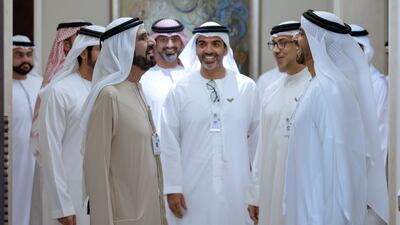
Sheikh Mohammed reviews hosting of Cop28 — in pictures

  • At the UAE Government Meeting in November 2022, Sheikh Mohammed bin Rashid said the hosting of Cop28 will be the UAE's biggest event next year. Photos: Wam
    At the UAE Government Meeting in November 2022, Sheikh Mohammed bin Rashid said the hosting of Cop28 will be the UAE's biggest event next year. Photos: Wam
  • Cop28 will be the first time countries will assess the progress of the 2015 Paris climate accord to limit global warming.
    Cop28 will be the first time countries will assess the progress of the 2015 Paris climate accord to limit global warming.
  • The global event, which will take place at Expo City Dubai, will welcome more than 140 heads of state and government and 80,000 participants.
    The global event, which will take place at Expo City Dubai, will welcome more than 140 heads of state and government and 80,000 participants.
  • Dr Sultan Al Jaber, Minister of Industry and Advanced Technology, Special Envoy for Climate Change and chairman of Masdar, gave a presentation at the meeting outlining what will be involved in hosting one of the largest global events of the year.
    Dr Sultan Al Jaber, Minister of Industry and Advanced Technology, Special Envoy for Climate Change and chairman of Masdar, gave a presentation at the meeting outlining what will be involved in hosting one of the largest global events of the year.

Harvard University's Dr David Keith, who has been active in the field since 2007, suggests it could cost as little as $1 billion per year.

That compares to the $178 trillion cost of unchecked climate change to the global economy over the next half century, or the trillions of annual investment required for the new green economy.

David Victor, a specialist in climate international relations, observed in 2008 that, “A lone Greenfinger, self-appointed protector of the planet and working with a small fraction of the Gates bank account, could force a lot of geoengineering on his own”.

This is where Mr Iseman comes in. In April, he released two helium balloons containing a few grams of sulphur dioxide from Mexico, expecting that at altitude they would burst and release their payload.

In October, he incorporated Make Sunsets, a company offering to sell “cooling credits”, which planned to make further launches this month.

His action has attracted criticism from those in the field. They rightly point out that his experiment was scientifically worthless — it carried no monitoring equipment and nobody knew if it reached the stratosphere or functioned as intended.

They worry that lone actors will give the field a bad name, forestalling the careful public debate and government regulation that should precede any large-scale geoengineering.

Releasing cooling particles can have other consequences, in particular, altering rainfall patterns.

It does not reduce the level of carbon dioxide, and so does not stop ocean acidification, which damages coral reefs and other marine life.

If we began a large-scale effort to manage solar radiation, then had to stop, warming would resume abruptly, a scenario explored in Neal Stephenson’s 2021 novel Termination Shock.

Inevitably, academics point cautiously to these risks and call for more research. Environmentalists furiously oppose “geoengineering”, considering it a seductively easy, dangerous cop-out from the hard, trillion-dollar work of a building a green economy.

They point to “moral hazard” — the lure of a simple fix prevents action on reducing emissions today.

But compared to putting a few million tonnes of sulphates into the air, which rain out within months to three years, we are currently carelessly conducting a geophysical experiment on a far vaster scale: putting 37 billion tonnes of carbon dioxide annually into the atmosphere, which will remain there for millennia.

No one seriously suggests giving up on low-carbon options such as wind and solar power in favour of massive geoengineering.

And contrary to the moral hazard concept, we are collectively not doing nearly enough today despite all the scientific consensus of impending disaster.

If we pass a tipping point and see a rapid climatic deterioration, hasty geoengineering may be essential — it would be wise to be prepared.

If environmentalists believe — correctly — that even 1.5 degrees of warming is dangerous, they should support a combination of deploying low-carbon technologies and careful solar radiation management to cut overall warming to 1ºC or less.

This would buy time for carbon dioxide removal over several decades to return the atmosphere to an agreed state.

Mr Iseman’s action is provocative, even irresponsible.

But maybe that is what the climate field needs. It is not an either/or: we require massive deployment of green technologies, huge efforts on carbon dioxide removal and a sensible, calibrated level of solar radiation management to make up for our wasted decades.

If we don’t want our climate future determined by freelance “Greenfingers”, it’s time for environmentalists, governments and society to take geoengineering seriously.

Robin M. Mills is the chief executive of Qamar Energy and author of The Myth of the Oil Crisis

The specs

Engine: 2.0-litre 4-cyl turbo

Power: 247hp at 6,500rpm

Torque: 370Nm from 1,500-3,500rpm

Transmission: 10-speed auto

Fuel consumption: 7.8L/100km

Price: from Dh94,900

On sale: now


Six tips to secure your smart home

Most smart home devices are controlled via the owner's smartphone. Therefore, if you are using public wi-fi on your phone, always use a VPN (virtual private network) that offers strong security features and anonymises your internet connection.

Keep your smart home devices’ software up-to-date. Device makers often send regular updates - follow them without fail as they could provide protection from a new security risk.

Use two-factor authentication so that in addition to a password, your identity is authenticated by a second sign-in step like a code sent to your mobile number.

Set up a separate guest network for acquaintances and visitors to ensure the privacy of your IoT devices’ network.

Change the default privacy and security settings of your IoT devices to take extra steps to secure yourself and your home.

Always give your router a unique name, replacing the one generated by the manufacturer, to ensure a hacker cannot ascertain its make or model number.

STAGE 4 RESULTS

1 Sam Bennett (IRL) Deceuninck-QuickStep - 4:51:51

2 David Dekker (NED) Team Jumbo-Visma

3 Caleb Ewan (AUS) Lotto Soudal 

4 Elia Viviani (ITA) Cofidis

5 Matteo Moschetti (ITA) Trek-Segafredo

General Classification

1 Tadej Pogacar (SLO) UAE Team Emirates - 12:50:21

2 Adam Yates (GBR) Teamn Ineos Grenadiers - 0:00:43

3 Joao Almeida (POR) Deceuninck-QuickStep - 0:01:03

4 Chris Harper (AUS) Jumbo-Visma - 0:01:43

5 Neilson Powless (USA) EF Education-Nippo - 0:01:45

Moving%20Out%202
%3Cp%3E%3Cstrong%3EDeveloper%3A%3C%2Fstrong%3E%20SMG%20Studio%3Cbr%3E%3Cstrong%3EPublisher%3A%3C%2Fstrong%3E%20Team17%3Cbr%3E%3Cstrong%3EConsoles%3A%3C%2Fstrong%3E%20Nintendo%20Switch%2C%20PlayStation%204%26amp%3B5%2C%20PC%20and%20Xbox%20One%3Cbr%3E%3Cstrong%3ERating%3A%3C%2Fstrong%3E%204%2F5%3C%2Fp%3E%0A
FA CUP FINAL

Manchester City 6
(D Silva 26', Sterling 38', 81', 87', De Bruyne 61', Jesus 68')

Watford 0

Man of the match: Bernardo Silva (Manchester City)

Five expert hiking tips
    Always check the weather forecast before setting off Make sure you have plenty of water Set off early to avoid sudden weather changes in the afternoon Wear appropriate clothing and footwear Take your litter home with you
Brief scores:

Toss: Australia, chose to bat

Australia: 272-9 (50 ov)

Khawaja 100, Handscomb 52; Bhuvneshwar 3-48

India: 237 (50 ov)

Rohit 56, Bhuvneshwar 46; Zampa 3-46

Player of the Match: Usman Khawaja (Australia)

Player of the Series: Usman Khawaja (Australia)

COMPANY%20PROFILE
%3Cp%3E%3Cstrong%3EName%3A%3C%2Fstrong%3E%20PlanRadar%3Cbr%3E%3Cstrong%3EStarted%3A%20%3C%2Fstrong%3E2013%3Cbr%3E%3Cstrong%3ECo-founders%3A%20%3C%2Fstrong%3EIbrahim%20Imam%2C%20Sander%20van%20de%20Rijdt%2C%20Constantin%20K%C3%B6ck%2C%20Clemens%20Hammerl%2C%20Domagoj%20Dolinsek%3Cbr%3E%3Cstrong%3EBased%3A%20%3C%2Fstrong%3EVienna%2C%20Austria%3Cbr%3E%3Cstrong%3ESector%3A%20%3C%2Fstrong%3EConstruction%20and%20real%20estate%3Cbr%3E%3Cstrong%3ECurrent%20number%20of%20staff%3A%20%3C%2Fstrong%3E400%2B%3Cbr%3E%3Cstrong%3EInvestment%20stage%3A%20%3C%2Fstrong%3ESeries%20B%3Cbr%3E%3Cstrong%3EInvestors%3A%3C%2Fstrong%3E%20Headline%2C%20Berliner%20Volksbank%20Ventures%2C%20aws%20Gr%C3%BCnderfonds%2C%20Cavalry%20Ventures%2C%20Proptech1%2C%20Russmedia%2C%20GR%20Capital%3C%2Fp%3E%0A
Polarised public

31% in UK say BBC is biased to left-wing views

19% in UK say BBC is biased to right-wing views

19% in UK say BBC is not biased at all

Source: YouGov

Hurricanes 31-31 Lions

Wellington Hurricanes: 
Tries: Gibbins, Laumape, Goosen, Fifita tries, Barrett
Conversions: Barrett (4)
Penalties: Barrett

British & Irish Lions:
Tries: Seymour (2), North
Conversions: Biggar (2)
Penalties: Biggar (4)

Stats at a glance:

Cost: 1.05 billion pounds (Dh 4.8 billion)

Number in service: 6

Complement 191 (space for up to 285)

Top speed: over 32 knots

Range: Over 7,000 nautical miles

Length 152.4 m

Displacement: 8,700 tonnes

Beam:   21.2 m

Draught: 7.4 m

Who has lived at The Bishops Avenue?
  • George Sainsbury of the supermarket dynasty, sugar magnate William Park Lyle and actress Dame Gracie Fields were residents in the 1930s when the street was only known as ‘Millionaires’ Row’.
  • Then came the international super rich, including the last king of Greece, Constantine II, the Sultan of Brunei and Indian steel magnate Lakshmi Mittal who was at one point ranked the third richest person in the world.
  • Turkish tycoon Halis Torprak sold his mansion for £50m in 2008 after spending just two days there. The House of Saud sold 10 properties on the road in 2013 for almost £80m.
  • Other residents have included Iraqi businessman Nemir Kirdar, singer Ariana Grande, holiday camp impresario Sir Billy Butlin, businessman Asil Nadir, Paul McCartney’s former wife Heather Mills. 
Hunting park to luxury living
  • Land was originally the Bishop of London's hunting park, hence the name
  • The road was laid out in the mid 19th Century, meandering through woodland and farmland
  • Its earliest houses at the turn of the 20th Century were substantial detached properties with extensive grounds


GOODBYE%20JULIA
%3Cp%3E%3Cstrong%3EDirector%3A%20%3C%2Fstrong%3EMohamed%20Kordofani%3C%2Fp%3E%0A%3Cp%3E%3Cstrong%3EStarring%3A%20%3C%2Fstrong%3ESiran%20Riak%2C%20Eiman%20Yousif%2C%20Nazar%20Goma%3C%2Fp%3E%0A%3Cp%3E%3Cstrong%3ERating%3A%3C%2Fstrong%3E%205%2F5%3C%2Fp%3E%0A
The specs

Engine: 2.0-litre 4cyl turbo

Power: 261hp at 5,500rpm

Torque: 405Nm at 1,750-3,500rpm

Transmission: 9-speed auto

Fuel consumption: 6.9L/100km

On sale: Now

Price: From Dh117,059

ADCC AFC Women’s Champions League Group A fixtures

October 3: v Wuhan Jiangda Women’s FC
October 6: v Hyundai Steel Red Angels Women’s FC
October 9: v Sabah FA

25-MAN SQUAD

Goalkeepers: Francis Uzoho, Ikechukwu Ezenwa, Daniel Akpeyi
Defenders: Olaoluwa Aina, Abdullahi Shehu, Chidozie Awaziem, William Ekong, Leon Balogun, Kenneth Omeruo, Jamilu Collins, Semi Ajayi 
Midfielders: John Obi Mikel, Wilfred Ndidi, Oghenekaro Etebo, John Ogu
Forwards: Ahmed Musa, Victor Osimhen, Moses Simon, Henry Onyekuru, Odion Ighalo, Alexander Iwobi, Samuel Kalu, Paul Onuachu, Kelechi Iheanacho, Samuel Chukwueze 

On Standby: Theophilus Afelokhai, Bryan Idowu, Ikouwem Utin, Mikel Agu, Junior Ajayi, Valentine Ozornwafor

Related
Updated: January 30, 2023, 3:00 AM