
Cop27, the climate change conference that gathered more than 90 heads of state from 190 countries in Egypt this month, focused the world’s attention once again on net-zero ambitions.
While a lot has changed since Cop26, the role that investors can play in reaching those targets has again been highlighted.
There are many investor-orientated net-zero initiatives, all of which have the same objective: to provide broad guidelines to investors around the theme of decarbonisation.
Investors, especially those who follow these guidelines, increasingly include climate change considerations in their investment practices.
___________
Watch: Biden at Cop27 - climate crisis is about 'very life of the planet'
The ultimate goal of these initiatives is to guide investors who want to support a transition to a low-carbon economy or, in other words, achieve real-world decarbonisation.
This naturally tends towards decarbonising portfolios over time. However, the interaction between portfolio and real-world decarbonisation is an area of ambiguity.
Here, I explore these two concepts and try to shed light on how each one affects the other.
What is real-world decarbonisation?
As the name suggests, real world decarbonisation is the reduction of emissions in the real economy. Generally, investors influence this by engaging with companies directly, making primary market investments in climate solutions and green technologies, and by contributing to discussions with governments and regulators.
What is portfolio decarbonisation?
Portfolio decarbonisation refers more precisely to an improvement in the emissions profile of a specific investment portfolio.
Generally speaking, this can happen in two ways: the first is more passive, namely a “natural” reduction in emissions associated with the investment portfolio driven by a reduction of emissions by investee companies within it — effectively through real-world decarbonisation.
The second is a more proactive approach, where investors can adjust the allocation of investments held in a portfolio.
This might involve tilts towards companies with lower carbon emission profiles relative to peers, for example, by setting carbon intensity reduction criteria or excluding the most emissions-heavy companies altogether.
How do they influence each other?
The impact of real-economy emissions reduction on portfolio level metrics is fairly clear — if companies you’ve invested in are decarbonising their own operations, the portfolios that hold stakes in those companies are also decarbonising.
This is the main channel of impact that net-zero frameworks push for.
However, understanding the interaction in the reverse direction is trickier — a recent paper reviewed empirical evidence on the mechanisms of investor impact and concluded:
“ … We conclude that shareholder engagement is a relatively reliable mechanism. Capital allocation can either accelerate the growth of companies, or incentivise companies to implement ESG practices, but there remain gaps in the evidence …”
____________
Cop27 in Sharm El Sheikh — in pictures
-
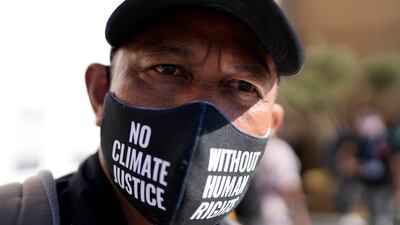
A man wears a face mask that reads "no climate justice without human rights" during a protest at the COP27 UN Climate Summit in Sharm El Sheikh, Egypt. AP -
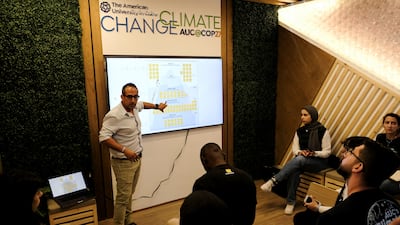
A presentation at the American University in Cairo Pavilion. Reuters -
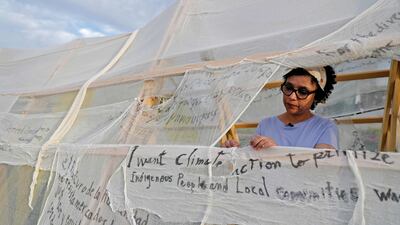
Egyptian artist Bahia Sheha stands inside her installation "Heaven & Hell in the Anthropocene." AFP -
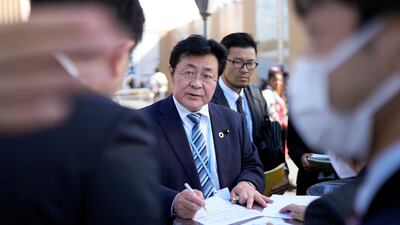
Akihiro Nishimura, minister of the environment of Japan, reviews notes with others at the COP27. AP -
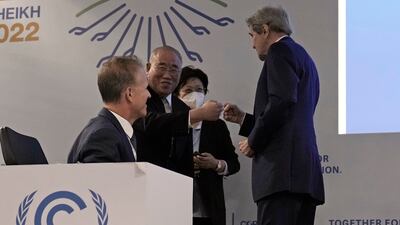
US Special Presidential Envoy for Climate John Kerry, right, and Xie Zhenhua, China's special envoy for climate greet each other at the COP27 UN Climate Summit in Sharm el-Sheikh, Egypt. AP -

Brazilian president-elect Luiz Inacio Lula da Silva poses for a group photograph with representatives of his country's indigenous people. AFP -

People attend the COP27 UN Climate Summit in Sharm El-Sheikh. EPA -

Activists dancing during a discussion on leaflets at the Cop27 climate conference, taking place in Sharm El Sheikh, Egypt. AFP -

An activist wears a polar bear outfit as part of campaigning. AFP -

From left, Rakia Amandou of Niger, Ba Aminata of Burkina Faso, Kenyan Rosemary Nenini, Fatima Mustafa Ahmed from Sudan and Djeneb Dicko from Burkina Faso at the Indigenous Peoples Pavilion. AP -
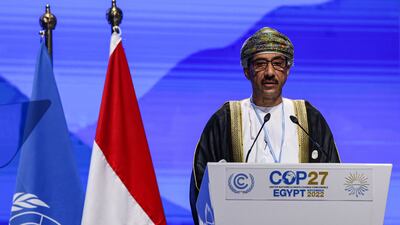
Abdulla Nasser Musallam Al Rahbi, Oman's Ambassador to Egypt and Permanent Representative to the Arab League, speaks at the COP27 climate conference in Egypt's Red Sea resort city of Sharm el-Sheikh. AFP -
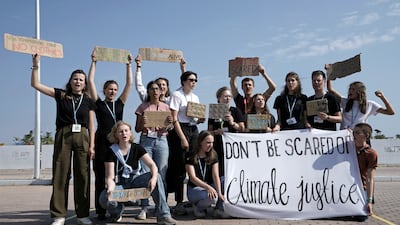
Climate activists demonstrate in the designated protest zone. AP -
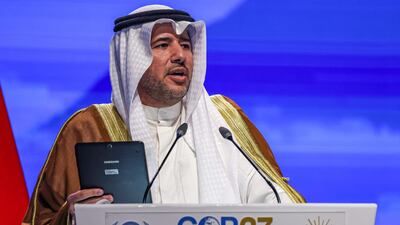
Sheikh Abdullah, Director General of Environment at the Public Authority of Kuwait, speaks at Cop27. AFP -
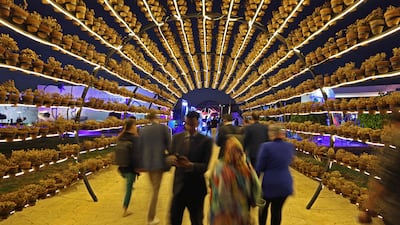
Visitors at the Sharm El Sheikh International Convention Centre. AFP -
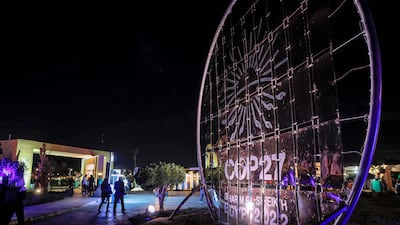
A display outside the convention centre. AFP -

A fountain in the green zone at the International Convention Centre at sunset. AFP -
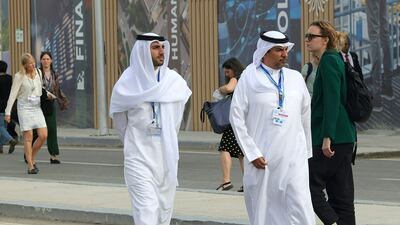
Mohamed bin Daina, right, Bahrain's Special Envoy for Climate Affairs and Chief Executive at the Supreme Council for Environment, at the conference. AFP -
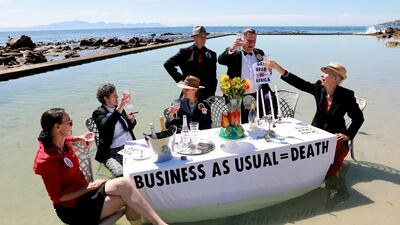
Members of Extinction Rebellion stage a protest at the Glencairn tidal pool outside Cape Town, South Africa to mark Cop27's 'Water Day'. AP -
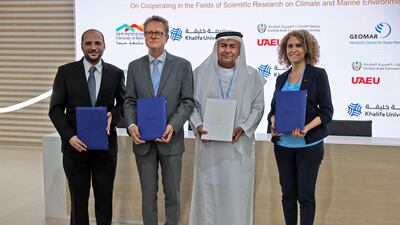
From left, Fahad Al Maskari of the Khalifa University, Frank Hartmann, Ghaleb Al Breiki of the UAE University, and Mouna Maroun of the University of Haifa, sign an agreement at Cop27. AFP -
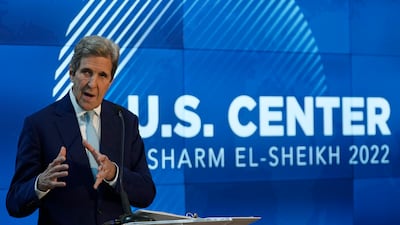
John Kerry, US special presidential envoy for climate, at Cop27 in Sharm El Sheikh, Egypt. AP Photo -

Australian climate activists offer bananas to climate summit participants. AFP -

Climate activist Sabrina Elba. AP Photo -

Egyptian security forces stand guard during the protest. AFP -
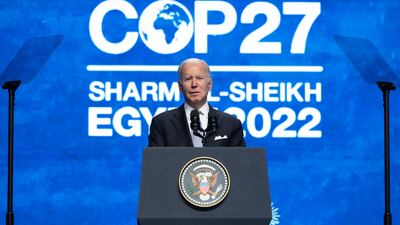
US President Joe Biden. AFP -

Mr Biden with Egyptian President Abdel Fattah El Sisi. AP -

A Cop27 sign in Sharm El Sheikh, Egypt, provides the backdrop for this woman's selfie. Reuters -
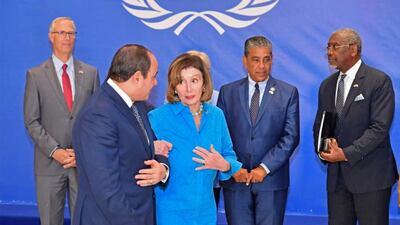
Egypt's President Abdel Fattah El Sisi speaks to US House Speaker Nancy Pelosi at the climate summit. AFP -

A water wonderland greets this child at an acquarium in the Cop27 Green Zone. Reuters -
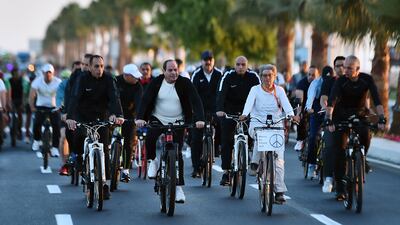
Mr El Sisi, second left, takes part in a cycling marathon on the sidelines of Cop27. EPA -
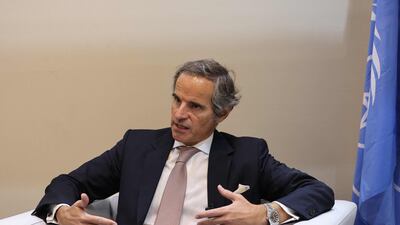
Rafael Grossi, director of the International Atomic Energy Agency, speaks in Sharm El Sheikh about 'complicated' talks to set up a protection zone around Ukraine's Zaporizhzhia nuclear plant. AFP -
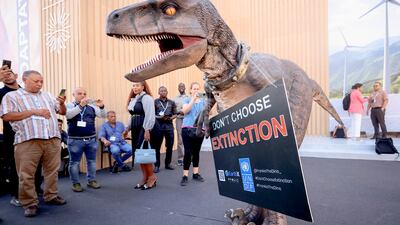
Frankie the dinosaur. Reuters -

US House Speaker Nancy Pelosi. Reuters -

Sheikha Shamma bint Sultan, CEO of the Alliances for Global Sustainability; Mariam Al Mheiri, Minister of Climate Change and Environment and Minister of State for Food Security; and Hatem Dowidar, group CEO at e&. AFP -

Sameh Shoukry, Cop27 president, centre left, poses for photos in the youth pavilion. AP -

A visitor looks at the 'Zero Point' series of collage portraits by Turkish artist Deniz Sagdic, each of which is made from a particular kind of upcycled waste material. Getty -

Participants visit the Ukrainian pavillon. AFP -

Mr Kerry speaks during a session on accelerating the clean energy transition in developing countries. AP -

Youth climate activists. Pictured, from the left, Eric Njuguna of Kenya, Nicole Becker of Argentina, Vanessa Nakate of Uganda, Sophia Kianni from Iran, and Mitzi Jonelle Tan of the Philippines. AP -
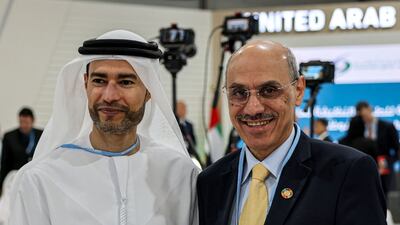
Muhammad Sulaiman Al Jasser, right, chairman of the Islamic Development Bank Group, poses for a photo with Mohamed Hadi Al Hussaini, the UAE's Minister of State for Financial Affairs. AFP -
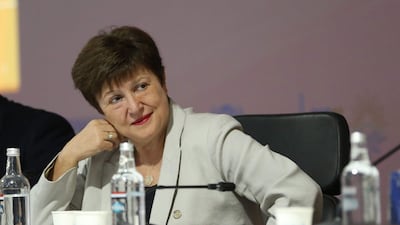
Kristalina Georgieva, managing director of the International Monetary Fund. Bloomberg -
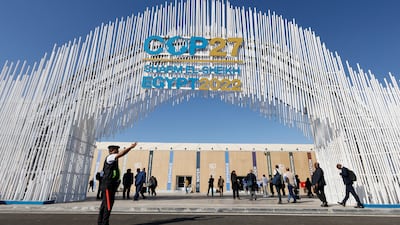
A police officer stands at the entrance of the Sharm El Sheikh International Convention Centre during Cop27. Reuters -

United Nations Secretary General Antonio Guterres. AP Photo -

Former US vice president Al Gore speaks during a session at Cop27. AP Photo -
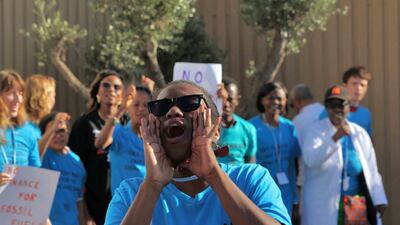
Demonstrators shout slogans during a protest. AFP


In other words, both engagement and capital allocation approaches have supporting literature, but more evidence is needed to support the second approach.
In general, portfolio decarbonisation approaches affect capital allocation — less money is allocated to high-carbon intensity businesses and more is allocated to low-carbon intensity businesses.
However, given that most equity and fixed-income investments are made in secondary markets, changing portfolio allocations only really transfers the ownership of those emissions from one investor to another, without having a clear impact on real economy emissions reductions.
Advocates believe that if portfolio allocation changes are made by a critical mass of investors, the stock and bond prices of highly carbon-intensive companies may then fall, while prices for less carbon-intensive companies rise.
This potentially leads to changes in the cost of capital for those companies affected and sends a negative signal to carbon-intensive companies and a positive one to those that are less so.
What are the implications for asset allocation?
So, what should investors do with their portfolio allocations to achieve their respective goals?
There’s unlikely to be a universal approach.
For example, if the investor prefers to pursue climate-risk management as a dominant element in their portfolio (potentially driven by a belief that climate risks are not fully priced in), then the most straightforward approach might be to favour investments in companies that already have relatively low carbon intensity.
If, on the other hand, the investor wishes to pursue real-world decarbonisation as a primary objective, they might incorporate both engagement and capital allocation approaches.
A balanced approach would be to remain invested in broad public equities and fixed income (both indexed and active), and pursue engagement with investee companies, while also carving out an allocation to portfolio decarbonisation approaches and illiquid investments in climate solutions companies.
EMEA head of ESG investment strategy at State Street Global Advisors
Where does this leave us?
For most investors, the path is likely to incorporate aspects of engagement, as well as capital allocation approaches to varying degrees.
When working with clients, we find that no two strategies are exactly alike, and perhaps one of the most important elements is the ability to tailor.
But we have seen more engagement on this issue in recent years than ever before. A decarbonisation investment strategy has gone from a specialist, esoteric concern to something many investors expect by default.
The world’s attention is focused on immediate announcements made during Cop27.
However, beyond the headlines, it is worth keeping in mind that the allocation of private capital was highlighted as one of the key contributors to changes needed to meet set climate goals by 2050.
Investors have a role to play.
Carlo Funk is the EMEA head of ESG investment strategy at State Street Global Advisors, a member of The Gulf Capital Market Association

