

In its latest 2,913-page report, the Intergovernmental Panel on Climate Change repeats with ever greater urgency the disastrous effects of climate change and how to limit it.
Recent progress in low-carbon energy has been tremendous. But the heroically unlikely scale of what is needed make it clear that global heating will go beyond the 1.5° Celsius commitment at Paris in 2015. The world needs to plan accordingly.
First, the good news. The Paris Agreement set a goal of limiting warming by 2100 to less than 2°C, with an aspiration of keeping it under 1.5°C.
Previous IPCC reports have laid out the dangerous consequences of even 1.5°C of warming, with rising temperatures causing seas to rise almost a metre, the destruction of nearly all coral reefs, more intense hurricanes, heatwaves, huge wildfires, less food production across the tropics and subtropics, and more insect-borne diseases.
The second-order effects – such as pandemics, economic depressions, embargoes, famines, mass migrations, state collapses and wars – are less predictable, but even more catastrophic. The worst burdens will fall on poorer countries, which lack the finance, infrastructure and capability to cope.
Following Paris, and especially around November’s Cop26 conference in Scotland, there was a flurry of commitments by countries and companies to reach “net-zero” carbon emissions, usually by about 2050.
The IPCC has estimated a range of future scenarios that yield heating between 1°C and a truly apocalyptic 6°C by 2100. New research published in Nature suggests that warming on the current path is likely to be about 2.4°C.
This relative improvement is because of the rapid improvements in performance and cost of low-carbon technologies, and stronger government policies. If all countries meet their net-zero commitments, expected warming is 1.9°C.
We can hope the outcome is likely to be better than this. Government policies will become more stringent, some countries without net-zero targets will adopt them and, above all, technological advances will further replace carbon-emitting energy.
Solar power costs dropped 85 per cent during the 2010s, wind costs by 55 per cent. Offshore wind has rapidly become economically competitive, the share of electric vehicles in Europe and China is soaring, a nascent hydrogen industry is emerging and forests are growing back.
Energy demand and emissions fell sharply during the pandemic. The Russian war in Ukraine and the associated high fossil fuel prices are pushing Europe and other countries to get off oil, gas and coal faster than planned.
-
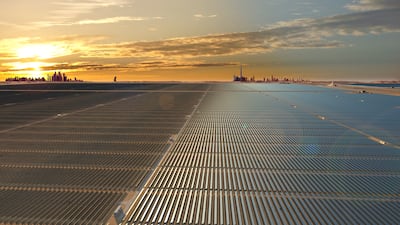
The third phase of the Mohammed bin Rashid Al Maktoum Solar Park in Dubai. Photo: Masdar -
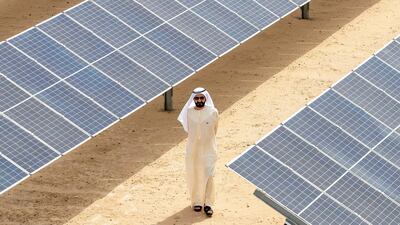
Sheikh Mohammed bin Rashid Al Maktoum, Vice President and Ruler of Dubai, inaugurates Dubai Electricity and Water Authority’s Innovation Centre and the 800MW third phase of the Mohammed bin Rashid Al Maktoum Solar Park, the largest single-site solar park in the world. Wam -
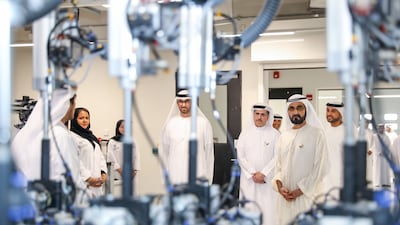
Sheikh Mohammed at the Mohammed bin Rashid Al Maktoum Solar Park. Wam -
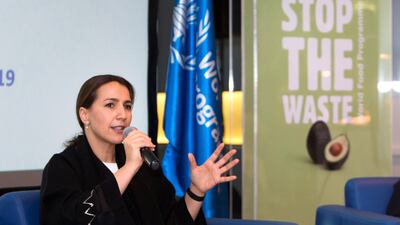
Mariam Al Mheiri, Minister for Food Security, speaks at the World Food Programme Stop the Waste campaign at Jumeirah Beach Hotel, Dubai. Leslie Pableo for The National -

Khaled bin Mohamed bin Zayed has launched a landmark clean energy partnership between Adnoc and EWEC that will see EWEC supply Adnoc’s grid power from nuclear and solar energy sources from January 2022. Photo: Abu Dhabi Government Media Office -
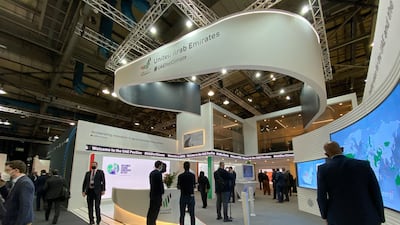
The UAE pavilion at the Cop26 summit in Scotland. Ashraf Helmi / The National -
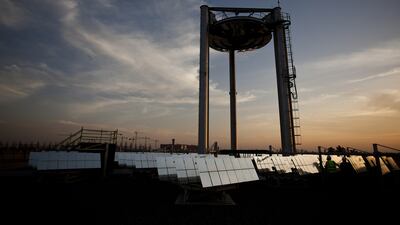
Masdar City in Abu Dhabi. Andrew Henderson / The National -

The Barakah Unit 2 grid connection delivers clean electricity. Photo: Emirates Nuclear Energy Corporation -

An aerial view of the Qurum Walkway in Jubail Mangrove Park. The UAE is doing everything it can to tackle climate change, from limiting greenhouse gas emissions to planting more mangroves. Wam -
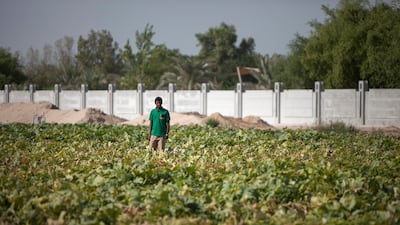
The Ministry of Climate Change and Environment is working to increase the amount of local produce grown by 5 to 10 per cent a year. Silvia Razgova / The National -
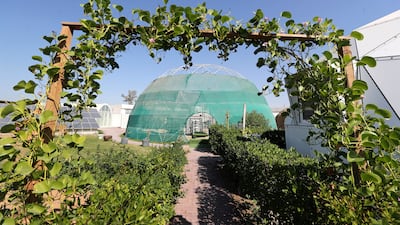
The eco-green technologies research site at Sharjah Research Technology and Innovation Park. Chris Whiteoak / The National -
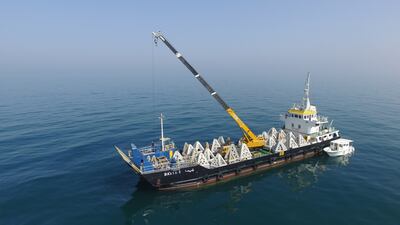
The Ministry of Climate Change and Environment has installed 300 artificial caves made of eco-friendly materials across 30 sites to enhance fish stocks in UAE waters. -
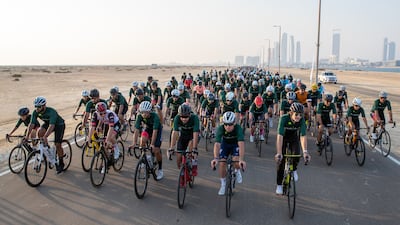
The future of cycling in Al Hudayriat Island, Abu Dhabi, is commemorated by a community ride around the track. Victor Besa / The National


But now comes the bad news. Scenarios that limit warming to 1.5°C – the Paris aspiration – require greenhouse gases to start falling today and drop by almost 40 per cent by 2030, just eight years away. If worldwide emissions don’t peak by 2030, even keeping warming under 2.5°C will be out of reach.
But 2021 emissions were probably the highest on record, beating the immediate pre-pandemic level.
The Ukraine crisis has distracted international attention from climate change. Getting off Russian gas quickly means more use of dirtier coal. European countries are bringing back oil and gas subsidies to cushion voters.
And, most seriously, the more optimistic projections assume that governments actually live up to their commitments. A net-zero promise 30 years or more away is an easy short-term approach for some politicians.
The required emissions reductions require colossal quantities of renewable energy, batteries and electric cars, hydrogen and carbon capture, biofuels and reforestation, while countries compete for scarce minerals and land. Energy efficiency must improve at rates never sustained historically. And all major countries must act near-simultaneously, with no room for laggards.
Beyond just cutting emissions and replanting forests, the IPCC confirms that we need to suck vast quantities of carbon dioxide back out of the air and lock it away permanently.
Carbon dioxide removal took a tremendous leap forward last week: a consortium of technology companies including Stripe, Google, Facebook and others committed $925 million to accelerate the development of the technology.
But CDR is at an embryonic scale and still far too expensive. Limiting warming to between 1.5°C and 2°C may require capturing 10 billion tonnes of carbon, on average, each year from now to 2100 – an industry a million times larger than today’s.
Carbon pricing struggles to be politically adopted outside Europe. Consumers want climate action but don’t want to take expensive flights, pay more to drive electric cars or stop eating meat, and oppose new nuclear plants, lithium mines, electricity transmission, carbon capture sites, hydroelectric dams and wind farms built near them.
There is only one way out of this conundrum, one that is unpalatable to most environmentalists. That is “geo-engineering”, or methods for blocking out some of the sun’s rays, such as injecting fine particles into the upper atmosphere. This would limit warming and buy us time for low-carbon technologies and CDR to scale up.
It appears effective and relatively cheap. But activists have blocked serious research. They fear the prospect of large geo-engineering would discourage more rapid emissions cuts, but perhaps the terrifying necessity would instead spur action.
This is not a counsel of despair. We are not driving over a cliff-edge, but down an ever-steepening slope.
Every tonne of emissions cut today makes the task for the rest of the century a little easier. Every 0.1°C is worth fighting for.
Every 0.1°C means the preservation of some human well-being, some monument of civilisation and some magical part of the natural world.
Robin Mills is the chief executive of Qamar Energy and author of The Myth of the Oil Crisis

