


Until recently, it was one of the Gulf region's paradoxes that domestic equity investors had little access to its colossal oil and gas resources.
At the same time, a decade of dismal underperformance by international energy companies has finally been succeeded by a good year and a bit.
Dubai Electricity and Water Company (Dewa) will be the latest local company to capitalise on a positive trend.
For a long time, investors in Gulf stock exchanges had very little choice of energy-related businesses: mostly, Taqa, the power utility, and a non-state petroleum producer, Dana Gas, in Abu Dhabi, a few Saudi petrochemical companies such as Sabic and Sipchem, Qatari fuel distributor Woqod and some oil services stocks. Banks, telecoms and real estate dominated the benchmark indexes.
Since the initial public offerings of Adnoc Distribution in 2017 and Saudi Aramco in late 2019, things have changed. Last year, Adnoc Drilling and fertiliser joint venture Fertiglobe listed on the Abu Dhabi Securities Exchange, and Saudi power and water developer Acwa Power on the Tadawul in Saudi Arabia.
Last week, Dewa announced it would launch an IPO for 6.5 per cent of its shares on the Dubai Financial Market. The world’s largest district cooling company Empower, a joint venture between Dewa itself and Tecom Investments, is looking for an offering in the fourth quarter.
In all, 10 Dubai government entities are to be listed, although it has yet to be announced which these are, and whether they might include Emirates National Oil Company, Dubai’s other big energy company.
Abu Dhabi plastics producer Borouge, a joint venture between Adnoc and Austrian oil company OMV, is planning an IPO with a valuation Bloomberg puts at about $20 billion. Emirates Aluminium is also said to be preparing for a listing.
Chief executive of Bahrain’s Nogaholding, the owner of its petroleum assets, says “everything is on the table”. And Oman’s OQ may launch IPOs for some of its energy-related businesses. The obvious absentees so far are Qatar and Kuwait.
The listings so far have done well. Adnoc Distribution is up 64 per cent on the IPO price, Fertiglobe 94 per cent, Adnoc Drilling 60 per cent, and Acwa Power has gained 37 per cent. Since October, when both Adnoc Drilling and Fertiglobe started trading, Abu Dhabi's benchmark index has increased 22 per cent, so the two companies have substantially outperformed. Aramco has risen 31 per cent, as well as paying some substantial dividends.
Of course, apart from Aramco, none of these companies are direct holders or producers of Gulf hydrocarbon resources, but they all serve or add value to the region’s energy wealth.
The investment cases in different ways combine three bets: on the robustness of global energy markets and their need of the Gulf to serve them, on the growth of the regional economy and population, and on the transition to low-carbon energy. Aramco, Adnoc Drilling and Borouge, for instance, rely on the first theme; Acwa, Dewa and Empower more on the second and third.
-
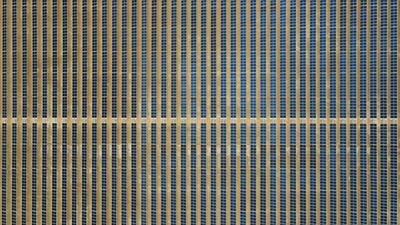
An aerial view of Mohammed bin Rashid Solar Park in Dubai in January 2022. Solar is essential to the UAE's new energy mix. All photos by Pawan Singh / The National -
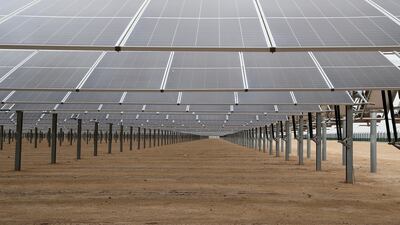
The fifth phase of a clean energy project at the Mohammed bin Rashid Solar Park will further help reduce carbon emissions. -

An aerial view of the Solar Park in the Dubai desert. -
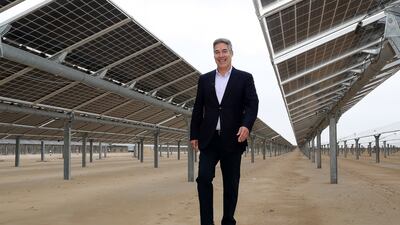
Marco Garcia, chief commercial officer of Nextracker, a US company which has provided photovoltaic technology used in the project. -
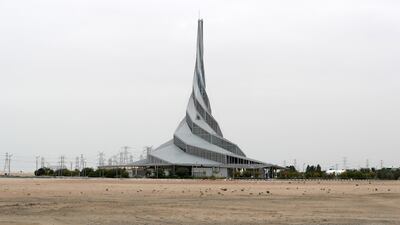
The Innovation Centre at the MBR Solar Park in Dubai, where machine learning is being utilised to track direct sunlight to maximise efficient energy capture, storage and transmission. -

The solar powered panels follow the path of the sun to help the emirate reach its clean energy transition goals. -
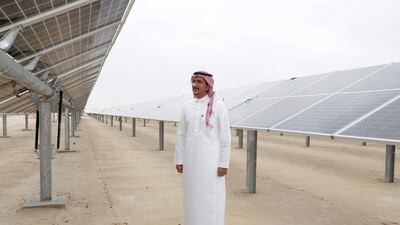
Omar Al Hassan, chief executive of Shuaa Energy 3, the company operating the scheme, says the vast project will ultimately create clean energy to power more than 250,000 houses in Dubai. -
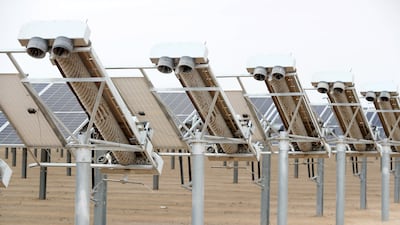
Robotic cleaning systems are installed on the solar panels. -
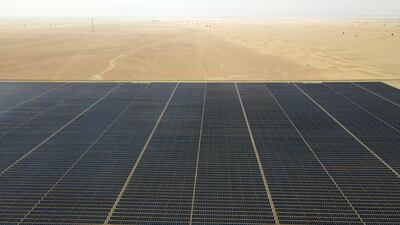
More than 2.5 million photovoltaic modules have been fitted during phase 5 of the project.


The Dewa prospectus points to its role as the sole electricity and drinking water provider to a population in the emirate expected to grow to 5.8 million by 2040 from 3.5 million today. The company has not yet released 2021 statistics, but peak demand rose more than 4 per cent annually between 2011 and 2020.
It also discussed its climate-related initiatives. These particularly revolve around renewable energy: expansion of centralised solar power from 1.5 to 5 gigawatts by 2030; continuing integration of “rooftop” solar, which reached 399 megawatts at the end of last year, with another 225MW on its way; and construction of a pumped hydroelectric storage plant at Hatta.
In addition, it has improved efficiency, reduced leakage and system losses, and is venturing into electric vehicle charging and green hydrogen production.
The authority plans to reach 100 per cent clean energy by 2050, in line with the national net-zero carbon goal. It will convert the new coal plant at Hassyan to burn gas, and won’t build any further fossil fuel-fired plants after the two under construction at Jebel Ali and Al Awir.
Dewa has set world records for low-cost solar power, and this should bring down its average generation costs over time.
The company’s offer pricing is due on Thursday. For now, its valuation is put around $25bn by Bloomberg, so the IPO could raise about $1.6bn for the Dubai government. That would be a significant contribution to the emirate’s $16.3bn budget this year. It plans to pay a minimum dividend of Dh6.2bn annually.
Although investors will run their own numbers, Dewa presents an attractive case, and another addition to the UAE’s growing stable of quite large, financially solid and strategic listed businesses.
This wave of energy sector-related IPOs raises two critical policy questions. Firstly, will any other regional governments follow Riyadh’s lead and offer listed equity access to their oil and gas production? Bahrain has suggested it may, but it is the smallest producer in the GCC. By reinvesting IPO revenues in diversified businesses, governments in the GCC can reduce their exposure to hydrocarbons, monetising at a favourable time while world commodity prices and demand are buoyant.
And secondly, is the listing of relatively small minority stakes a way to raise money and bulk up local exchanges? Or will it lead to something more strategic?
Though Aramco, Dewa and the others have been well-run prior to their IPOs, the introduction of public scrutiny and outside shareholders can always bring improvement. Privatisation of larger stakes, mergers or international acquisitions are options down the line. The proactive steps of recent years could be the prelude to a wider Gulf economic transformation.
Robin Mills is chief executive of Qamar Energy and author of The Myth of the Oil Crisis

