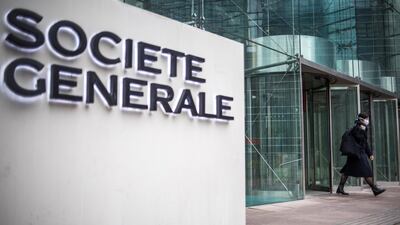
France-based Societe Generale are among the lenders who are suspending dividend payments to shore up capital amid coronavirus crisis. EPA

What US firms can learn from Europe's payout cuts amid coronavirus crisis


  • English
  • Arabic

European companies have been quick to slash or cancel their dividends in response to the coronavirus crisis, fueling calls from market participants that US firms should take heed and preserve cash.

The pandemic’s damage to profit as well as regulators’ calls for corporations to preserve liquidity have so far pushed 107 companies in the benchmark Stoxx Europe 600 Index to cancel or delay their payouts. This compares with only 10 S&P 500 companies that have so far suspended their dividends, with a further 21 projected to trim their payouts in the second quarter.

“Europe has always been more thoughtful about dividend policy - in the US a lot of companies treat dividends as sacrosanct, something to never be cut,” said Edward Perkin, who oversees $45 billion (Dh165.2bn) as chief equity investment officer at Eaton Vance Management in Boston. “The US may rethink that and try to have more flexibility in dividend policies going forward.”

Until this year, the European equity market had a reputation for some of the world’s highest dividends, nearly double those of the US - a feature that attracted investors hunting for yields.

But as the coronavirus continues to spread across the world and economies suffer from lockdown measures, shareholders are increasingly favouring companies with strong balance sheets and credit quality. The February fund manager survey by Bank of America showed that investor calls for companies to improve their financial positions overtook those for increasing capital spending for the first time since October, with just 15 per cent in favour of firms returning cash to shareholders.

“In this situation you need to preserve cash as much as you can, so this is a move protecting cash that makes absolute sense,” said Charles de Boissezon, deputy head of global asset allocation and equity strategy at Societe Generale. “The pressure that you see with dividends in Europe is the pressure you see on buybacks in the US where these have gone too far, raising debt and burning cash just to conduct buybacks.”

In the US, shareholder returns are usually dominated by buybacks, which have exceeded dividends in every quarter since 2010. President Donald Trump said two weeks ago he disapproved when proceeds of his 2017 tax cut were spent on such returns. Some major US firms are slashing or suspending buybacks, but maintaining their dividends, Intel Corporation being a case in point.

European banks, particularly in the UK, France and Spain, are leading other industries in terms of payout cancellations following the European Central Bank’s recommendation that lenders delay dividends until at least October after offering them unprecedented support measures. While the Euro Stoxx Banks Index sank to a 1988 low this week, John Teahan, a portfolio manager at RWC Partners, is focusing on the longer-term benefits of such moves.

“We believe UK banks themselves have done a very good job in ensuring they were in a strong position to begin with, in stark contrast to their position facing the financial crisis a decade ago, while the halt to dividends, share buybacks and cash bonuses for senior management will reinforce this strong position,” he said.

Martin Todd, a portfolio manager at Federated Hermes, says he’s staying invested in European stocks that are affected by dividend cancellations or cuts, including banks, business services, leisure and industrials. He praised their response to the crisis and said that if the economy rebounds, these firms can always pay a special dividend later on.

“I’ve certainly been impressed by how quick European companies have been to cut or defer their dividends,” Mr Todd said by phone. “We simply don’t know how long this downturn can last and how deep it can be. So it could be very prudent for companies to not pay their dividends.”

Firms in Europe should also benefit from not having lavished the kind of sums on buybacks that US companies have, he said.

“In Europe we haven’t had anything like the US buyback activity, you haven’t really seen companies issuing debt and buying back shares and levering up. Now, most companies are very glad they didn’t do that considering how important balance-sheet strength is.”


The specs
  • Engine: 3.9-litre twin-turbo V8
  • Power: 640hp
  • Torque: 760nm
  • On sale: 2026
  • Price: Not announced yet

Mercer, the investment consulting arm of US services company Marsh & McLennan, expects its wealth division to at least double its assets under management (AUM) in the Middle East as wealth in the region continues to grow despite economic headwinds, a company official said.

Mercer Wealth, which globally has $160 billion in AUM, plans to boost its AUM in the region to $2-$3bn in the next 2-3 years from the present $1bn, said Yasir AbuShaban, a Dubai-based principal with Mercer Wealth.

Within the next two to three years, we are looking at reaching $2 to $3 billion as a conservative estimate and we do see an opportunity to do so,” said Mr AbuShaban.

Mercer does not directly make investments, but allocates clients’ money they have discretion to, to professional asset managers. They also provide advice to clients.

“We have buying power. We can negotiate on their (client’s) behalf with asset managers to provide them lower fees than they otherwise would have to get on their own,” he added.

Mercer Wealth’s clients include sovereign wealth funds, family offices, and insurance companies among others.

From its office in Dubai, Mercer also looks after Africa, India and Turkey, where they also see opportunity for growth.

Wealth creation in Middle East and Africa (MEA) grew 8.5 per cent to $8.1 trillion last year from $7.5tn in 2015, higher than last year’s global average of 6 per cent and the second-highest growth in a region after Asia-Pacific which grew 9.9 per cent, according to consultancy Boston Consulting Group (BCG). In the region, where wealth grew just 1.9 per cent in 2015 compared with 2014, a pickup in oil prices has helped in wealth generation.

BCG is forecasting MEA wealth will rise to $12tn by 2021, growing at an annual average of 8 per cent.

Drivers of wealth generation in the region will be split evenly between new wealth creation and growth of performance of existing assets, according to BCG.

Another general trend in the region is clients’ looking for a comprehensive approach to investing, according to Mr AbuShaban.

“Institutional investors or some of the families are seeing a slowdown in the available capital they have to invest and in that sense they are looking at optimizing the way they manage their portfolios and making sure they are not investing haphazardly and different parts of their investment are working together,” said Mr AbuShaban.

Some clients also have a higher appetite for risk, given the low interest-rate environment that does not provide enough yield for some institutional investors. These clients are keen to invest in illiquid assets, such as private equity and infrastructure.

“What we have seen is a desire for higher returns in what has been a low-return environment specifically in various fixed income or bonds,” he said.

“In this environment, we have seen a de facto increase in the risk that clients are taking in things like illiquid investments, private equity investments, infrastructure and private debt, those kind of investments were higher illiquidity results in incrementally higher returns.”

The Abu Dhabi Investment Authority, one of the largest sovereign wealth funds, said in its 2016 report that has gradually increased its exposure in direct private equity and private credit transactions, mainly in Asian markets and especially in China and India. The authority’s private equity department focused on structured equities owing to “their defensive characteristics.”

Dhadak 2

Director: Shazia Iqbal

Starring: Siddhant Chaturvedi, Triptii Dimri 

Rating: 1/5

Specs

Engine: Dual-motor all-wheel-drive electric

Range: Up to 610km

Power: 905hp

Torque: 985Nm

Price: From Dh439,000

Available: Now

Labour dispute

The insured employee may still file an ILOE claim even if a labour dispute is ongoing post termination, but the insurer may suspend or reject payment, until the courts resolve the dispute, especially if the reason for termination is contested. The outcome of the labour court proceedings can directly affect eligibility.


- Abdullah Ishnaneh, Partner, BSA Law 

UPI facts

More than 2.2 million Indian tourists arrived in UAE in 2023
More than 3.5 million Indians reside in UAE
Indian tourists can make purchases in UAE using rupee accounts in India through QR-code-based UPI real-time payment systems
Indian residents in UAE can use their non-resident NRO and NRE accounts held in Indian banks linked to a UAE mobile number for UPI transactions

The biog

Name: Mariam Ketait

Emirate: Dubai

Hobbies: I enjoy travelling, experiencing new things, painting, reading, flying, and the French language

Favourite quote: "Be the change you wish to see" - unknown

Favourite activity: Connecting with different cultures

Sole survivors
  • Cecelia Crocker was on board Northwest Airlines Flight 255 in 1987 when it crashed in Detroit, killing 154 people, including her parents and brother. The plane had hit a light pole on take off
  • George Lamson Jr, from Minnesota, was on a Galaxy Airlines flight that crashed in Reno in 1985, killing 68 people. His entire seat was launched out of the plane
  • Bahia Bakari, then 12, survived when a Yemenia Airways flight crashed near the Comoros in 2009, killing 152. She was found clinging to wreckage after floating in the ocean for 13 hours.
  • Jim Polehinke was the co-pilot and sole survivor of a 2006 Comair flight that crashed in Lexington, Kentucky, killing 49.
ESSENTIALS

The flights

Emirates flies direct from Dubai to Rio de Janeiro from Dh7,000 return including taxes. Avianca fliles from Rio to Cusco via Lima from $399 (Dhxx) return including taxes. 

The trip

From US$1,830 per deluxe cabin, twin share, for the one-night Spirit of the Water itinerary and US$4,630 per deluxe cabin for the Peruvian Highlands itinerary, inclusive of meals, and beverages. Surcharges apply for some excursions.

Babumoshai Bandookbaaz

Director: Kushan Nandy

Starring: Nawazuddin Siddiqui, Bidita Bag, Jatin Goswami

Three stars

Islamophobia definition

A widely accepted definition was made by the All Party Parliamentary Group on British Muslims in 2019: “Islamophobia is rooted in racism and is a type of racism that targets expressions of Muslimness or perceived Muslimness.” It further defines it as “inciting hatred or violence against Muslims”.