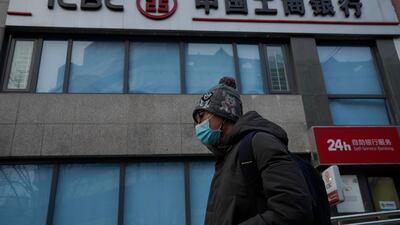
Chinese lenders led by ICBC dominated the world's top five most valuable banking brands, while 10 UAE banks led by Emirates NBD, First Abu Dhabi Bank and ADCB featured in the top 100 ranks.
The brand value of the world's largest banks contracted for two consecutive years, according to consultancy Brand Finance. Nearly two-third of the world's 500 most valuable bank brands recorded losses in brand value, as profits and interest rates were impacted by the Covid-19 pandemic, according to the Brand Finance Banking 500 2021 report issued on Monday.
"Banking institutions were the main culprit in the last financial crash; this time around they are a large part of helping people overcome the repercussions of Covid-19," David Haigh, chief executive of Brand Finance, said. "Brand Finance research shows that banks’ responses to the global pandemic have led to a year-on-year increase in overall reputation scores among customers, which no doubt could result in an uptick in brand values in the coming year.”
Chinese banks held their dominance over the top rankings, accounting for one-third of total brand value and seven of the 10 top climbers by absolute brand value.
While two-thirds of banking brands in the ranking have experienced losses, Chinese lenders recorded a healthy 3 per cent average brand value growth. That is due to the banking sector’s role in China’s timely and effective response to Covid-19, which included regulatory policy adjustments for asset management, wealth management, and inter-banking, as well as increased investment into digitalisation, the report said.
Despite a 10 per cent drop in brand value to $72.8 billion, ICBC remains the world’s most valuable banking brand, followed by China Construction Bank and Agricultural Bank of China.
Five US banks claimed spots in the top 10, with Bank of America highest ranked in fifth position and a brand value of $32.8bn. It was followed by Citi, Wells Fargo, Chase and JP Morgan.
JP Morgan and Chase, which merged in 2000, still provide services to clients under separate brands. Since Brand Finance evaluates brands, as opposed to companies, these are valued separately.
JP Morgan was the only brand in the top 10 to record a growth in brand value, up three per cent to $23.6bn.
US banks account for almost a quarter of the total brand value in the ranking, with the country's 74 banks reaching a cumulative brand value of $274.8bn.
Vietnam’s banking sector saw the greatest year-on-year brand value growth compared to any other nation, standing at 23 per cent.
Vietnam’s ability to effectively control and constrain Covid-19 has allowed it to buck the sector-wide trend of declining brand value, the report said.
The Union Bank of India was the fastest growing in ranking, more than doubling to $1.2bn and simultaneously soaring 128 places to claim the169th position.
While some of the world's largest banks struggled during the pandemic, 23 newcomers have joined the ranking from Europe, Asia, the US, and South America.
The highest new entrant is Truist in 36th position, with a brand value of $8bn.
Sberbank, Russia's largest lender, increased in brand strength year-on-year to become the strongest brand in the banking ranking, with a Brand Strength Index (BSI) score of 92.0 out of 100 and a coveted AAA+ brand strength rating.
Ten banks from the UAE featured in the banking report, with a combined brand value of $13.7bn.
Leading the pack is Emirates NBD, which sits in 74th position in the overall ranking despite the impact of the pandemic. The lender is the official partner of the Expo2020 – rescheduled to commence in October – which will be "the perfect opportunity to boost the brand’s profile globally as it helps to demonstrate the nation’s innovative culture," the report said.
First Abu Dhabi Bank's brand value is $3.6bn while ADCB stood at $2.1bn. The two lenders are the UAE's second and third most valuable banking brands respectively, the report showed.
National Bank of Fujeirah's brand value increased 2 per cent to $259 million. Commercial Bank of Dubai's brand value is estimated at $334m, while Mashreq, Dubai's oldest bank has a brand value of $484m.

Motori Profile
Date started: March 2020
Co-founder/CEO: Ahmed Eissa
Based: UAE, Abu Dhabi
Sector: Insurance Sector
Size: 50 full-time employees (Inside and Outside UAE)
Stage: Seed stage and seeking Series A round of financing
Investors: Safe City Group
Mohammed bin Zayed Majlis
Company%20profile
%3Cp%3EName%3A%20Tabby%3Cbr%3EFounded%3A%20August%202019%3B%20platform%20went%20live%20in%20February%202020%3Cbr%3EFounder%2FCEO%3A%20Hosam%20Arab%2C%20co-founder%3A%20Daniil%20Barkalov%3Cbr%3EBased%3A%20Dubai%2C%20UAE%3Cbr%3ESector%3A%20Payments%3Cbr%3ESize%3A%2040-50%20employees%3Cbr%3EStage%3A%20Series%20A%3Cbr%3EInvestors%3A%20Arbor%20Ventures%2C%20Mubadala%20Capital%2C%20Wamda%20Capital%2C%20STV%2C%20Raed%20Ventures%2C%20Global%20Founders%20Capital%2C%20JIMCO%2C%20Global%20Ventures%2C%20Venture%20Souq%2C%20Outliers%20VC%2C%20MSA%20Capital%2C%20HOF%20and%20AB%20Accelerator.%3Cbr%3E%3C%2Fp%3E%0A
Racecard
6pm: The Pointe - Conditions (TB) Dh82,500 (Turf) 1,400m
6.35pm: Palm West Beach - Maiden (TB) Dh82,500 (T) 1,800m
7.10pm: The View at the Palm - Handicap (TB) Dh85,000 (Dirt) 1,400m
7.45pm: Nakeel Graduate Stakes - Conditions (TB) Dh100,000 (T) 1,600m
8.20pm: Club Vista Mare - Handicap (TB) Dh95,000 (D) 1,900m
8.55pm: The Palm Fountain - Handicap (TB) Dh95,000 (D) 1,200m
9.30pm: The Palm Tower - Handicap (TB) Dh87,500 (T) 1,600m
Ten tax points to be aware of in 2026
1. Domestic VAT refund amendments: request your refund within five years
If a business does not apply for the refund on time, they lose their credit.
2. E-invoicing in the UAE
Businesses should continue preparing for the implementation of e-invoicing in the UAE, with 2026 a preparation and transition period ahead of phased mandatory adoption.
3. More tax audits
Tax authorities are increasingly using data already available across multiple filings to identify audit risks.
4. More beneficial VAT and excise tax penalty regime
Tax disputes are expected to become more frequent and more structured, with clearer administrative objection and appeal processes. The UAE has adopted a new penalty regime for VAT and excise disputes, which now mirrors the penalty regime for corporate tax.
5. Greater emphasis on statutory audit
There is a greater need for the accuracy of financial statements. The International Financial Reporting Standards standards need to be strictly adhered to and, as a result, the quality of the audits will need to increase.
6. Further transfer pricing enforcement
Transfer pricing enforcement, which refers to the practice of establishing prices for internal transactions between related entities, is expected to broaden in scope. The UAE will shortly open the possibility to negotiate advance pricing agreements, or essentially rulings for transfer pricing purposes.
7. Limited time periods for audits
Recent amendments also introduce a default five-year limitation period for tax audits and assessments, subject to specific statutory exceptions. While the standard audit and assessment period is five years, this may be extended to up to 15 years in cases involving fraud or tax evasion.
8. Pillar 2 implementation
Many multinational groups will begin to feel the practical effect of the Domestic Minimum Top-Up Tax (DMTT), the UAE's implementation of the OECD’s global minimum tax under Pillar 2. While the rules apply for financial years starting on or after January 1, 2025, it is 2026 that marks the transition to an operational phase.
9. Reduced compliance obligations for imported goods and services
Businesses that apply the reverse-charge mechanism for VAT purposes in the UAE may benefit from reduced compliance obligations.
10. Substance and CbC reporting focus
Tax authorities are expected to continue strengthening the enforcement of economic substance and Country-by-Country (CbC) reporting frameworks. In the UAE, these regimes are increasingly being used as risk-assessment tools, providing tax authorities with a comprehensive view of multinational groups’ global footprints and enabling them to assess whether profits are aligned with real economic activity.
Contributed by Thomas Vanhee and Hend Rashwan, Aurifer
Mercer, the investment consulting arm of US services company Marsh & McLennan, expects its wealth division to at least double its assets under management (AUM) in the Middle East as wealth in the region continues to grow despite economic headwinds, a company official said.
Mercer Wealth, which globally has $160 billion in AUM, plans to boost its AUM in the region to $2-$3bn in the next 2-3 years from the present $1bn, said Yasir AbuShaban, a Dubai-based principal with Mercer Wealth.
“Within the next two to three years, we are looking at reaching $2 to $3 billion as a conservative estimate and we do see an opportunity to do so,” said Mr AbuShaban.
Mercer does not directly make investments, but allocates clients’ money they have discretion to, to professional asset managers. They also provide advice to clients.
“We have buying power. We can negotiate on their (client’s) behalf with asset managers to provide them lower fees than they otherwise would have to get on their own,” he added.
Mercer Wealth’s clients include sovereign wealth funds, family offices, and insurance companies among others.
From its office in Dubai, Mercer also looks after Africa, India and Turkey, where they also see opportunity for growth.
Wealth creation in Middle East and Africa (MEA) grew 8.5 per cent to $8.1 trillion last year from $7.5tn in 2015, higher than last year’s global average of 6 per cent and the second-highest growth in a region after Asia-Pacific which grew 9.9 per cent, according to consultancy Boston Consulting Group (BCG). In the region, where wealth grew just 1.9 per cent in 2015 compared with 2014, a pickup in oil prices has helped in wealth generation.
BCG is forecasting MEA wealth will rise to $12tn by 2021, growing at an annual average of 8 per cent.
Drivers of wealth generation in the region will be split evenly between new wealth creation and growth of performance of existing assets, according to BCG.
Another general trend in the region is clients’ looking for a comprehensive approach to investing, according to Mr AbuShaban.
“Institutional investors or some of the families are seeing a slowdown in the available capital they have to invest and in that sense they are looking at optimizing the way they manage their portfolios and making sure they are not investing haphazardly and different parts of their investment are working together,” said Mr AbuShaban.
Some clients also have a higher appetite for risk, given the low interest-rate environment that does not provide enough yield for some institutional investors. These clients are keen to invest in illiquid assets, such as private equity and infrastructure.
“What we have seen is a desire for higher returns in what has been a low-return environment specifically in various fixed income or bonds,” he said.
“In this environment, we have seen a de facto increase in the risk that clients are taking in things like illiquid investments, private equity investments, infrastructure and private debt, those kind of investments were higher illiquidity results in incrementally higher returns.”
The Abu Dhabi Investment Authority, one of the largest sovereign wealth funds, said in its 2016 report that has gradually increased its exposure in direct private equity and private credit transactions, mainly in Asian markets and especially in China and India. The authority’s private equity department focused on structured equities owing to “their defensive characteristics.”
COMPANY%20PROFILE%20
%3Cp%3E%3Cstrong%3ECompany%3A%20%3C%2Fstrong%3EOlive%20Gaea%3Cbr%3E%3Cstrong%3EStarted%3A%3C%2Fstrong%3E%202021%3Cbr%3E%3Cstrong%3ECo-founders%3A%3C%2Fstrong%3E%20Vivek%20Tripathi%2C%20Jessica%20Scopacasa%3Cbr%3E%3Cstrong%3EBased%3A%3C%2Fstrong%3E%20Dubai%3Cbr%3E%3Cstrong%3ELicensed%20by%3A%20%3C%2Fstrong%3EDubai%20World%20Trade%20Centre%3Cbr%3E%3Cstrong%3EIndustry%3A%3C%2Fstrong%3E%20Climate-Tech%2C%20Sustainability%3Cbr%3E%3Cstrong%3EFunding%3A%20%3C%2Fstrong%3E%241.1%20million%3Cbr%3E%3Cstrong%3EInvestors%3A%20%3C%2Fstrong%3ECornerstone%20Venture%20Partners%20and%20angel%20investors%3Cbr%3E%3Cstrong%3ENumber%20of%20employees%3A%3C%2Fstrong%3E%208%3Cbr%3E%3C%2Fp%3E%0A
Racecard
%3Cp%3E%0D5pm%3A%20Al%20Maha%20Stables%20%E2%80%93%20Maiden%20(PA)%20Dh80%2C000%20(Turf)%201%2C400m%0D%3Cbr%3E5.30pm%3A%20Al%20Anoud%20Stables%20%E2%80%93%20Handicap%20(PA)%20Dh80%2C000%20(T)%201%2C200m%0D%3Cbr%3E6pm%3A%20Wathba%20Stallions%20Cup%20%E2%80%93%20Handicap%20(PA)%20Dh70%2C000%20(T)%201%2C400m%0D%3Cbr%3E6.30pm%3A%20Arabian%20Triple%20Crown%20Round%202%20%E2%80%93%20Group%203%20(PA)%20Dh%20300%2C000%20(T)%202%2C200m%0D%3Cbr%3E7pm%3A%20Liwa%20Oasis%20%E2%80%93%20Group%202%20(PA)%20Dh300%2C000%20(T)%201%2C400m%0D%3Cbr%3E7.30pm%3A%20Dames%20Stables%20%E2%80%93%20Handicap%20(TB)%20Dh80%2C000%20(T)%201%2C400m%3C%2Fp%3E%0A
MATCH INFO
Sheffield United 2 Bournemouth 1
United: Sharp (45 2'), Lundstram (84')
Bournemouth: C Wilson (13')
Man of the Match: Jack O’Connell (Sheffield United)
What is Folia?
Prince Khaled bin Alwaleed bin Talal's new plant-based menu will launch at Four Seasons hotels in Dubai this November. A desire to cater to people looking for clean, healthy meals beyond green salad is what inspired Prince Khaled and American celebrity chef Matthew Kenney to create Folia. The word means "from the leaves" in Latin, and the exclusive menu offers fine plant-based cuisine across Four Seasons properties in Los Angeles, Bahrain and, soon, Dubai.
Kenney specialises in vegan cuisine and is the founder of Plant Food Wine and 20 other restaurants worldwide. "I’ve always appreciated Matthew’s work," says the Saudi royal. "He has a singular culinary talent and his approach to plant-based dining is prescient and unrivalled. I was a fan of his long before we established our professional relationship."
Folia first launched at The Four Seasons Hotel Los Angeles at Beverly Hills in July 2018. It is available at the poolside Cabana Restaurant and for in-room dining across the property, as well as in its private event space. The food is vibrant and colourful, full of fresh dishes such as the hearts of palm ceviche with California fruit, vegetables and edible flowers; green hearb tacos filled with roasted squash and king oyster barbacoa; and a savoury coconut cream pie with macadamia crust.
In March 2019, the Folia menu reached Gulf shores, as it was introduced at the Four Seasons Hotel Bahrain Bay, where it is served at the Bay View Lounge. Next, on Tuesday, November 1 – also known as World Vegan Day – it will come to the UAE, to the Four Seasons Resort Dubai at Jumeirah Beach and the Four Seasons DIFC, both properties Prince Khaled has spent "considerable time at and love".
There are also plans to take Folia to several more locations throughout the Middle East and Europe.
While health-conscious diners will be attracted to the concept, Prince Khaled is careful to stress Folia is "not meant for a specific subset of customers. It is meant for everyone who wants a culinary experience without the negative impact that eating out so often comes with."
CHATGPT%20ENTERPRISE%20FEATURES
%3Cp%3E%E2%80%A2%20Enterprise-grade%20security%20and%20privacy%3C%2Fp%3E%0A%3Cp%3E%E2%80%A2%20Unlimited%20higher-speed%20GPT-4%20access%20with%20no%20caps%3C%2Fp%3E%0A%3Cp%3E%E2%80%A2%20Longer%20context%20windows%20for%20processing%20longer%20inputs%3C%2Fp%3E%0A%3Cp%3E%E2%80%A2%20Advanced%20data%20analysis%20capabilities%3C%2Fp%3E%0A%3Cp%3E%E2%80%A2%20Customisation%20options%3C%2Fp%3E%0A%3Cp%3E%E2%80%A2%20Shareable%20chat%20templates%20that%20companies%20can%20use%20to%20collaborate%20and%20build%20common%20workflows%3C%2Fp%3E%0A%3Cp%3E%E2%80%A2%20Analytics%20dashboard%20for%20usage%20insights%3C%2Fp%3E%0A%3Cp%3E%E2%80%A2%20Free%20credits%20to%20use%20OpenAI%20APIs%20to%20extend%20OpenAI%20into%20a%20fully-custom%20solution%20for%20enterprises%3C%2Fp%3E%0A
