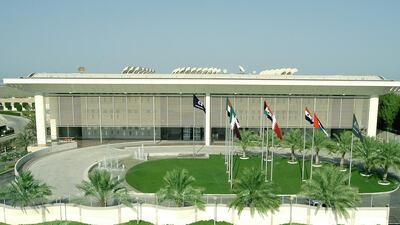
The Arab Petroleum Investments Corporation, a multilateral lender focused on the energy sector, reported that its first-half net profit fell by 22 per cent, compared with a year ago, as the coronavirus-induced slowdown hit revenue.
Net income for the six-month period to June 30 declined to $54.8 million (Dh201.28m) from a year ago, the lender said on Sunday.
Gross operating income for the reporting period fell by 20 per cent to $144.7m.
“Net profit results are notable under the current market conditions due to the Covid-19 pandemic and oil price fluctuations,” Apicorp said.
“Revenue was mainly affected by the decrease in dividends from portfolio companies, as well as revaluations in the equity investment portfolio due to the pandemic.”
Income from the lender’s treasury and capital markets business rose by an annual 38 per cent to $60.4m.
Apicorp’s assets rose by 10 per cent to $8.1 billion in the first six months, mainly due to growth in its treasury and capital markets portfolio, it said.
The share of Apricorp’s liabilities with a maturity beyond two years rose to 45 per cent of its total debt. Impairment charges at the end of the reporting period climbed to $4.5m, from zero during the same period a year ago.
Chief executive Ahmed Attiga said the results were a “testament to the resilience of Apicorp in the face of a tough global business environment”.
The lender strengthened its operational and capital base despite the triple crisis of Covid-19, oil price volatility and an economic downturn, Mr Attiga said.
“We are looking forward to the coming period for a gradual recovery in our operating environment and the new opportunities it will bring,” he said.
Lenders around the world are making provisions for loan losses and revaluing their investment levels as the global economy slides into its deepest recession since the 1930s.
Apicorp is owned by 10 members of the Organisation of Arab Petroleum Exporting Countries – Saudi Arabia, the UAE, Kuwait, Libya, Iraq, Qatar, Algeria, Bahrain, Egypt and Syria.
The multilateral lender was set up in 1975 to extend financial support to Arab countries in the energy sector.
Apicorp raised $750m in June through the issuance of a five-year bond at record low rates.
The lender said at the time that the bonds, which were issued under its $3bn Global Medium-Term Note programme, would allow it to take a “countercyclical role in 2020” to support the Mena region’s energy sector at a time of falling demand.
Apicorp unveiled a $500m support package in April to help clients in the energy sector to continue to fund their projects amid lower oil prices after the pandemic hit demand.
Earlier this year, Apicorp increased its callable share capital from $1bn to $8.5bn to boost investment in the energy sector.
It also increased its authorised capital from $2.4bn to $20bn while subscribed capital rose from $2bn to $10bn.
“We will continue to support our member countries and partners to alleviate the impact of Covid-19, with a focus on sustainable impact-driven energy projects and activities in the region,” Mr Attiga said.

Mercer, the investment consulting arm of US services company Marsh & McLennan, expects its wealth division to at least double its assets under management (AUM) in the Middle East as wealth in the region continues to grow despite economic headwinds, a company official said.
Mercer Wealth, which globally has $160 billion in AUM, plans to boost its AUM in the region to $2-$3bn in the next 2-3 years from the present $1bn, said Yasir AbuShaban, a Dubai-based principal with Mercer Wealth.
“Within the next two to three years, we are looking at reaching $2 to $3 billion as a conservative estimate and we do see an opportunity to do so,” said Mr AbuShaban.
Mercer does not directly make investments, but allocates clients’ money they have discretion to, to professional asset managers. They also provide advice to clients.
“We have buying power. We can negotiate on their (client’s) behalf with asset managers to provide them lower fees than they otherwise would have to get on their own,” he added.
Mercer Wealth’s clients include sovereign wealth funds, family offices, and insurance companies among others.
From its office in Dubai, Mercer also looks after Africa, India and Turkey, where they also see opportunity for growth.
Wealth creation in Middle East and Africa (MEA) grew 8.5 per cent to $8.1 trillion last year from $7.5tn in 2015, higher than last year’s global average of 6 per cent and the second-highest growth in a region after Asia-Pacific which grew 9.9 per cent, according to consultancy Boston Consulting Group (BCG). In the region, where wealth grew just 1.9 per cent in 2015 compared with 2014, a pickup in oil prices has helped in wealth generation.
BCG is forecasting MEA wealth will rise to $12tn by 2021, growing at an annual average of 8 per cent.
Drivers of wealth generation in the region will be split evenly between new wealth creation and growth of performance of existing assets, according to BCG.
Another general trend in the region is clients’ looking for a comprehensive approach to investing, according to Mr AbuShaban.
“Institutional investors or some of the families are seeing a slowdown in the available capital they have to invest and in that sense they are looking at optimizing the way they manage their portfolios and making sure they are not investing haphazardly and different parts of their investment are working together,” said Mr AbuShaban.
Some clients also have a higher appetite for risk, given the low interest-rate environment that does not provide enough yield for some institutional investors. These clients are keen to invest in illiquid assets, such as private equity and infrastructure.
“What we have seen is a desire for higher returns in what has been a low-return environment specifically in various fixed income or bonds,” he said.
“In this environment, we have seen a de facto increase in the risk that clients are taking in things like illiquid investments, private equity investments, infrastructure and private debt, those kind of investments were higher illiquidity results in incrementally higher returns.”
The Abu Dhabi Investment Authority, one of the largest sovereign wealth funds, said in its 2016 report that has gradually increased its exposure in direct private equity and private credit transactions, mainly in Asian markets and especially in China and India. The authority’s private equity department focused on structured equities owing to “their defensive characteristics.”
Zidane's managerial achievements
La Liga: 2016/17
Spanish Super Cup: 2017
Uefa Champions League: 2015/16, 2016/17, 2017/18
Uefa Super Cup: 2016, 2017
Fifa Club World Cup: 2016, 2017
MATCH INFO
Alaves 1 (Perez 65' pen)
Real Madrid 2 (Ramos 52', Carvajal 69')
Summer special
MATCH INFO
Championship play-offs, second legs:
Aston Villa 0
Middlesbrough 0
(Aston Villa advance 1-0 on aggregate)
Fulham 2
Sessegnon (47'), Odoi (66')
Derby County 0
(Fulham advance 2-1 on aggregate)
Final
Saturday, May 26, Wembley. Kick off 8pm (UAE)
APPLE IPAD MINI (A17 PRO)
Display: 21cm Liquid Retina Display, 2266 x 1488, 326ppi, 500 nits
Chip: Apple A17 Pro, 6-core CPU, 5-core GPU, 16-core Neural Engine
Storage: 128/256/512GB
Main camera: 12MP wide, f/1.8, digital zoom up to 5x, Smart HDR 4
Front camera: 12MP ultra-wide, f/2.4, Smart HDR 4, full-HD @ 25/30/60fps
Biometrics: Touch ID, Face ID
Colours: Blue, purple, space grey, starlight
In the box: iPad mini, USB-C cable, 20W USB-C power adapter
Price: From Dh2,099
What is tokenisation?
Tokenisation refers to the issuance of a blockchain token, which represents a virtually tradable real, tangible asset. A tokenised asset is easily transferable, offers good liquidity, returns and is easily traded on the secondary markets.
Paatal Lok season two
Directors: Avinash Arun, Prosit Roy
Stars: Jaideep Ahlawat, Ishwak Singh, Lc Sekhose, Merenla Imsong
Rating: 4.5/5
