JP Morgan Chase has raised and deployed more than $20 billion into the Gulf region since the beginning of the Iran war, and estimates hundreds of billions more will be needed postwar to rebuild infrastructure and support diversification.
“We've deployed significantly more capital and we've expanded our risk limits across the region, one because the region needs it at the moment, but maybe more important than that is we're just scaling it in dimension of the opportunity,” Doug Petno, JP Morgan's co-chief executive of commercial and investment banking operations at the biggest US lender told The National.
Declining to specify the degree to which the lender has changed its risk appetite in the war-affected region, Mr Petno said the bank is mapping the Middle East through dedicated teams to ascertain how it can help meet the massive capital expenditure (capex) requirements.

Commercial lenders are not the only ones seeking the opportunity, he said. Private equity firms are also travelling to the region to fill the capital gaps as there's some “time sensitivity” attached to some of the infrastructure projects.
“It could be our balance sheet, it could be the public market, it could be a private market, but the numbers are substantial, market by market,” he said.
True scale
However, given the region is still embroiled in the conflict, it is hard to judge the true scale of what will be the aggregate capex needs.
“When it's over, I think the world will get a better sense for what it's going to cost to repair and what it's going to cost to diversify,” Mr Petno said. “The one thing I think is certain, the number will be substantial – in the hundreds of billions of dollars.”
US and Israeli strikes on Iran, and Tehran's subsequent attacks on its Arab neighbours, which began on February 28, have tipped the region into a conflict that has severely disrupted business activity and threatened global economic growth.
Iranian strikes on energy and civilian infrastructure in March and early April means that Gulf nations, as well as Iraq, not only need to repair the damages, but also require financing to continue investing in diversifying their economies.

“The conversation was very different depending on the country … [as] the economic situation is very different depending upon the cash flow, impact [of war] on their economy, how diverse they already were,” Mr Petno, who met sovereign and corporate clients in recent weeks, said.
Resilience of data centres, infrastructure including oil and gas installations, product pipelines, logistics, and “where do we go from here” topped conversations and that is where JP Morgan expects most capex will be required in postwar rebuilding efforts.
Another substantial chunk of capital layout will be needed for the AI supercycle in the region, which it is “very well placed to participate in, given the natural advantages it has around energy and their energy cost curve”, Mr Petno said.
“In some markets, we had significant conversations related to our work on security and resiliency, and it ties to defence tech, it ties in with having supply chain resiliency.
“Most countries have … [a] single point of failure that they were reminded of in this crisis, and now they are taking steps to remedy that. And for that, they're going to need capital, need access to strategic partners, and they're going to need our help.”
Transformation
Iran’s forced closure of the Strait of Hormuz, through which a fifth of the world’s oil normally passes, has also triggered an energy crisis, stoking fears of a rise in global inflation and a recession in some oil import-dependent nations.
With vessel transits through Hormuz coming down to a trickle, Gulf energy producers have also been forced to reduce oil and gas production as they are unable to ship to their customers, predominantly in Asia and Europe.
Gulf states, which account for about a third of the world’s proven oil reserves, have been diversifying their economies away from oil and gas, which still account for a major chunk of their revenue.
The latest conflict has deepened their conviction to continue and even accelerate reforms, changing how they view geopolitical risks going forward and plans for transformation are “being set right now”, Mr Petno said.
-

Iranian missiles fly towards Israel, amid the US-Israeli conflict with Iran, as seen from Hebron, in the Israeli-occupied West Bank. Reuters -

Venezuelan opposition leader Maria Corina Machado holds the flags of Venezuela and Chile during a rally in Santiago, Chile. EPA -

The Liberia-flagged LPG tanker Aquarama sails towards the Pacific Ocean near the Panama Canal. Reuters -
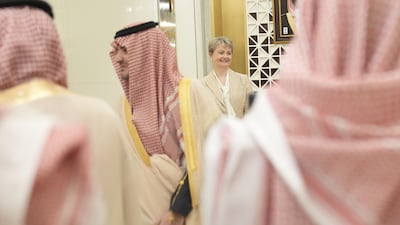
Foreign Secretary Yvette Cooper waits to meet with the Interior Minister Prince Abdulaziz bin Saud Al Saud at the Ministry of Interior in Riyadh, during a visit to Saudi Arabia. PA -

A burst of burning debris erupts following reported Israeli strikes in the southern suburbs of Beirut, after an escalation between Hezbollah and Israel, amid the US-Israeli conflict with Iran. Reuters -
Ferrari's Monegasque driver Charles Leclerc goes off track during a practice session ahead of the Formula One Chinese Grand Prix at the Shanghai International Circuit. AFP -

A passenger from a Qatar Airways flight, which departed from Doha, is welcomed upon arrival at Guarulhos International Airport in Brazil, amid the US-Israeli conflict with Iran. Reuters -
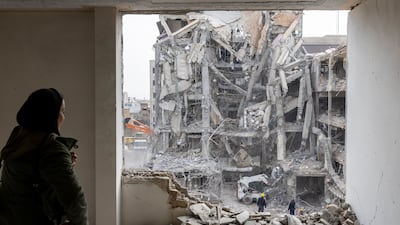
A woman looks out upon residential buildings that were destroyed a few days ago following the US and Israeli attack in in Tehran, Iran. Getty Images -
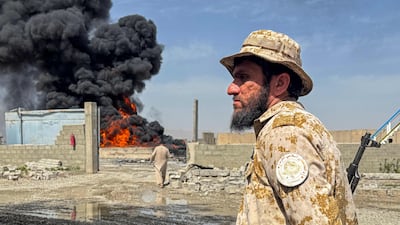
A Taliban security personnel stands guard as smoke rises following Pakistani air strikes that hit oil depots near the Kandahar airport in the Daman district of Kandahar province. AFP -

A Thai Buddhist monk feeds an elephant during an all-you-can-eat elephant buffet to mark National Elephant Day at the Ayutthaya Elephant Palace and Royal Kraal in Ayutthaya, Thailand. EPA


The Gulf countries that built pipelines as an alternative to the Strait of Hormuz export route are thankful they invested in long-term projects, while those that did not consider the possibility of the strait's closure regret it.
“I think everybody's reformulating their thinking around risk appetite,” Mr Petno said.
“How much resiliency do I need? How much is it going to cost me? How do I weigh the cost benefit of 'is this ever going to happen again?' I think this has changed thinking around resiliency and single points of failure.”
Emerging stronger
It is an extremely challenging phase for the region, with the conflict now in its fourth month. While the US tries to strike a permanent deal to end hostilities in the region, growth is set slow this year amid shrinking hydrocarbons revenue.
However, "confidence and optimism” still prevails, and Gulf nations are determined to emerge even stronger from the war, Mr Petno said.
Although the current pause in hostilities is teetering on a fragile ceasefire, the broader sentiment in the region is that the conflict is likely to get resolved.
“There are strong economic reasons, strong geopolitical reasons to get this thing solved sooner rather than later,” Mr Petno said. “We didn't feel like it would be in this same situation at the end of the year.”

Long-term commitment
Following the week-long trip, there is “more optimism about the medium to long term potential” of the region and JP Morgan is going to “move faster” in terms of building its capabilities across the region.
A big part of the government and client meetings, he said, was to determine what JP Morgan’s “balance sheet request might be” once the conflict is resolved.
“We have a large balance sheet for a reason. We can see through to the other side, and we were there personally to get that message [across],” he said.
The lender, which last year established its regional headquarters in Riyadh, plans to build its UAE operations and double the regional headcount in the next three to five years, Mr Petno said.
JP Morgan, which has been present in the region for more than nine decades, is looking beyond the war’s short-term impact on debt, equities capital market (ECM) activity and deals flow.
Across the Gulf, it's certainly been disruptive, notably in ECM, he said. Although the sentiment was bearish initially, “it's not been catastrophic”, Mr Petno added.
Debt capital markets, on the other hand, have remained open and transactions currently are more strategic and defensive in nature rather than opportunistic.
“It's open, and we've remained active … it's behaving as you would expect it to behave as it's quite a disruptive moment for the region,” Mr Petno said.
JP Morgan is not focused on what the subdued market activity means for its business as it is ensuring its clients have the market access they need. “All things considered, I think the markets have been fairly resilient in the region,” Mr Petno said.