
As the second era of faster-than-sound air travel nears, one of the niche industry’s pioneering players is looking further into the future—toward flights that are even faster.
Aerion, the supersonic jet builder founded by Texas billionaire Robert Bass, plans to deliver its first AS2 business jet in 2027, with top speeds of 1.4 times the speed of sound, or about 1,074 mph—roughly double that of traditional commercial aircraft. Still, with rivals like Boom Technologies and others advancing their own supersonic plans, Aerion chief executive Tom Vice is already anticipating the arrival of hypersonic travel.
“Our long-term vision is to allow people to travel between any two points on the planet within three hours,” Mr Vice said October 2 in an interview with Bloomberg News. To do so — and to avoid the physical rigors and technical complexities of suborbital space flight — Aerion’s next craft would have to cruise within the atmosphere at more than four times the speed of sound, or about 3,000 mph.
-

Boom Supersonic's demonstrator aircraft XB-1 is seen parked at an airfield in Denver, Colorado, in an undated photograph released October 7, 2020. Boom Supersonic/Nathan Leach-Proffer/Handout via REUTERS. -

Passengers aboard a Concorde supersonic jetliner flight await lunch as the delta-winged aircraft cruises over the Atlantic Ocean at twice the speed of sound in May 1978. The digital display on the left bulkhead at the front of the cabin shows that the plane has reached Mach 2. AP -
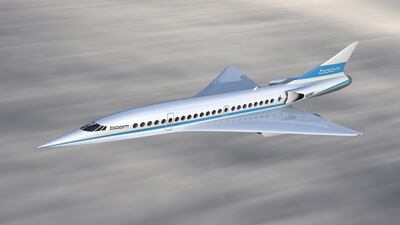
An artist's impression shows Boom's 55-seat supersonic aircraft in this undated handout. Reuters/Boom Supersonic. -
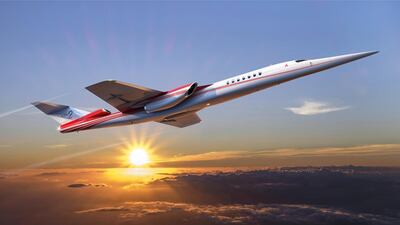
Boeing has tied up with Aerion to bring its AS2 supersonic business jet to market. Courtesy Boeing -
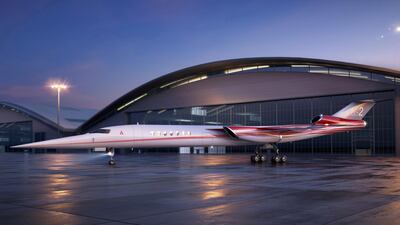
The Aerion AS2, the world's first supersonic business jet, being developed by Lockheed Martin partnering with plane maker Aerion of Reno, Nevada, is shown in this handout photo illustration. Aerion Corporation/Handout via Reuters -

Texas billionaire Robert Bass stands with a model of a planned supersonic business jet during a news conference at the National Business Aviation Association Convention & Exhibition in Orlando, Florida. Bass’s Aerion will get help from Airbus in its quest to have the supersonic jet ready by 2021. Bloomberg -
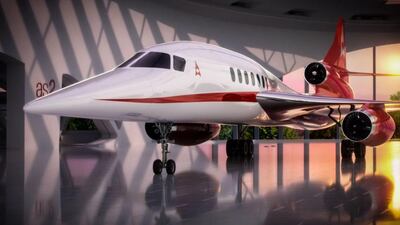
Aerion say its “boomless cruise” technology will prevent sonic booms from reaching the ground. Illustration: Aerion -

Aerion says its AS2 supersonic aircraft will cruise at Mach 1.4, allowing for a New York-to-London flight in four hours. Illustration: Aerion -
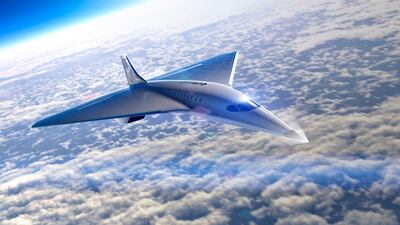
Space company Virgin Galactic on August 3, 2020, announced a preliminary partnership with engine maker Rolls Royce to build an airliner capable of flying at three times the speed of sound. Courtesy of Virgin Galactic -
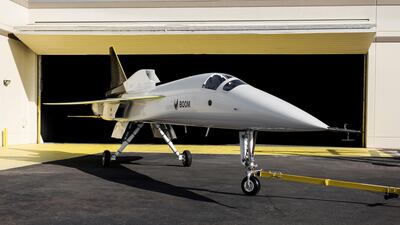
Boom Supersonic's demonstrator aircraft XB-1 is seen parked at a hangar in Denver, Colorado, in an undated photograph released on October 7, 2020. Boom Supersonic/Nathan Leach-Proffer/Handout via Reuters -
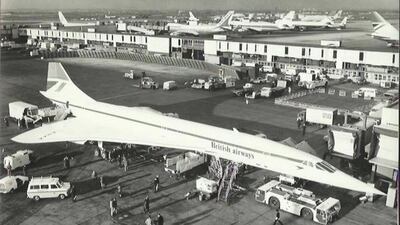
A first for British Airways as a supersonic jet gets set to take off from London bound for Bahrain on January 21, 1976. Courtesy British Airways -
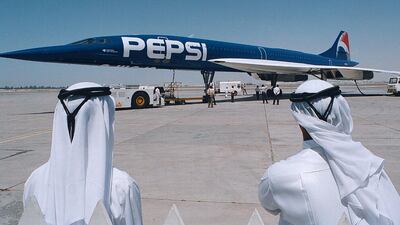
Dubai aviation officials watch the arrival of Pepsi's Concorde, leased from Air France and sporting the new electric-blue Pepsi colours, which stopped over in the emirate on April 7 while on a whirlwind marketing tour of the Middle East. The visit is part of a $500 million project called " Project Blue" to win back market shares from Coca-Cola. While in Dubai, Pepsi took 100 VIP guests on a supersonic flight. The flight arrived from Beirut and will continue on to Jeddah and Cairo. Reuters


Aerion, which is moving its headquarters from Reno, Nevada, to Melbourne, Florida—adjacent to its planned assembly center—is one of several firms in the nascent field of supersonic civil aviation, which has been heating up this year despite the economic shocks of the coronavirus pandemic.
Virgin Galactic Holdings surprised some investors in August with plans for a Mach 3 aircraft seating as many as 19 people, an interim step on the company’s path toward eventual hypersonic point-to-point travel. Virgin’s supersonic project is being assisted by Rolls-Royce, which is also working with Boom on supersonic engine technologies.
And a fourth player, Boston-based Spike Aerospace, plans a 12-18-passenger supersonic jet that cruises at Mach 1.6 and has range to cover nonstop flights from London to Hong Kong and Dubai to New York. The company hasn’t offered a timeline for its development, however.
While many companies in this space have been big on pronouncements, the engineering obstacles to bringing a new generation of supersonic planes—let alone hypersonic planes—to market are nothing to sniff at. Aerion’s aspiration to hypersonic speeds comes almost five years before it even plans to build a production-model of its $120 million supersonic business jet, and seven years before the first delivery, assuming everything goes right.
Boeing holds an equity stake in Aerion, while General Electric is designing and building a new Affinity supersonic engine for the company.
Aerion said it plans further capital raises over the next three or four years and will add additional equity investors before it turns to the debt market for financing, Vice said.
Boom Technologies, meanwhile, plans a $200m supersonic jet that can carry 65 to 85 passengers at more than twice the speed of sound, which it said will enter service by 2030. The company has orders for 30 jets from Japan Airlines and Virgin.
Colorado-based Boom plans to introduce a one-third demonstration model on Wednesday, the XB-1, which will allow the company to begin flight testing in 2021 to glean data on the jet’s wings and fuselage. Boom plans to use three GE J85 engines to power the XB-1 and is evaluating engine designs with Rolls-Royce for the production aircraft, which Boom calls Overture.
Mr Vice argues that Aerion has an advantage over supersonic competitors when it comes to engine development, pointing to its partnership with GE and its plan to build the first commercial supersonic power plant in more than five decades. The design is exclusive for Aerion, said Mr Vice, who declined to disclose how much the engine development will cost or how it’s being financed.
“Somebody else wanting to build a supersonic business jet—they’re going to have to go find a different engine,’’ Mr Vice said. Aerion “for sure” will be the first new supersonic commercial aircraft to market, he predicted. “We’ll get there years ahead of anybody else.”
Aerion said it scoured the world for an engine, including Russian designs that would meet noise restrictions, fuel-burn requirements and reliability over thousands of hours of high-speed flying. No existing engines fit the bill, though. Instead, the company turned to GE to build an engine with 20,000 pounds of thrust, special acoustic linings to reduce take-off noise and dual turbo-fans that don’t require fuel-guzzling afterburners.
GE’s Affinity engine will also be the first designed to run on traditional kerosene and synthetic fuel made in part by capturing carbon dioxide from the air. GE spokesman Nick Hurm confirmed the company’s “unique commercial agreement with Aerion” to build the engine, but declined to disclose financial terms.
Cruising at Mach 1.4, the AS2 would allow for a New York-London flight in four hours or London-Chicago in five hours, each two hours faster than conventional jet flights. The company said it has a $3.5 billion order backlog.
As if making supersonic work again wasn’t hard enough, some of these companies are also working toward what they say will be an environmentally responsible means of travel, without the extreme noise or emissions that accompanied the former Concorde.
Unlike that aircraft’s sonic boom, Aerion contends its “boomless cruise” technology will make the boom refract off a denser, lower layer of air, never reaching the ground. Aerion and Boom also plan to use new synthetic fuels to reduce carbon output.
At some point in the future, as supersonic develops into a viable mode for civil aviation, well-heeled travellers keen to save even more time may be able to turn to hypersonic flights—where cruise velocities can top Mach 5.
Recently, hypersonic flight has been in the news as Russia, China and the US invest enormous research and funds into new, nuclear-capable missiles and uncrewed drones. (Orbital space vehicles routinely re-enter the earth’s atmosphere at Mach 25, or 19,000 mph; meanwhile, several military fighter jets can top Mach 2, or 1,500 mph.)
“Supersonic business jets remain an intriguing idea. Supersonic airliners remain unlikely,” said Richard Aboulafia, an aerospace analyst with the Teal Group. “Hypersonic travel remains a very remote prospect. If anyone can build a hypersonic weapon that functions (other than a rocket), then a few decades later we might see this technology commercialised.”
Nevertheless, pledges to reach such speeds for commercial travel have already been made. Elon Musk’s Space Exploration Technologies and Virgin Galactic have said their eventual high-speed point-to-point aircraft service will operate above earth’s atmosphere, at hypersonic speeds, unlike envisioned supersonic aircraft that cruise at lower altitudes, around 60,000 feet.
Mr Vice said Aerion is focused on speeds around Mach 4.3 for the AS3 because of heating, shock waves and other tricky engineering issues that emerge at Mach 5 and above.
“I think it’s really exciting, frankly, that there are a number of companies now in this space thinking of high-speed flight,” Mr Vice said. “I’m encouraged by that. There are a lot of really great folks who are trying to find different paths. But you’ve got to solve the engine issue.”

