

Emirates, the world's biggest long-haul airline, is taking "aggressive" measures to protect its business from the impact of the Covid-19 pandemic while navigating a gradual return to operations in the coming months after reporting a 21 per cent rise in annual profit.
The Dubai-based carrier's net income for the financial year ending March 31 rose to Dh1.1 billion, from Dh871 million a year ago, due to "healthy" demand and cheaper fuel, though the Covid-19 crisis impacted its fourth quarter, Emirates said in a statement on Sunday. Annual revenue declined six per cent year-on-year to Dh92 billion due to temporary suspension of passenger flights in March and the 45-day runway closure at Dubai International Airport.
"For the first 11 months of 2019-20, Emirates and dnata were performing strongly, and we were on track to deliver against our business targets," Sheikh Ahmed bin Saeed Al Maktoum, Emirates' chairman, said.
"However, from mid-February things changed rapidly as the Covid-19 pandemic swept across the world, causing a sudden and tremendous drop in demand for international air travel as countries closed their borders and imposed stringent travel restrictions."
The virus outbreak has battered the global aviation industry, with strict lockdown measures wiping out passenger travel demand. Global airlines are facing a severe liquidity crisis and risk of bankruptcy as revenue withers in the wake of reduced capacity or complete passenger flight suspensions.
Emirates' revenue fell 4 per cent as it carried 56.2 million passengers. The carrier reduced seat capacity by six per cent, leading to passenger load factor of 78.5 per cent, reflecting the airline's "successful capacity management and positive travel demand across nearly all markets up until the outbreak of Covid-19 in the last quarter."
The UAE suspended all passenger flights from March 25 to limit the spread of the virus. Emirates currently operates a limited number of passenger repatriation flights and continues full cargo services.
Operating costs fell 10 per cent as the airline's fuel bill declined 15 per cent due to the lower prices of jet fuel. The drop in the energy costs offers some respite as fuel accounts for 31 per cent of the carrier's operating cost.
The carrier ended the year with Dh20.2bn in cash assets.
"We continue to take aggressive cost management measures, and other necessary steps to safeguard our business, while planning for business resumption," Sheikh Ahmed said. Emirates plans to tap the bank market for further liquidity in the first quarter of its fiscal year to "provide a cushion" against the impact of Covid-19 on the cash flows in the short term, it said, without revealing how much debt it will raise.
The Dubai government has already pledged financial support for Emirates to help the state-owned carrier cope with the coronavirus impact.
Emirates Group, which includes airport and travel services arm dnata, reported an annual 28 per cent decline in profit to Dh1.7bn, due to the impact of the coronavirus in the fourth quarter. Annual revenue dropped five per cent to Dh104bn.
A strong dollar and unfavourable currency swings eroded the group's profits by Dh1bn, it said.
The group will not pay a dividend to its government shareholder, the Investment Corporation of Dubai, due to the "unprecedented business environment" during the Covid-19 pandemic and to protect the group’s liquidity position. The group ended the year with a cash balance of Dh25.6bn.
-
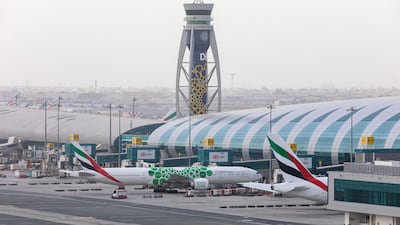
Passenger aircraft operated by Emirates stand beside the terminal building at Dubai International Airport in Dubai during March. All photos by Bloomberg -
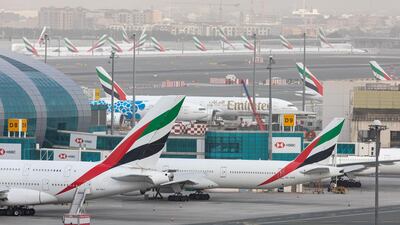
Passenger aircraft operated by Emirates stand beside the terminal building at Dubai International Airport. -
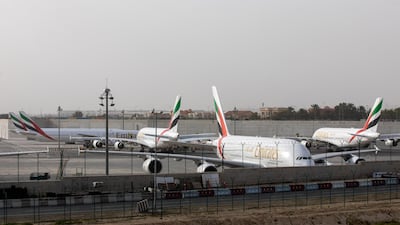
Multiple Airbus SE A380-800 aircraft, operated by Emirates, stand in a parking zone at Dubai International Airport. -

Emirates Boeing Co. 777-300 aircraft are seen in a parking zone at Dubai International Airport. -
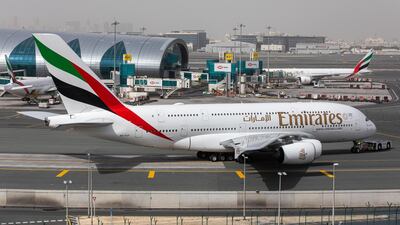
An Airbus SE A380-800 aircraft, operated by Emirates, taxis past the terminal. -
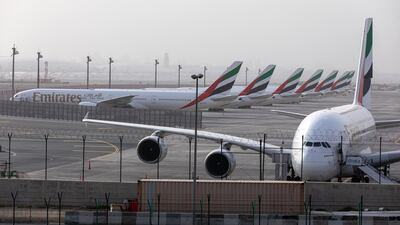
An Airbus SE A380-800, right, and a line of Boeing Co. 777-300 aircraft, operated by Emirates, stand in a parking zone at Dubai International Airport. -
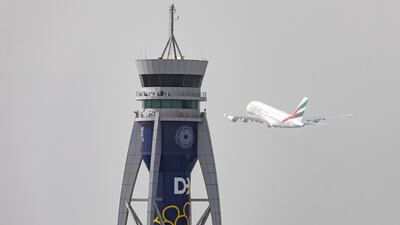
An Airbus SE A380-800 aircraft, operated by Emirates, takes off past the control tower. -
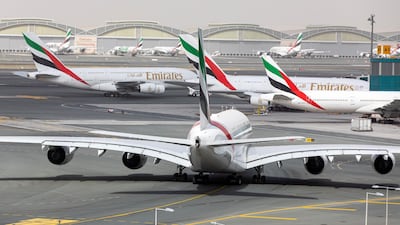
An Airbus SE A380-800 aircraft, operated by Emirates, taxis at Dubai International Airport. -
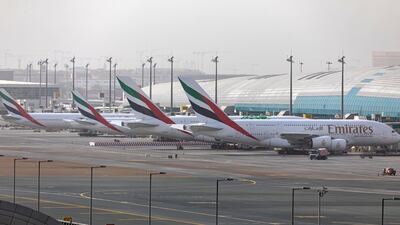
An Airbus SE A380-800 aircraft, right, stands alongside a line of Boeing Co. 777-300 aircraft at Dubai International Airport. -
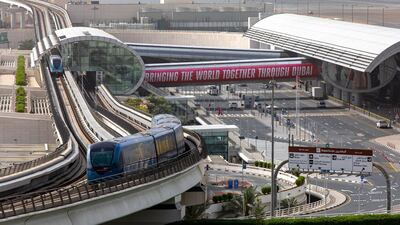
An airport access train departs the arrivals hall in Terminal Three at Dubai International Airport.


Dnata posted a 57 per cent drop in profit to Dh618m.
Sheikh Ahmed said the airline is working with relevant regulators and stakeholders on health and safety standards in a post-pandemic era.
"The Covid-19 pandemic will have a huge impact on our 2020-21 performance, with Emirates’ passenger operations temporarily suspended since 25 March, and dnata’s businesses similarly affected by the drying up of flight traffic and travel demand all around the world," he said. "We expect it will take 18 months at least, before travel demand returns to a semblance of normality."
Sheikh Mohammed bin Rashid, Vice President and Ruler of Dubai, said he is upbeat about the group's rebound after the Covid-19 pandemic.
"I am confident that Emirates and dnata will emerge from this difficult period, strong and ready to reclaim their position as global leaders shaping the future of the aviation, travel and tourism industries," he said in the group's 186-page annual report.
Emirates is in a "better position" that its Middle East peers to overcome the crisis, which would involve recapturing its network with sustainable capacity, Mark Martin, founder of Martin Consulting, said.
"Emirates will optimise their costs, including the existing A380 fleet offering," he said.
The Dubai carrier's "robust branding, loyalty and extensive passenger network will again be reinstated over time, but this will largely be paced by how quickly the global medical community can develop a Covid-19 vaccine or some sort of medicinal suppressant that will allow confidence for travellers to want to be able to fly again as well as regulatory requirements around pre-flight health checks and screening to ensure added safety wherever possible," Saj Ahmed, chief analyst at StrategicAero Research, said.
"Going forward, Emirates will have, like other airlines, very important product, strategy, marketing and positioning decisions to make," he added.

