

Etihad Airways carried 22.4 million passengers last year, marking a 21 per cent increase year-on-year as the Abu Dhabi airline continues to expand its route network and demand for travel soars.
The rise in passenger numbers is the “highest annual total in the airline’s history”, Etihad’s chief executive Antonoaldo Neves said in a statement on Monday.
Last year marked "strong growth" for Etihad. "Closing the year with a record December reflects the confidence our customers place in our product and service,” Mr Neves said.

Passenger load factor for the full year was 88.3 per cent, up about two percentage points on 2024.
The airline carried 2.2 million passengers in December, up nearly 28 per cent annually. Load factor for the month reached 87.6 per cent, tying in with the peak end-of-year travel period.
The growth is in line with Etihad Airways revising its target to carry 37 million passengers and have 200 planes in its fleet by 2030, up from a target of 160 aircraft and 30 million annual passengers.
The airline aims to expand 15 per cent every year until the end of the decade as it carries more passengers, adds 20 planes annually and reaps benefits from joint venture partnerships with Ethiopian Airlines and China Eastern, Mr Neves told The National in July.
In line with its fleet expansion plans, Etihad in November announced deals to add 32 Airbus wide-body passenger planes and freighters to extend its long-haul network and meet its capacity growth target.
At the Dubai Airshow, the airline signed a purchase agreement with Airbus for six A330 Neo aircraft, which are scheduled for delivery between 2028 and 2029.
In May, Etihad confirmed an order for 28 Boeing 787 and 777X aircraft.
Mr Neves said in October that it is scheduled to receive the first of its Boeing 777X aircraft in 2031 and is unaffected by the programme’s seven-year delay.
At the end of 2025, Etihad’s operating fleet stood at 127 aircraft, the airline said on Monday. That followed the addition of 29 aircraft during the year, marking the “largest single-year fleet expansion” in its history, it said.
The new aircraft included the Airbus A321LR, a narrow-body aircraft that the airline says will deliver the same standard of luxury as a wide-body model.
It will allow Etihad to offer its premium cabin product on a wider range of short- and medium-haul routes, supporting further network growth. The airline said in July it plans to equip its entire fleet of wide-bodies and narrow-bodies with a first-class product by 2030, going against an industry-wide trend of many airlines removing their first-class seats and improving their business-class product.
-
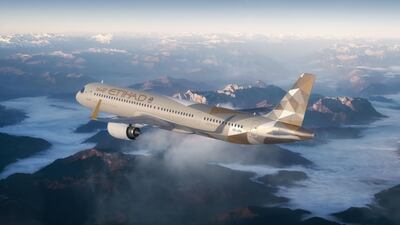
Etihad Airways announces the introduction of 10 Airbus A321LRs to its fleet from August 1. All photos: Etihad Airways -
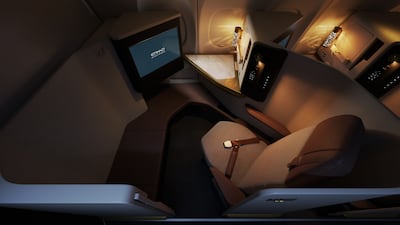
Etihad will also introduce the first First Class suite aboard this narrow-body aircraft -
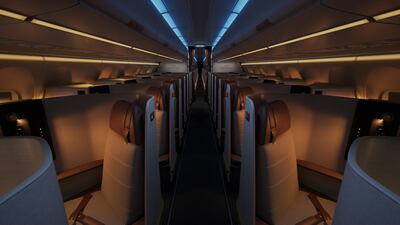
Etihad Business Class will have 14 lie-flat beds as part of its offering aboard the A321LR -
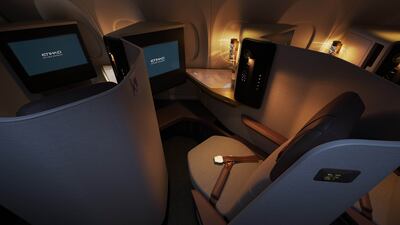
The airliner is arranged along a single aisle -
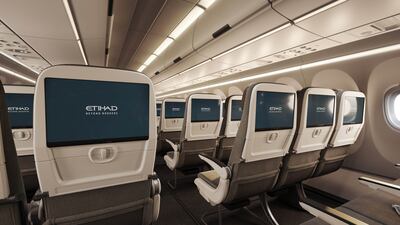
There will be 144 seats in Etihad Economy on the new A321LR airliners -
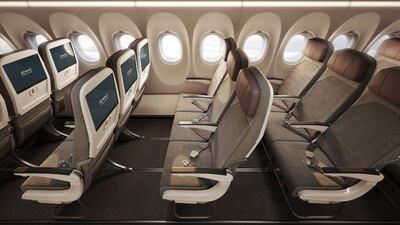
Touchscreens will be available across Economy Class -
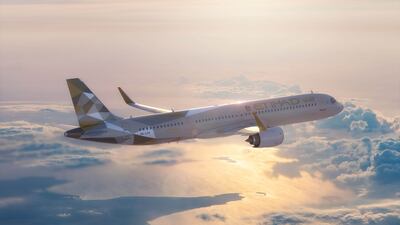
The Etihad A321LR will be rolled out for service on a variety of destinations from August 1


“With the largest fleet in Etihad’s history … Etihad is better positioned than ever to welcome more visitors to Abu Dhabi,” Mr Neves said.
Etihad expects to become a $9 billion revenue airline, carrying about 25 million passengers in 2026, Mr Neves said during the Dubai Airshow.
The airline has also hired more than 2,600 staff, including about 200 pilots and 1,500 cabin crew, in the first nine months of 2025, it previously said.

