Dubai's Emirates Airline posted a 13 per cent increase in record half-year profits after tax to Dh9.9 billion ($2.7 billion) amid “strong and sustained” travel demand across regions that withstood geopolitical turbulence.
The airline recorded revenue of Dh65.6 billion, up six per cent year on year, on “unabated” travel demand, especially for premium cabins, it said in a statement on Thursday. Emirates' fiscal year ends in March.
Emirates “maintained its position as the world’s most profitable airline for the period, thanks to strong demand and growing customer preference for our premium products and services”, Sheikh Ahmed bin Saeed, chairman and chief executive of Emirates Airline and group, said.
The airline's performance was driven by “unflagging demand”, he added, and the appetite for travel is expected to continue in the second half of its fiscal year.
“Global demand for air transport and travel services has been buoyant, despite geopolitical events and economic concerns in some markets. We expect this demand resilience to continue for the rest of 2025-26,” Sheikh Ahmed said.
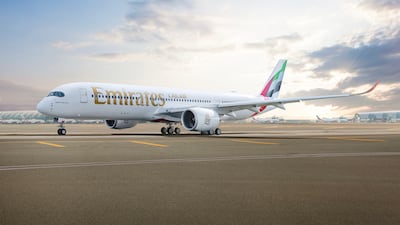
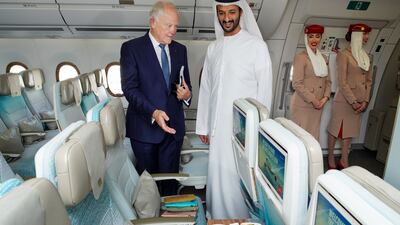
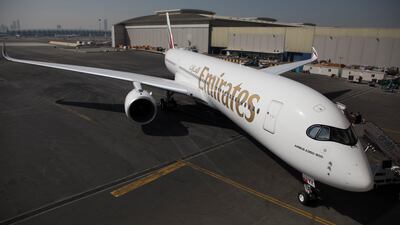
Emirates expects to increase its capacity to grow revenue as new Airbus A350 wide-body aircraft join its fleet and new facilities open for global airport services company dnata, he added.
The wider Emirates Group, which includes dnata, posted a 13 per cent increase in half-year profits after tax to Dh10.6 billion, its fourth consecutive year of record profitability for the half-year reporting period, Sheikh Ahmed said.
The group recorded revenue of Dh75.4 billion, up four per cent year-on-year, as the airline carried more passengers through its Dubai hub.
The group also paid the remaining Dh2 billion in dividends, of the Dh6 billion declared during the 2024-2025 financial year, to its government shareholder.
The group's workforce grew 3 per cent to 124,927 employees during the April to September period. Emirates and dnata are continuing to recruit to meet future requirements.
Load factor dip
The Dubai airline carried 27.8 million passengers during the six-month period, up 4 per cent from the same time last year.
However, load factor, a measure of how well an airline fills available seats with paying passengers, dipped slightly to 79.5 per cent, compared to 80 per cent during the same period last year.
Emirates’ operating costs, including fuel, increased 4 per cent, in line with increased operations, it said. Fuel remained the largest component of the airline’s operating costs at 30 per cent.
The state-owned airline benefitted from passenger flows through Dubai despite the aviation industry grappling with tensions in the Middle East and economic uncertainty arising from US President Donald Trump's trade policies.
Dubai welcomed 13.95 million overnight visitors in the first nine months of the year, a five per cent increase from the same period in 2024, according to the latest data from the Dubai Department of Economy and Tourism.
The emirate has set a goal to exceed last year's 18.7 million visitors to the city, Shahab Shayan of the department said at the World Travel Market in London this week.
Dubai International Airport, Emirates' home hub, handled 22.5 million passengers in the second quarter of 2025, an increase of 3.1 per cent over the same period last year.
To accommodate the anticipated future growth in passengers, Dubai is building a $35 billion terminal at its second airport, Al Maktoum International, which will become home to Emirates Airline's operations by 2032.
Softening cargo yields
Emirates SkyCargo, the airline's cargo arm, carried 1.25 million tonnes in the first six months of the year, up by 4 per cent annually.
However, cargo yields decreased six per cent due to softening demand in some market segments amid tariff concerns, the airline said.
Emirates SkyCargo added capacity after the delivery of three new Boeing 777 freighters.
At the end of September, Emirates’ passenger and cargo network spanned 153 airports in 81 countries and territories.
International Air Transport Association director general Willie Walsh said on Tuesday that “globally, 2025 is shaping up well despite political and economic uncertainty, armed conflict, and trade friction”.
In first nine months of the year, passenger demand is up 4.8 per cent and cargo demand by 3.2 per cent, according to Iata.
“Considering the circumstances, these are strong numbers, particularly so for cargo. And this year it’s the cargo performance that once again demonstrates the resilience of our industry and the speed of reaction to changing external factors,” Mr Walsh said.
Emirates' dnata posted record half-year revenue of Dh11.7 billion, up 13 per cent annually. Dnata’s profit after tax rose 22 per cent to Dh697 million, as it continued to expand operations across its cargo and ground handling, catering and retail, and travel services businesses.

Hunger and Fury: The Crisis of Democracy in the Balkans
Jasmin Mujanović, Hurst Publishers
more from Janine di Giovanni
'The worst thing you can eat'
Trans fat is typically found in fried and baked goods, but you may be consuming more than you think.
Powdered coffee creamer, microwave popcorn and virtually anything processed with a crust is likely to contain it, as this guide from Mayo Clinic outlines:
Baked goods - Most cakes, cookies, pie crusts and crackers contain shortening, which is usually made from partially hydrogenated vegetable oil. Ready-made frosting is another source of trans fat.
Snacks - Potato, corn and tortilla chips often contain trans fat. And while popcorn can be a healthy snack, many types of packaged or microwave popcorn use trans fat to help cook or flavour the popcorn.
Fried food - Foods that require deep frying — french fries, doughnuts and fried chicken — can contain trans fat from the oil used in the cooking process.
Refrigerator dough - Products such as canned biscuits and cinnamon rolls often contain trans fat, as do frozen pizza crusts.
Creamer and margarine - Nondairy coffee creamer and stick margarines also may contain partially hydrogenated vegetable oils.
What is cyberbullying?
Cyberbullying or online bullying could take many forms such as sending unkind or rude messages to someone, socially isolating people from groups, sharing embarrassing pictures of them, or spreading rumors about them.
Cyberbullying can take place on various platforms such as messages, on social media, on group chats, or games.
Parents should watch out for behavioural changes in their children.
When children are being bullied they they may be feel embarrassed and isolated, so parents should watch out for signs of signs of depression and anxiety
Key figures in the life of the fort
Sheikh Dhiyab bin Isa (ruled 1761-1793) Built Qasr Al Hosn as a watchtower to guard over the only freshwater well on Abu Dhabi island.
Sheikh Shakhbut bin Dhiyab (ruled 1793-1816) Expanded the tower into a small fort and transferred his ruling place of residence from Liwa Oasis to the fort on the island.
Sheikh Tahnoon bin Shakhbut (ruled 1818-1833) Expanded Qasr Al Hosn further as Abu Dhabi grew from a small village of palm huts to a town of more than 5,000 inhabitants.
Sheikh Khalifa bin Shakhbut (ruled 1833-1845) Repaired and fortified the fort.
Sheikh Saeed bin Tahnoon (ruled 1845-1855) Turned Qasr Al Hosn into a strong two-storied structure.
Sheikh Zayed bin Khalifa (ruled 1855-1909) Expanded Qasr Al Hosn further to reflect the emirate's increasing prominence.
Sheikh Shakhbut bin Sultan (ruled 1928-1966) Renovated and enlarged Qasr Al Hosn, adding a decorative arch and two new villas.
Sheikh Zayed bin Sultan (ruled 1966-2004) Moved the royal residence to Al Manhal palace and kept his diwan at Qasr Al Hosn.
Sources: Jayanti Maitra, www.adach.ae
ABU%20DHABI'S%20KEY%20TOURISM%20GOALS%3A%20BY%20THE%20NUMBERS
%3Cp%3EBy%202030%2C%20Abu%20Dhabi%20aims%20to%20achieve%3A%3C%2Fp%3E%0A%3Cp%3E%3Cstrong%3E%E2%80%A2%2039.3%20million%20visitors%2C%3C%2Fstrong%3E%20nearly%2064%25%20up%20from%202023%3C%2Fp%3E%0A%3Cp%3E%3Cstrong%3E%E2%80%A2%20Dh90%20billion%20contribution%20to%20GDP%2C%3C%2Fstrong%3E%20about%2084%25%20more%20than%20Dh49%20billion%20in%202023%3C%2Fp%3E%0A%3Cp%3E%3Cstrong%3E%E2%80%A2%20178%2C000%20new%20jobs%2C%3C%2Fstrong%3E%20bringing%20the%20total%20to%20about%20366%2C000%3C%2Fp%3E%0A%3Cp%3E%3Cstrong%3E%E2%80%A2%2052%2C000%20hotel%20rooms%2C%3C%2Fstrong%3E%20up%2053%25%20from%2034%2C000%20in%202023%3C%2Fp%3E%0A%3Cp%3E%3Cstrong%3E%E2%80%A2%207.2%20million%20international%20visitors%2C%3C%2Fstrong%3E%20almost%2090%25%20higher%20compared%20to%202023's%203.8%20million%3C%2Fp%3E%0A%3Cp%3E%3Cstrong%3E%E2%80%A2%203.9%20international%20overnight%20hotel%20stays%2C%3C%2Fstrong%3E%2022%25%20more%20from%203.2%20nights%20in%202023%3C%2Fp%3E%0A
GIANT REVIEW
Starring: Amir El-Masry, Pierce Brosnan
Director: Athale
Rating: 4/5
Ten tax points to be aware of in 2026
1. Domestic VAT refund amendments: request your refund within five years
If a business does not apply for the refund on time, they lose their credit.
2. E-invoicing in the UAE
Businesses should continue preparing for the implementation of e-invoicing in the UAE, with 2026 a preparation and transition period ahead of phased mandatory adoption.
3. More tax audits
Tax authorities are increasingly using data already available across multiple filings to identify audit risks.
4. More beneficial VAT and excise tax penalty regime
Tax disputes are expected to become more frequent and more structured, with clearer administrative objection and appeal processes. The UAE has adopted a new penalty regime for VAT and excise disputes, which now mirrors the penalty regime for corporate tax.
5. Greater emphasis on statutory audit
There is a greater need for the accuracy of financial statements. The International Financial Reporting Standards standards need to be strictly adhered to and, as a result, the quality of the audits will need to increase.
6. Further transfer pricing enforcement
Transfer pricing enforcement, which refers to the practice of establishing prices for internal transactions between related entities, is expected to broaden in scope. The UAE will shortly open the possibility to negotiate advance pricing agreements, or essentially rulings for transfer pricing purposes.
7. Limited time periods for audits
Recent amendments also introduce a default five-year limitation period for tax audits and assessments, subject to specific statutory exceptions. While the standard audit and assessment period is five years, this may be extended to up to 15 years in cases involving fraud or tax evasion.
8. Pillar 2 implementation
Many multinational groups will begin to feel the practical effect of the Domestic Minimum Top-Up Tax (DMTT), the UAE's implementation of the OECD’s global minimum tax under Pillar 2. While the rules apply for financial years starting on or after January 1, 2025, it is 2026 that marks the transition to an operational phase.
9. Reduced compliance obligations for imported goods and services
Businesses that apply the reverse-charge mechanism for VAT purposes in the UAE may benefit from reduced compliance obligations.
10. Substance and CbC reporting focus
Tax authorities are expected to continue strengthening the enforcement of economic substance and Country-by-Country (CbC) reporting frameworks. In the UAE, these regimes are increasingly being used as risk-assessment tools, providing tax authorities with a comprehensive view of multinational groups’ global footprints and enabling them to assess whether profits are aligned with real economic activity.
Contributed by Thomas Vanhee and Hend Rashwan, Aurifer
World record transfers
1. Kylian Mbappe - to Real Madrid in 2017/18 - €180 million (Dh770.4m - if a deal goes through)
2. Paul Pogba - to Manchester United in 2016/17 - €105m
3. Gareth Bale - to Real Madrid in 2013/14 - €101m
4. Cristiano Ronaldo - to Real Madrid in 2009/10 - €94m
5. Gonzalo Higuain - to Juventus in 2016/17 - €90m
6. Neymar - to Barcelona in 2013/14 - €88.2m
7. Romelu Lukaku - to Manchester United in 2017/18 - €84.7m
8. Luis Suarez - to Barcelona in 2014/15 - €81.72m
9. Angel di Maria - to Manchester United in 2014/15 - €75m
10. James Rodriguez - to Real Madrid in 2014/15 - €75m
UPI facts
More than 2.2 million Indian tourists arrived in UAE in 2023
More than 3.5 million Indians reside in UAE
Indian tourists can make purchases in UAE using rupee accounts in India through QR-code-based UPI real-time payment systems
Indian residents in UAE can use their non-resident NRO and NRE accounts held in Indian banks linked to a UAE mobile number for UPI transactions