

Dubai International Airport (DXB) handled a record 92.3 million passengers last year, an annual increase of nearly 6 per cent, as the emirate solidified its standing as a global tourist destination.
The world's busiest airport by international traffic beat its November forecast of 91.9 million annual passengers last year, up from 87 million in 2023 and exceeding its pre-Covid record of 89.1 million in 2018.
“Dubai is the airport of the world … and a new world in the aviation sector,” Sheikh Mohammed bin Rashid, Vice President and Ruler of Dubai, said on X on Thursday.
Dubai Airports over the next 10 years will invest Dh128 billion ($34.8 billion) to “restructure the global aviation landscape with Emirati standards”, he said.
DXB recorded 300,000 flight movements, served 106 airline customers and operated flights to 272 cities in 107 countries last year, he added.
December was the airport's busiest month of last year, with 8.2 million passengers, the Dubai Media Office said.
-
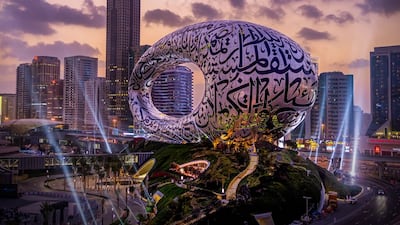
The Museum of the Future, with its remarkable architecture, has quickly become a highlight for visitors to Dubai. Photo: DTCM -
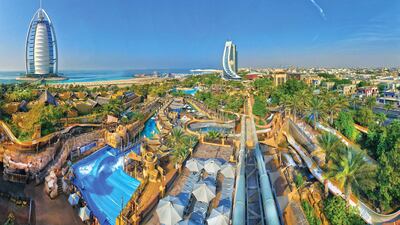
The Wild Wadi Waterpark in Jumeirah is one of the attractions that make Dubai a family-friendly destination. Photo: Wild Wadi -

The shops, cafes, bars and restaurants along Jumeirah Beach Residence in Dubai are popular among tourists. Photo: Reuters -
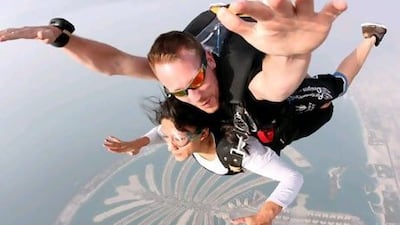
A jump at Skydive Dubai has become a must-do for daredevil visitors. Photo: Skydive Dubai -
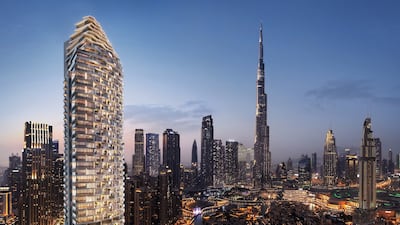
Admirers will say that the Burj Khalifa, the tallest tower in the world at about 830 metres, is Dubai's most famous tourist attraction. Photo: Dar Al Arkan -
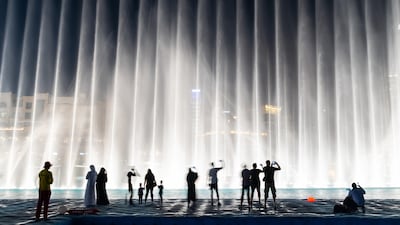
Visitors can enjoy an almost immersive experience of water and light at the Dubai Fountain. Photo: Alamy -

A visit to Dubai often involves a trip to Al Fahidi Fort, with its dhow installation to celebrate the Gulf's maritime history. Photo: Alamy -
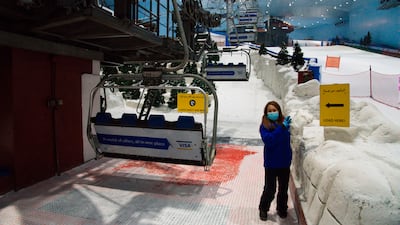
The ski lift at Ski Dubai inside the Mall of the Emirates. With its 22,500 square metres of skiiing, the centre is arguably one of the Gulf region's most eye-catching and unexpected attractions. Photo: AP -

Bluewaters Island, where the Ain Dubai wheel is located. Photo: Reuters -
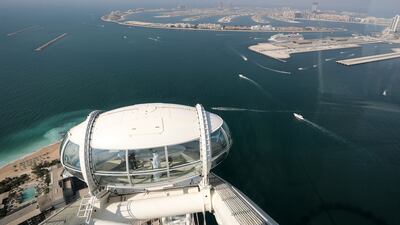
One of the pods on the Ain Dubai that offer visitors sweeping views of the city and Arabian Gulf waters. Chris Whiteoak / The National -
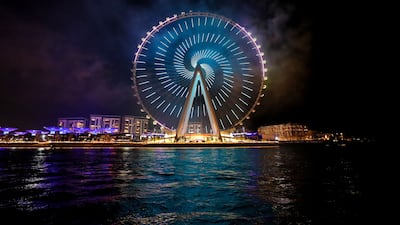
The Ain Dubai lights up. Chris Whiteoak / The National -

The Lost Chambers Aquarium at Atlantis, The Palm. Photo: Atlantis, The Palm


Dubai welcomed nearly 17 million international visitors in the first 11 months of last year, the Dubai Department of Economy and Tourism's latest data shows. Western Europe was its top source market followed by South Asia and the Gulf countries, as the emirate continued to expand its tourism sector.
Emirates, the world's largest long-haul airline and the home carrier at DXB, said in November that it expects travel demand to “remain strong” for the rest of its 2024-2025 financial year, with plans to increase capacity and grow revenue as new aircraft join its fleet.
-
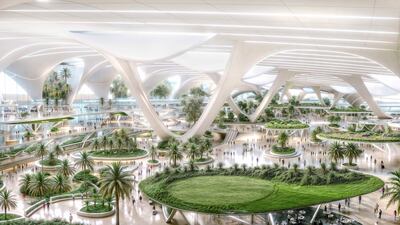
The Dubai government has approved designs for a new passenger terminal at Al Maktoum International Airport and has started construction at a cost of Dh128 billion. Photo: Dubai government via AP -
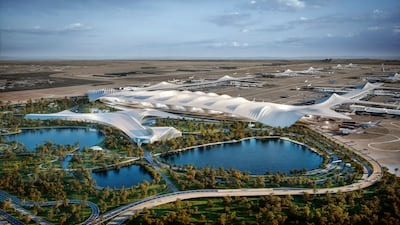
Spread across 70 square kilometres, the new airport will be five times the size of the current Dubai International Airport. Photo: Dubai government via AP -
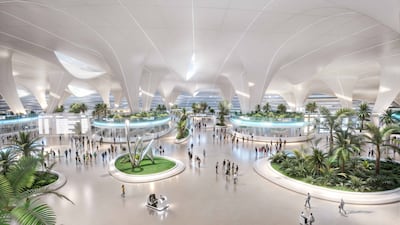
Once complete, Al Maktoum International Airport will have "the world's largest capacity", reaching up to 260 million passengers. Photo: Dubai government via AP -
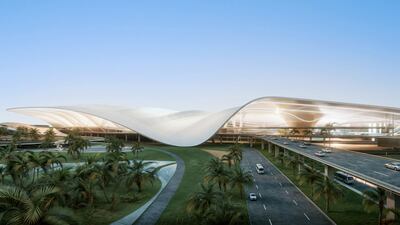
The Al Maktoum International Airport will fully absorb Dubai International Airport’s operations within 10 years. Photo: Dubai government via AP -
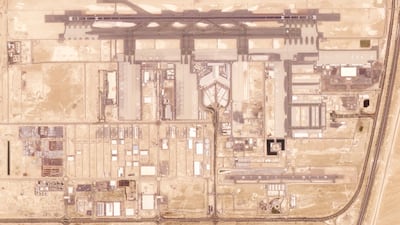
A satellite image shows the site of Al Maktoum International Airport. The airport will feature 400 gates, five parallel runways and new aviation technology. Photo: Planet Labs PBC via AP


To accommodate future growth in passenger traffic, Dubai is also expanding its second hub, Al Maktoum International Airport (DWC), with a $35 billion terminal that will have a capacity of 260 million passengers a year once the final phase is completed. That airport currently has a capacity of 32.5 million passengers − handling mainly cargo and some low-cost airlines.
Dubai is pursuing a strategy to diversify its non-oil sector with a heavy focus on tourism, aviation, hospitality, technology and trade.
For the first half of last year, the emirate’s economy grew by 3.2 per cent to reach Dh231 billion, according to the latest available official data from the Dubai Media office in November.
Popular markets
Last year, India retained its position as DXB’s largest destination market, with 12 million passengers. Saudi Arabia recorded double-digit growth, with passenger numbers reaching 7.6 million.
Other top markets included the UK (6.2 million), Pakistan (4.5 million) and the US (3.5 million), while China recorded a 30.7 per cent year-on-year growth, driven by a surge in direct traffic.
London remained the top city destination, with 3.9 million passengers, followed by Riyadh (3.2 million), Mumbai (2.5 million), Jeddah (2.3 million) and New Delhi (2.2 million).
In terms of air freight, DXB handled 2.2 million tonnes of cargo throughout last year, an year-on-year increase of 20.5 per cent.
Outlook for DXB
Dubai Airports is “confident” about reaching the milestone of 100 million annual passengers by 2027, it said.
However, Paul Griffiths, chief executive of Dubai Airports, said on Thursday that the operator is likely to bring that forecast forward, predicting that DXB can reach the 100 million-mark in 2026.
“Because of the strong growth we've had and the fact that we've revised our forecast during the course of last year at least three times in the upward direction, that's giving us the confidence to suggest that we might end up reaching 100 million earlier,” Mr Griffiths said.
In 2025, DXB is expected to handle “94 million plus” passengers, as a continuing shortage of new aircraft risks constraining its growth, Mr Griffiths said.
“The uncertainty of delivery schedules and the hugely long lead times that both Boeing and Airbus have for their aircraft is having a big impact, exacerbated by the aircraft retirements that many airlines put in place during the Covid-19 pandemic,” he said.
“So many airlines are waiting for aircraft deliveries that are, in some cases, years behind schedule. That's why in 2025 we've got only a 1.7 million passenger increase in that number in our forecast. We don't believe that the supply of new aircraft will be in sufficient volume to fuel the growth that we would otherwise be able to facilitate if the aircraft were available.”
UAE airlines such as Emirates have joined a chorus of international carriers airing their frustration about continuing delays in aircraft deliveries that are costing them growth opportunities.
DWC airport terminal expansion
Meanwhile, the Dubai government is working on plans for the expansion of DWC with a new airport terminal to accommodate the anticipated growth in passenger numbers in the next decade.
The planned airport terminal expansion is still in the detailed design phase, with discussions under way with Emirates and flydubai, as well as construction companies, Mr Griffiths said.
“The aim is, by 2032, to have the airport pretty close to finishing and to have a capacity of 150 million on opening day,” he said. “We're working very closely with all the partners on this mega-project to ensure that we have timely delivery, because we cannot afford to constrain the growth of aviation here in Dubai, because that's a constraint on the growth of the economy, and both of those are absolute no-go areas.”
Asked if DXB's capacity will be able to stretch to accommodate increasing passenger traffic until the new DWC terminal is ready, Mr Griffiths said this is “clearly a challenge”.
However, there is a “safety valve” with the current passenger terminal in DWC to which some airlines can migrate their operations over the next few years, he said.
The biggest concern is to ensure that the road and railway network around DXB is able to cope with an increasing numbers of passengers, to ensure that the DWC expansion project is delivered on time and to maximise the growth at DXB, he added.

